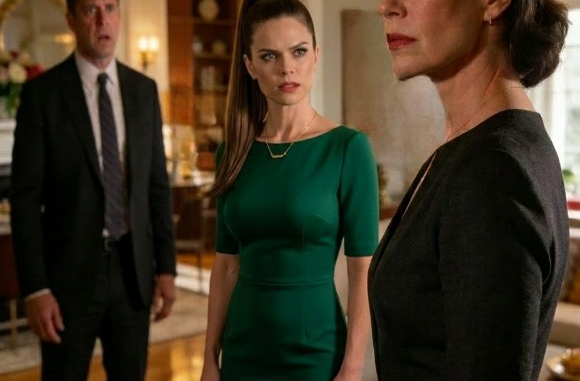
The woman at my front door looked me over the way people assess furniture—quick, dismissive, already certain I had no value.
I’d answered in black slacks, a cream blouse, and an apron dusted with flour, finishing a dessert for a dinner my husband had failed to mention until that morning. The house was spotless, the staff gone, and I was handling the final details myself—as I always did.
She was mid-twenties, polished, carrying the kind of designer bag meant to signal importance. She smiled as if we shared something.
“I’m here for Graham,” she said lightly. “You can tell him Savannah’s here.” Then her eyes flicked to my apron. “You must be the help.”
For a moment, everything went still—not because I hadn’t faced condescension before, but because of how effortlessly she assumed she belonged here and I didn’t.
Then I noticed the car behind her. My husband stepped out—from the passenger side.
He saw me, saw her, and went pale instantly.
“Graham,” she called over her shoulder, “your housekeeper is being weird.”
Housekeeper.
I watched realization crash over him. Seventeen years of marriage, and in that moment, he understood exactly how much was about to unravel. The house, the lifestyle, the company behind it all—mine.
She turned back, impatient. “Can you take my coat?”
I smiled—not kindly, just enough to make him panic.
Because I had just recognized her name. Savannah Whitmore. The same name on the florist card inside. The daughter of one of my senior employees.
She had no idea.
So I stepped forward and said calmly, “I’m not the help. I’m Eleanor Vale. I own this house—and the company your father works for. I suggest you rethink your tone.”
Behind her, my husband made a strangled sound. Her confidence drained in seconds as understanding set in.
He tried to speak. I stopped him. I wanted the silence.
She recovered quickly, shifting blame the way people like her are taught. “I didn’t know who you were.”
“That’s obvious,” I said.
Then she tried another angle—casting herself as misled. He had told her we were separated. I didn’t doubt that. Men like him rely on layers of lies.
But the fact remained—she stood in my home and called me “the help.”
That was the moment everything changed.
What followed wasn’t chaos. It was precision.
I asked questions. She answered. The timeline surfaced—six months. The lies unraveled. He had used company resources, my resources, to fund the affair. Not catastrophic, but careless enough to matter.
And when I asked if her father knew, her silence told me everything.
No.
That’s when I shifted from wife to CEO.
I didn’t react emotionally. I called legal.
Within the hour, everything was contained, documented, and understood. By the end of the night, she left in tears, and he stood outside like a man finally facing consequences.
The next week, I handled it all cleanly—separation, financial review, revoked access. No drama, just decisions.
Her father kept his job. He had done nothing wrong.
My husband, on the other hand, lost the illusion that he controlled anything.
Months later, the truth was simple.
When she called me “the help,” she wasn’t entirely wrong—just not in the way she meant.
Because that’s exactly what my husband had mistaken me for: someone who maintained everything while he enjoyed the benefits.
He forgot one thing.
The help answers to someone.
And in that house, that company, and ultimately that marriage—
that someone was me.
Leave a Reply