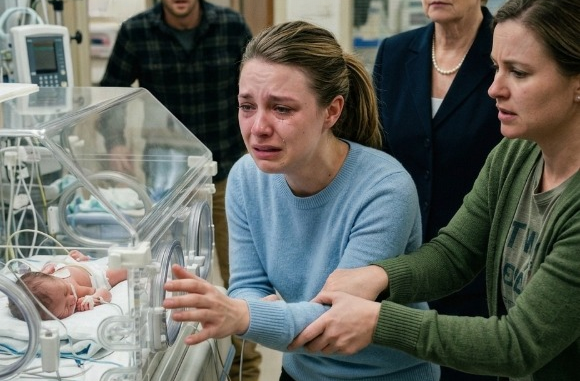
My mother’s words shattered me the moment she yanked my premature daughter’s oxygen monitor from the wall.
“These weak children don’t deserve to live.”
For a second, I thought I’d misheard. The fluorescent lights hummed softly above the NICU family room. Nurses moved down the corridor. Yet those words cut through everything like glass. My baby girl, Lily, lay in her transport bassinet beside me, so small she seemed more like a prayer than a person. Her skin was pink, fragile; her breathing shallow. Every tiny movement was a battle she hadn’t chosen—but somehow was winning.
I lunged to reconnect the cord, but my sister, Vanessa, gripped my wrist so tightly her nails dug in.
“Don’t,” she hissed.
“Are you insane?” I shouted, yanking against her. “She needs that!”
My mother, Diane, didn’t flinch. She stood in her tailored beige coat, as calm as if we were debating dinner plans. “You need to face reality, Emily,” she said coldly. “That baby is suffering. You’re suffering. A child born this early is nothing but bills, pain, and heartache.”
Lily let out a faint, struggling cry, and it tore straight through me.
A nurse burst in. “What happened?”
“My mother pulled the monitor!” I yelled.
Vanessa let go, stepping back, stunned. “No… Emily is overwhelmed. She’s been emotional for days,” she said quickly.
“Check my baby!” I screamed.
The room erupted. Another nurse lifted Lily, checking her airway. A doctor reattached the line, barking instructions I could barely process. My knees nearly gave out.
Then I saw him. Ryan.
He stood frozen in the doorway, navy jacket still on from his construction job, face drained of color. He had driven three hours from Columbus after my single voicemail: “Please come. Something is wrong.”
He took in the scene, then looked at me. “Emily,” he said, voice unsteady, “what did they do?”
My mother crossed her arms. “This is a family matter.”
Ryan’s eyes blazed. “No,” he said. “That little girl is my family.”
The attending physician turned to us, grave. “We need to discuss whether this was accidental—or intentional.” Silence fell like a weight.
Hospital security separated us within minutes. My mother and Vanessa were escorted away while a social worker led Ryan and me to a private room. I trembled, barely able to hold the paper cup of water. Ryan sat close, one hand on my back, the other gripping mine so tightly it hurt. I welcomed it—it kept me grounded.
Dr. Patel, Lily’s neonatologist, sat across from us. “Your daughter is stable,” she said first, and I broke down.
Ryan pressed his forehead to mine. “She’s okay,” he whispered. But stable wasn’t safe.
Dr. Patel explained the oxygen monitor had been disconnected long enough to cause a dangerous drop, but the team responded quickly. Security had filed a report. Local police had been contacted.
That night, Ryan booked a hotel across the street. At 2 a.m., while Lily slept under the careful watch of machines and nurses who suddenly felt like family, we sat shoulder to shoulder in the dim waiting area.
“I should’ve been here sooner,” he murmured.
“Ryan, don’t,” I said.
“I let your mother get in my head,” he admitted, jaw tight. “When you told me she said I wasn’t good enough… I kept trying to prove her wrong instead of protecting you.”
Months earlier, I had returned to Cincinnati for family support after complications in pregnancy. My mother had exploited our cracks—telling Ryan I needed someone more reliable, telling me he wouldn’t be enough. By the time Lily arrived seven weeks early, we were barely speaking.
“I let her do the same thing to me,” I whispered. “She said you wouldn’t want a sick baby.”
Ryan turned sharply. “Emily, I drove through a thunderstorm with half a tank of gas because I thought I might lose both of you. I was never leaving.”
I cried, this time from relief. He pulled me close, and everything false between us cracked and fell away.
The next day, police interviewed staff and visitors. Security footage confirmed my mother reaching behind the bassinet. By noon, the officer returned: emergency protective orders were advised. Ryan answered for both of us: “We will.”
Two weeks later, Lily came home. Five pounds, wearing a knit cap that swallowed her face, making soft, determined sounds as Ryan buckled her in. I hovered, hand near her chest, terrified of looking away. Ryan drove carefully, more present than ever.
Those weeks weren’t about a nursery—they were about rebuilding trust. Lawyer meetings, counseling, protective orders, locks changed. For the first time, we stopped pretending love was enough and treated trust like something living, fragile, and worth daily care.
A month later, my mother requested a mediated meeting. She cried, explained she was “spared from panic” for Lily, that fragile children grow fragile adults. I understood: she never meant Lily. She meant me.
I stood, voice steady. “You didn’t protect my daughter. You tried to decide whether she deserved to live.”
Vanessa cried. I looked at her. “And you helped.”
No answers came. We left. Some stories don’t heal through reunion. They heal through boundaries, distance, and finally speaking the truth.
That night, Ryan rocked Lily in the nursery while I watched. He kissed her forehead, then looked at me—terrified, furious, devoted.
“We’re okay,” he whispered.
I nodded. “Yeah. We are.”
Not because the past disappeared, but because we chose each other anyway.
Leave a Reply