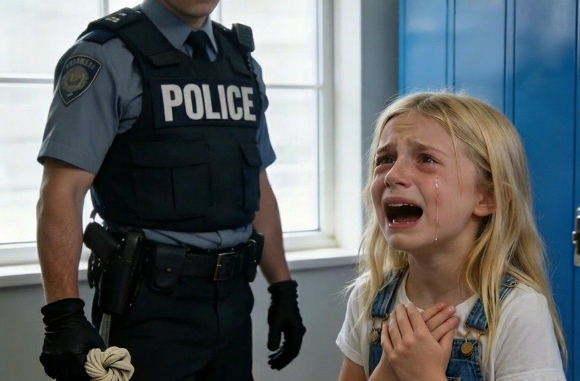
At my 10-year-old daughter’s school program, a staff member gently tapped my shoulder. “Can I speak with you for a moment?” she asked. I followed her down the hall to a small office where a police officer stood, his face tense. “I need you to see this,” he said. The moment I looked at the screen, a chill ran through me. I felt frozen.
The gym smelled of popcorn and polished wood, just like any school event. Folding chairs scraped across the floor as parents crowded in to watch the fifth-grade “Living History” presentations. My daughter, Chloe Bennett, stood near the stage in a paper bonnet, clutching her notecards. She grinned when she spotted me, missing a front tooth, full of pride.
I lifted my phone to record, my heart swelling with simple joy.
Then someone touched my shoulder.
“Mrs. Bennett?” a woman said softly, wearing a school badge and a polite smile that didn’t reach her eyes. “I’m Ms. Carter. May I speak with you for a minute?”
My stomach sank. Every parent knows that tone—it signals something is wrong before a word is spoken.
“Chloe’s about to go on,” I said, glancing toward the stage.
“It’ll only take a moment,” she said gently, guiding me down the hallway.
We passed trophy cases and colorful student artwork that blurred as my pulse raced. She led me into a small conference room near the main office. Inside, a uniformed police officer and a school administrator waited. The air was cold and silent.
“Mrs. Bennett,” the officer said, “I’m Officer Miguel Ramirez. Please have a seat.”
My mouth went dry. “Is Chloe okay?”
He didn’t answer immediately, and the silence felt heavy.
“Please look at this,” he said, sliding a tablet across the table.
The screen showed a security photo: a young girl with long brown hair in a blue cardigan walking near the back parking lot. Chloe’s cardigan. The same yellow ribbon I’d tied in her hair that morning. Next to her was a man I didn’t know, his hand resting on her shoulder, guiding her toward a gray SUV.
“That’s my daughter,” I whispered.
Officer Ramirez nodded. “This was taken yesterday. It was emailed anonymously to the school this morning.”
He tapped the screen, showing the message that accompanied it:
“YOUR DAUGHTER TALKS TOO MUCH. FIX IT OR WE WILL.”
My vision narrowed. I gripped the edge of the table to steady myself.
“Where is she?” I asked.
“She’s still in the gym,” Ms. Carter said quietly. “She doesn’t know.”
Officer Ramirez leaned forward. “Has Chloe mentioned anyone recently? A man talking to her? Asking her to keep a secret?”
My heart pounded. “No… she hasn’t—”
Then I remembered her casually mentioning a “nice man” who said the library was safer than the pickup line. I’d dismissed it.
“You’re remembering something,” the officer said.
In that moment, I understood. Someone had gotten close enough to my child to touch her shoulder. And I hadn’t seen it.
My instinct screamed to run to the gym, but Officer Ramirez stopped me. “We need to handle this carefully. Reacting suddenly could make things worse.”
“Carefully?” I said, voice breaking. “Someone threatened my daughter.”
“I know,” he said softly. “Which is why we must do this the right way.”
The administrator explained that staff had been quietly stationed at exits. No announcements would be made.
I looked back at the tablet. The gray SUV. The man’s hand on Chloe’s shoulder. She didn’t look frightened—she looked calm. Children trust someone who seems safe.
Officer Ramirez zoomed in on the man’s wrist—a slim red-and-black braided bracelet.
“Does that look familiar?” he asked.
I shook my head, but my mind raced. The “nice man.” The library shortcut. The back lot.
“He’s been talking to her before,” I realized.
Ms. Carter admitted Chloe had mentioned a man helping her look for a lost water bottle. She had assumed he was a parent and told Chloe to stay near doors next time.
I asked to see the email again. It was a single sentence:
YOUR DAUGHTER TALKS TOO MUCH. FIX IT OR WE WILL.
“Talks too much about what?” I whispered.
“That’s what we’re trying to figure out,” Ramirez said.
Chloe wasn’t good at keeping secrets. She told me everything. Even so, I remembered small details: her asking if adults could get in trouble at work. I had brushed it off.
Ramirez asked about my job at Ridgeway Construction, which had been quietly under investigation. My heart sank.
Then a staff member interrupted: a man in the hallway claiming to be family, wearing a red-and-black braided bracelet. Everything inside me went cold.
“Lock the door,” Ramirez ordered. Staff followed his instructions. Moments later, a scuffle, a thud. “They’ve got him,” he said.
Chloe was brought in. Her smile vanished when she saw me. “Mom?” she asked quietly.
I hugged her. Officer Ramirez showed her the photo. She nodded. “That’s Mr. Dan,” she said. He’d offered ice cream, a library shortcut, and asked if she overheard money talk at home.
Detectives confirmed the man was linked to a Ridgeway subcontractor. He hadn’t targeted Chloe—he’d been targeting me.
They escorted us out through a side entrance while the program continued as if nothing had happened.
That day split my life in two: before—believing danger looked obvious; and after—understanding it can smile, call itself “Mr. Dan,” and walk into a school.
As we stepped into the sunlight, I made a silent promise: no one would ever get that close to my child again.
Leave a Reply