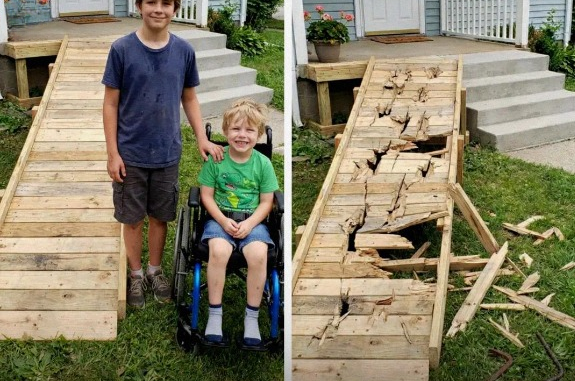
I assumed it was just another normal afternoon—until my son noticed something everyone else had overlooked. By the following day, our entire street would be different.
My son, Ethan, is 12. He’s the kind of kid who can’t ignore something that feels wrong, even if it has nothing to do with him.
Across the street lives Caleb, a quiet nine-year-old who spends most of his time sitting on his porch in a wheelchair, watching the neighborhood like it’s a world he can’t quite enter.
At first, I didn’t think much of it. Kids make do with what they have. But Ethan paid closer attention.
One afternoon, while we were bringing in groceries, he paused and looked over. Caleb sat there again, silently watching other kids ride their bikes.
“Mom… why doesn’t Caleb ever come down?” he asked.
I didn’t have an answer, but I could see the sadness in Caleb’s eyes. I told Ethan we could go ask later, and that was all the encouragement he needed.
That evening, we walked over—and that’s when I finally understood the problem.
Four steep steps. No railing. No ramp. No safe way down.
We knocked, and Caleb’s mother, Renee, answered. She looked exhausted but kind. When we asked, she explained that Caleb would love to play outside, but without a ramp, he had to be carried every time—and they simply couldn’t afford to build one. Insurance wouldn’t cover it.
We went home quietly, but Ethan clearly wasn’t done thinking about it.
That night, instead of playing games, he sat at the kitchen table sketching ideas. His father had taught him how to build before he passed away a few months earlier, and Ethan had taken to it ever since.
“I think I can build a ramp,” he said.
The next day, he emptied his savings—money he’d been saving for a bike—and insisted on using it for materials. At the hardware store, he carefully planned everything, asking questions and double-checking measurements.
For three days straight, he worked after school until dark. Measuring, cutting, sanding—he handled it all, and I helped where I could.
By the third evening, the ramp was finished. It wasn’t perfect, but it was solid.
We carried it across the street and installed it. When Caleb finally rolled down onto the sidewalk by himself for the first time, the joy on his face was unforgettable. Within minutes, neighborhood kids gathered, inviting him to play.
For the first time, he belonged.
But the next morning, everything changed.
I woke to shouting and rushed outside to see Mrs. Harlow, a neighbor, standing in front of the ramp, furious. Before anyone could stop her, she grabbed a metal bar and smashed it to pieces.
“This is an eyesore,” she snapped before walking away, leaving the ramp destroyed.
Caleb was back at the top of the steps—watching again.
Ethan blamed himself, thinking he hadn’t built it well enough. I told him what mattered was that he had done something kind—but it still hurt.
What we didn’t expect was what happened the next day.
Several black SUVs pulled up outside Mrs. Harlow’s house. Men in suits stepped out and approached her door. At first, she seemed pleased—until they began speaking.
They represented a major charitable organization she had been interviewing with for a leadership position. As part of their final evaluation, they had been observing her real-life behavior.
Then they showed her the video—her destroying the ramp and shouting.
Her expression collapsed.
They immediately withdrew her offer, explaining they could not choose someone who would take away a child’s independence over something so trivial.
But that wasn’t all.
They announced plans to purchase land nearby to build a fully accessible community space, complete with adaptive equipment and permanent ramps.
It turned out Renee had once worked for the organization and had sent them the footage after witnessing what happened.
Before leaving, they also honored Ethan—planning a permanent dedication in memory of his father and ensuring Caleb would receive a proper ramp.
In the end, what started as one small act of kindness changed everything.
And this time, Caleb wasn’t just watching—he was smiling, knowing something better was already on its way.
Leave a Reply