“You’re Still a Child”
A story about the line between asking for help and being expected to share your pain
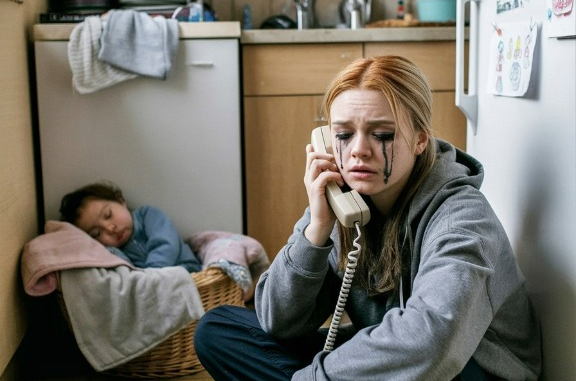
I called the county helpline at 2:11 in the morning, sitting on the cold linoleum between the stove and the sink—the only place in our trailer that didn’t feel like it was closing in on me. The living room was too drafty, the bathroom too cramped. That narrow space in the kitchen was just enough to curl into, and I had learned that small spaces could sometimes hold you together when everything else felt like it was falling apart.
I was thirteen. I had been awake since eleven, trying to get my little brother Noah warm enough to sleep. He was six, wearing one sock, the other long gone. He was too tired to care. He had curled up inside a laundry basket padded with towels because our mattress had broken weeks earlier, springs pushing through like they were trying to escape. In that basket, he looked even smaller than he was.
The woman who answered didn’t rush me. She let the silence exist. I told her no one was hurt, nothing was on fire—I just didn’t know how to make things better before morning. She asked what would help right now. Not forever. Just until sunrise.
I looked at Noah, restless even in sleep.
“A bed,” I said, my voice cracking. “Just somewhere he won’t wake up cold.”
She said my name twice—Ava—not because she forgot, but so I could hear it spoken by someone who cared.
“Stay on the line with me,” she said.
No sirens came. Just a gentle knock. A woman named Denise entered first, kneeling to meet me at eye level. A retired paramedic followed with blankets and snacks. Someone else brought a small lamp that filled the room with soft yellow light.
They didn’t make a show of helping. They just helped.
They fixed the heater. They gave us food and warmth. Before they left, they taped a note to the fridge:
You are still a child. You do not have to earn rest.
I read it over and over before believing it applied to me.
When my mom came home at dawn, she stopped in the doorway, taking in the light, the warmth, the change. I had seen her tired before. I had never seen her cared for.
“Who was here?” she asked.
“People who didn’t make us feel poor,” I said.
The next day, more people came. A librarian brought books and internet access. Volunteers built bunk beds. A neighbor turned old fabric into a curtain covered in stars.
Noah climbed onto the bottom bunk, laughing for the first time in weeks.
“It’s yours,” I told him.
“Really?”
“Yeah. I’ll take the top.”
That night, for the first time in a long while, we slept without bracing for something.
But by the next day, everything changed again.
A photo of our home—just a corner of the room, the bunk bed, the glowing lamp—had been shared online. No names, no faces. Still, people had opinions.
Some offered help. Others judged.
Where’s the father?
People want help after bad choices.
Funny how they have phones but no bed.
Strangers built a story about us from almost nothing.
Noah saw part of it. Not the words—but my face.
“Are they going to take my bed?” he asked.
That question hurt more than anything.
Denise came quickly, apologizing. The post was being taken down, but it had already spread. Help was increasing—but so was exposure.
My mom said something I won’t forget:
“I let myself believe we could be helped without becoming a story.”
At a community meeting days later, people talked about programs and numbers. But something felt off—like help came with conditions no one said out loud.
Then my mom stood up.
“My children are not brave because they suffered,” she said. “They are children. They should have had beds before anyone needed to feel something about it.”
The room went quiet.
I stood up too.
“I asked for help because I was tired,” I said. “Not dramatic tired. Real tired.”
I took a breath.
“Need is not permission.”
I told them about Noah. About our neighbors. About how people are more than the stories others tell about them.
“We shouldn’t have to trade our privacy just to deserve basic things,” I said. “Children shouldn’t have to become proof.”
Then I shared the only part I wanted repeated:
“The note said: you are still a child. You do not have to earn rest. If help means anything, it should mean adults don’t have to earn dignity either.”
That changed something.
Not everything. But something real.
In the weeks after, repairs began. Heat was fixed. Homes improved. Life didn’t magically become easy—but it became steadier.
One day, Noah stood in the middle of the trailer and said, “It doesn’t smell wet anymore.”
That meant more than anything.
I started drawing again. This time, I drew our life as it really was—not perfect, not broken. Just ours.
At the center was our home. The lamp glowing. The star curtain. My mom resting. Noah sleeping peacefully.
At the door, I drew many people—not just one.
Because I learned something important:
Help matters.
Kindness matters.
But dignity matters just as much.
And sometimes, the most powerful thing isn’t being seen.
It’s being respected without having to be exposed.
The note is still on our fridge.
I still read it on hard days.
Not because I forget—
but because some truths take time to feel real.
I am still a child.
And I never should have had to earn rest.
Leave a Reply