
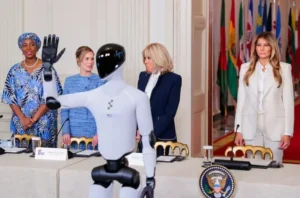
The humanoid robot Figure 3 appeared alongside Melania Trump as she welcomed global leaders at the Fostering the Future Together summit in Washington, DC.
In a moment that quickly grabbed attention online, the First Lady was seen walking through a red-carpeted White House hallway accompanied by the lifelike robot on March 25.
She made a striking entrance while hosting the summit, as the two slowly approached the gathering. The robot then stepped forward before a room full of international leaders and spoke, thanking Melania Trump for the invitation and expressing its honor at attending the inaugural global coalition meeting. Introducing itself as Figure 3, it highlighted its American origins and role in supporting efforts to expand children’s access to technology and education. It even greeted attendees in 11 different languages.
Following the robot’s remarks and a round of applause, Melania welcomed it warmly, noting that it was her first American-made humanoid guest at the White House.
According to its creator, the robotics company Figure, the robot is designed to independently handle household tasks such as cleaning, laundry, and dishwashing.
The summit brought together representatives from over 40 countries, including France’s First Lady Brigitte Macron, to discuss improving global access to education and technology for children.
Melania also spoke about the future of artificial intelligence, suggesting that humanoid robots like Figure 3 could soon become a common part of everyday life. She explained that AI is evolving beyond smartphones and may soon take human-like forms that can operate naturally within environments built for people.
She even invited the audience to imagine a humanoid teacher named “Plato,” capable of providing instant access to a vast range of knowledge—from literature and science to philosophy, art, and history—all from home.
However, the idea sparked mixed reactions online. While some praised the innovation, others expressed concern about the possibility of AI replacing human educators. Critics argued that schools should focus on better supporting teachers rather than introducing machines into classrooms, with some calling the concept unsettling and overly futuristic
Leave a Reply