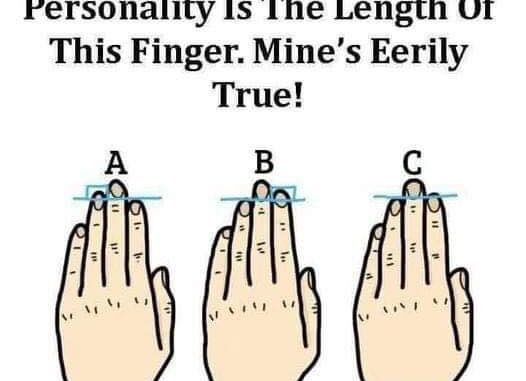
The notion that the length of our fingers—especially the ratio between the index (2D) and ring finger (4D)—can reveal something about our personality is certainly intriguing, even though it falls more into the realm of pseudoscience than established fact. Still, the idea has captured people’s imagination, suggesting that a simple physical trait might offer insight into behavior, tendencies, or character. It encourages many to glance at their hands differently and wonder whether there’s any truth behind it.
This concept revolves around the so-called “2D:4D ratio.” According to popular belief, if your ring finger is longer than your index finger, you’re more likely to be bold, competitive, and willing to take risks—someone driven, confident, and possibly even a bit aggressive. On the other hand, if your index finger is longer, you’re thought to lean toward empathy, kindness, and sensitivity, with a tendency to avoid conflict and prioritize cooperation. Those whose fingers are about the same length are often said to have a mix of both qualities, adapting their behavior depending on the situation.
While this paints a neat and appealing picture, it’s clearly an oversimplification of human personality. Still, it has gained a strong following, especially among people interested in alternative or intuitive ways of understanding themselves.
The idea itself isn’t new, but it gained wider attention through the work of evolutionary biologist John Manning from Swansea University. Over the past couple of decades, his research has inspired hundreds of studies exploring possible links between finger ratios and various traits—ranging from cognitive abilities and risk-taking to health conditions and aspects of identity. Some have even tried to apply these ideas to historical contexts, such as analyzing ancient cave art to infer traits about its creators.
Despite this, most scientists remain unconvinced. There’s little solid evidence to support the claim that finger length can reliably predict personality. In reality, personality is shaped by a complex mix of genetics, environment, upbringing, and life experiences. Reducing it to something as simple as finger proportions is, at best, an interesting idea—and at worst, misleading.
That said, part of the theory stems from research into prenatal hormones. Decades ago, scientists began exploring how exposure to hormones like testosterone in the womb might influence later traits and behavior. Since directly measuring those hormone levels was difficult, finger ratios were proposed as an indirect indicator. From there, speculation grew about possible links to personality, behavior, and even identity.
What makes this idea so compelling is how it taps into our natural curiosity about ourselves. It offers a simple, almost poetic shortcut: look at your hands, and you might uncover something deeper about who you are. Humans are naturally drawn to patterns and meaning, so it’s easy to see why this concept resonates.
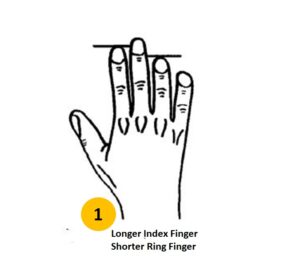
Even so, it’s important to stay grounded. While the research is thought-provoking, it doesn’t establish clear cause-and-effect relationships or dependable conclusions. People are far too complex to be defined by something so small. A longer ring finger doesn’t guarantee boldness, just as a longer index finger doesn’t rule out confidence or leadership.
Still, there’s something undeniably fascinating about the idea. Our bodies hold many mysteries, and whether or not finger length truly reflects personality, it serves as a reminder of how layered and intricate we are. Perhaps physical traits don’t define us—but they can still spark curiosity, inviting us to explore the deeper story of who we are.
Leave a Reply