PART 2
I wasn’t about to scream or make a scene; my daughter wanted a performance—an “awkward mother” to justify her cruelty. I decided to give her something else: proof.
From the shed, I began recording with my phone. First came her threat: “I’ll send you to a nursing home.” Then her triumphant declaration: “This house is mine now.” I saved everything to the cloud with a timestamp, in case she tried to snatch my phone.
I called my sister Inés and explained the situation briefly.
“Are you sure about this?” she whispered.
“I’m sure about what I won’t allow,” I replied.
The music blared, glasses clinked, and people came and went. At one point, two girls mistook the shed for a bathroom. When they saw me sitting calmly with my phone in hand, they froze.
“What are you doing here?” one asked, uneasy.
“Waiting,” I said. “And recording.”
They left nervously laughing, confirming my suspicion: Lucía had spun her story, but no one had the truth.
Later that night, I overheard a heated conversation.
“Hey… this isn’t yours, right?” a boy asked.
“Of course it is. My mother is outside. She doesn’t run things here,” Lucía replied arrogantly.
The silence that followed spoke volumes. Some laughed, others muttered, “That’s messed up… that’s abuse.” Lucía cranked up the music to drown them out.
Then came the doorbell—and loud knocks.
“Police. Open the door!”
Panic spread through the house. Lucía barked orders.
“Turn everything off! Nobody say anything!”
A voice challenged her.
“Your mom is locked outside?”
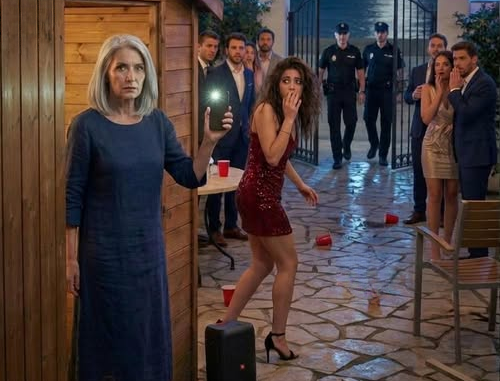
I took a deep breath, unlocked the shed, and stepped into the light as if emerging from a cave. Two officers scanned the scene.
“Are you the homeowner?” one asked.
“Yes,” I said steadily. “And I want my house back.”
Lucía, makeup cracking, tried a fake hug for appearances.
“Mum, you’re exaggerating…”
I stepped back and spoke loud enough for everyone to hear:
“Lucía, I recorded the nursing home threat. All of it.”
The party died instantly.
PART 3
The officers requested my documents. I handed over the deed and ID. Lucía only had her phone and her pride.
She tried the tears routine.
“She’s old… she gets confused. I just wanted to take care of her.”
Take care. The words made me sick.
I addressed the guests.
“No one is to blame for coming,” I said, “but you are responsible if you look away now that you know the truth.”
One of the boys, Álvaro, murmured, “Ma’am… I didn’t know…”
“I know,” I replied. “But now you do.”
The police cleared the house. Some left immediately, others lingered in shock. Lucía paced furiously, trying to provoke me.
“What are you trying to do? Ruin my life?” she hissed.
“No, Lucía. I’m trying to save mine.”
That night, I requested a temporary restraining order and filed a report for the confinement and threat. My neighbor Carmen testified. Álvaro offered to be a witness. My sister Inés arrived with food and blankets, embracing me like the world finally believed me.
Weeks later, Lucía called me “toxic” online. I didn’t reply. I presented my evidence where it mattered.
I rebuilt my home quietly—changed locks, repaired the shed, planted more bougainvillea. Sitting on the terrace, listening to the sea, I realized: peace isn’t begged for—it’s defended.
Yes, it hurts that my daughter hates me. But it hurts more to accept being treated like trash to entertain an audience.
Now I ask you: if you were in my shoes that night, what would you have done?
Would you have shouted, stayed silent… or gathered evidence like I did?
Tell me in the comments—because silence allows humiliation to repeat, and the one who abuses always wins.
Leave a Reply