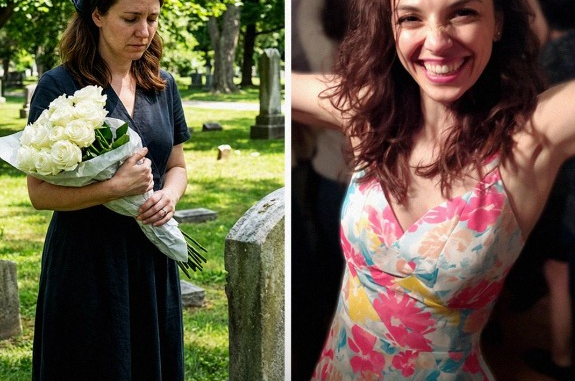
The day I laid my daughter to rest, my sister chose to throw a party. In my grief, I felt invisible—until one truth came out and shattered the illusion holding my family together. I never expected the reality behind Nancy’s death to surface that way, or that speaking up would finally give me room to start healing.
I understood loneliness the moment I stood beside my daughter’s casket and realized my own sister had chosen celebration over goodbye.
Nancy was only seven. The accident had taken her eight days earlier.
The pastor spoke her name softly, as if it might break in the silence. I kept my hands clasped, afraid that if I touched the casket again, I wouldn’t be able to let go.
Neighbors filled the pews. Her teacher sat in the front. Two police officers stood quietly in the back. Her best friend clutched a trembling sunflower.
But my family wasn’t there—not my mother, not my cousins, and not my sister, Rosie.
I kept glancing at the doors, hoping they’d open at the last second, expecting Rosie to rush in, apologetic and out of breath.
She never came.
After the burial, I lingered by Nancy’s grave long after everyone had left. Eventually, Mrs. Calder pressed a warm casserole into my hands and gently urged me to eat. I promised I would, though the words felt empty in my throat.
Back home, everything looked the same. Nancy’s magnets still decorated the fridge. Her shoes waited by the door, as if she might come running in.
I caught myself speaking out loud to her, telling her about the sunflowers, about the people who came.
When the kettle whistled, I poured tea—only to realize I’d made two cups out of habit.
Then my phone rang.
For a brief second, I hoped it might be my mother, ready to break the silence.
It was Rosie.
Her voice was bright, almost forced—too cheerful for a day like this.
She told me she had moved her housewarming party to today because the weather was perfect.
My fingers went cold.
“Today was Nancy’s funeral,” I said.
There was a pause, but she brushed past it.
She talked about her house, her guests, the gifts already brought. She asked how I could expect her to postpone everything.
“For my daughter?” I asked.
She called me dramatic. Said Nancy was gone. Asked if I was jealous.
I could barely process the words.
“I buried my child today,” I told her.
She replied that she had just bought her first home—and asked if I planned to bring up Nancy every time something good happened.
My legs gave out, and I sank into a chair.
I asked if our mother was there. She had been—bringing cake, leaving early. Everyone, Rosie said, had been asking about me.
Something in me shifted.
“Maybe I’ll come,” I said.
After hanging up, I stood in front of the mirror, steadying myself.
I wouldn’t scream. I wouldn’t fall apart.
But I would face her.
Rosie’s new house was decorated with green and gold balloons, laughter spilling into the street. People carried gifts inside, smiling, celebrating.
Nancy loved green balloons.
The thought nearly broke me, but I kept walking.
Inside, no one wore black. No one spoke softly. It was as if grief had been locked out completely.
Rosie pulled me aside, warning me not to make a scene. She even threatened to tell everyone I was unstable if I spoke up.
But I refused to stay quiet about my child.
We argued—her insisting she wouldn’t pause her life for my grief, me asking her to admit what she had done.
Then her husband, Neil, stepped in.
At first, she tried to silence him. But he didn’t stop.
He called for everyone’s attention.
And then he told the truth.
Nancy’s death hadn’t just been an accident. I hadn’t even planned to drive that day. Rosie had insisted—pushing me to take a faster route so I could run an errand for her before the party.
She had chosen convenience over safety.
And after the crash, she let everyone believe it was my decision.
The room fell silent as the truth settled in.
Rosie tried to deny it, but her words faltered. Guests began to whisper, to question, to see her differently.
Neil apologized—to me, to everyone—and then ended the party.
People left, carrying their gifts with them.
Rosie stood there, unraveling, as the image she had built collapsed around her.
I told her I didn’t need her approval. I needed a sister—and Nancy had needed an aunt who saw her as more than an inconvenience.
Outside, I untied a green balloon and let it drift into the sky.
“For you, Nance,” I whispered.
Neil joined me and offered to take me home.
For the first time since the accident, something inside me loosened.
The pain was still there. It always would be.
But the guilt was gone.
And in its place, there was just enough space to breathe again.
Leave a Reply