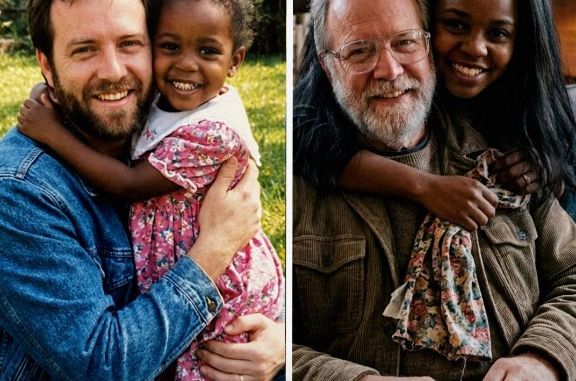
Last month, I said goodbye to the man who chose to raise me as his own when I was just three. He gave me his name, his care, and everything a child could hope for. But only three days after his funeral, an envelope appeared in his mailbox that made me question everything I thought I knew about the night my parents died.
The house felt wrong without Thomas. He wasn’t just a father—he was an incredible one. Everything was still in its place: his glasses on the side table, the chipped coffee mug I made him as a child sitting on the counter. Yet without him, it all felt empty, like a stage where the main actor had quietly disappeared.
I had gone there to begin packing his belongings, but days passed and I couldn’t bring myself to put anything away. As I stood in the living room holding an empty box, I noticed a woman outside slipping something into the mailbox before quickly walking off. Something about her urgency unsettled me, and I ran after her, calling out—but she didn’t stop.
When I checked the mailbox, I found a plain envelope with no name or address. Inside was a handwritten note and a flash drive. The message claimed I didn’t know the truth about my parents’ death—and that Thomas wasn’t who he seemed. It urged me to watch the contents of the drive.
Back inside, I sat for a long time before finally opening the file. A masked woman appeared on screen and claimed that Thomas had been driving the car the night my parents died—that he survived while they didn’t. She suggested that adopting me wasn’t just love, but a way to make up for what had happened.
The revelation shook me. The man I knew—the one who had cared for me, supported me, and stood by me through everything—suddenly felt like a mystery. Still, I reminded myself that an anonymous video wasn’t proof. Yet there was one thing I couldn’t ignore: he had always avoided talking about the accident.
Determined to find answers, I tracked down the woman who left the note. Her name was Amanda, and she told me a story that changed everything. She had once been engaged to Thomas. On the day of the accident, he had been driving my father’s car, with both my parents inside. The crash happened on a dangerous curve, and while he survived, they didn’t.
According to Amanda, the investigation found that the brakes had been tampered with—meaning the accident likely wasn’t his fault. But Thomas never believed that. He carried the guilt with him, convinced he could have prevented it.
When he learned I would be placed into foster care, he refused to let that happen. He decided to adopt me, even though it meant ending his engagement. Amanda admitted she couldn’t take on that responsibility, and Thomas chose to raise me on his own.
Hearing this, I began to understand the depth of what he had done—not out of obligation, but out of love shaped by loss and responsibility.
Later, I visited his grave with his favorite cupcakes and yellow roses. Standing there, I realized how much he had carried silently throughout his life. Yet despite it all, he never made me feel like a burden—not once.
I told him I wasn’t angry. The truth didn’t erase the years of love and care he had given me. If anything, it made me see him more clearly—not as perfect, but as deeply human, and even more remarkable because of it.
He may not have been the man I thought he was—but he was someone who chose love, every single day, without asking for anything in return. And in the end, that kind of quiet, selfless love felt even greater than I had ever imagined.
Leave a Reply