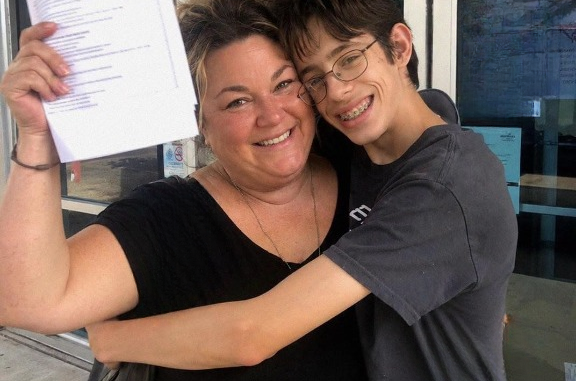
Everyone told me adopting Luke was a mistake. He was sixteen and had already gone through ten different foster placements. But just two weeks after his adoption became official, he sat across from me at dinner, started trembling, and whispered, “Mom, I need to tell you something.”
Three years earlier, I had buried both of my children after a terrible car accident.
For months afterward, I kept their bedroom doors shut.
Eventually, I started leaving them open because somehow the closed doors hurt even more.
The grief slowly changed. It went from something that crushed me every morning to something I learned to carry quietly, without letting anyone see.
Grace had left a sweatshirt hanging over her desk chair.
Noah still had three library books stacked beside his bed.
I couldn’t bring myself to move any of it.
Everyone told me that eventually grief would become easier.
They were right.
But the house was still painfully quiet.
Eventually, the silence became too much.
So one rainy Tuesday, I walked into a foster care agency and told a woman named Denise that I wanted to talk about becoming a parent again.
Denise didn’t smile.
“I’m going to ask you something difficult,” she said. “Are you trying to replace your children?”
“No.”
“Are you sure?”
“I don’t think anyone could replace them.”
She studied me for a moment.
“Good answer.”
The process took months.
There were training sessions, interviews, home inspections, background checks, and conversations about childhood trauma that sometimes left me crying alone in my car afterward.
Then one afternoon, Denise invited me to an agency event where prospective parents could meet some of the children.
Most of the younger kids were playing.
Near a window, however, a teenage boy sat alone with a paperback book.
A little girl knocked over a box of crayons.
The boy immediately put his book down and helped her gather them.
He even crawled underneath a table to retrieve the last blue crayon before returning to his chair.
I nodded toward him.
“Who’s that?”
Denise followed my gaze.
Her expression changed.
“Luke.”
“How old is he?”
“Sixteen.”
She hesitated.
“You should know he’s had a lot of placements.”
“How many?”
“Ten.”
I stared at her.
“Was he violent?”
“No.”
“Did he hurt younger children?”
“No.”
“Then what happened?”
“Different things. Luke is…complicated.”
I hated that word.
Years earlier, after my husband died, Noah’s teachers had called him complicated because he stopped talking in class.
What they really meant was that my grieving eleven-year-old had stopped making their jobs easy.
“I’d still like to meet him.”
Luke stood when I approached.
“Hi. I’m Caroline.”
He glanced at the empty chair beside him and gestured toward it.
“Please, ma’am. You can sit here.”
I almost laughed.
“I’m forty-seven, not ninety.”
His mouth twitched.
“I wasn’t implying anything.”
“You absolutely were.”
That earned me a real smile.
We spent almost an hour talking about the book he was reading.
When I left, Denise reminded me, “One good conversation doesn’t guarantee a placement.”
“I know.”
So I came back.
Again and again.
For four months, Luke and I met at the agency, libraries, diners, parks, and supervised outings.
I kept waiting for the difficult teenager everyone had warned me about.
He never showed up.
Luke was guarded but kind. He had a dry sense of humor and remembered almost everything I told him.
Once, I mentioned that Grace had hated raisins.
Three weeks later, Luke pushed a cookie across a café table.
“Don’t worry. I checked. No raisins.”
I stared at him.
“What?”
“Nothing.”
Eventually, we began discussing adoption.
“You’d really want that?” Luke asked.
“Yes.”
“Permanent?”
“That’s generally what adoption means.”
He looked down.
“What if I mess it up?”
“Then we’d deal with whatever you messed up.”
“What if you regret it?”
“Then I’d be an adult having a feeling. You’d still be my kid.”
His eyes stayed fixed on the table.
“You make everything sound simple.”
“No. I make commitment sound simple.”
That distinction mattered.
When Luke finally moved into my house, he acted as though he were borrowing everything.
He made his bed before breakfast.
He washed his plate immediately after eating.
He folded towels without being asked.
One Saturday morning, I nearly tripped over a loose porch step.
Luke appeared with a screwdriver.
“How long has this been like this?”
“A couple of years.”
He stared at me.
“You’ve been walking on this?”
“I enjoy danger.”
“You’re ridiculous.”
A month later, something happened that neither of us expected.
“Mom, have you seen my charger?”
We both froze.
Luke immediately turned red.
I pretended to search through a drawer while trying not to cry.
“Kitchen counter.”
“Right.”
Neither of us mentioned it.
But he kept calling me Mom.
By the time the adoption became official, I’d stopped waiting for Luke to suddenly become someone else.
Then, exactly two weeks later, he came to dinner and barely touched his meatloaf.
That worried me because Luke loved meatloaf.
“Sweetheart?”
“I’m fine.”
“Terrible lie.”
His fork scraped against the plate.
I reached across the table and touched his hand.
He was shaking.
He pulled away.
“Mom, I need to tell you something.”
“Okay.”
My fork slipped from my fingers.
“And you’ll probably wish you hadn’t adopted me.”
My stomach dropped.
“Luke, what happened?”
He looked terrified.
Then he whispered:
“I have a sister.”
“A sister?”
“Half-sister.”
“But your file said you didn’t have any siblings placed with you.”
“She’s not placed with me.”
Her name was Emma.
She was nine years old now.
Luke told me that they had entered foster care together years earlier, when Emma was still very young.
“I basically raised her,” he said.
He had made her breakfast, gotten her ready for school, helped with homework, and comforted her whenever she woke up frightened.
Then a family offered Emma a permanent home.
“They didn’t have room for me,” Luke said.
“Who told you that?”
“Everybody. They said Emma deserved stability.”
“And you agreed?”
“I was fourteen. They kept asking me what I thought was best for her.”
After Emma left, Luke began sabotaging his own foster placements.
Not by becoming violent.
He simply learned how to make families give up on him.
“I’d stop talking.”
“On purpose?”
“Mostly. Sometimes I just didn’t feel like talking.”
He refused outings.
Stayed in his room.
Said things he knew would hurt people.
“Why?”
His chin trembled.
“Because if I got adopted somewhere else, Emma might think I chose another family over her.”
Suddenly, those ten placements looked completely different.
“Did every family reject you?”
Luke shook his head.
“How many did you push away?”
“I don’t know.”
“Luke.”
“Most.”
Once, when a foster mother began talking about permanent guardianship, Luke packed his bags before she could finish.
“Why?”
“Because leaving hurts less when you decide when it happens.”
I had to look away.
Then he said the part that broke my heart.
“I was going to do it to you.”
I turned back.
“What?”
“When I moved in, I had a plan. Give it a couple of months, then start acting differently.”
“But you didn’t.”
Tears ran down his face.
“I messed up.”
Despite everything, I almost laughed.
“How?”
“I started loving you.”
I moved closer.
“I liked being here.”
Then his voice broke.
“Then the adoption happened, and everyone was happy, and all I could think was that Emma would hate me.”
I sat beside him.
“You should have told me.”
“I know.”
“But you’re not going anywhere. You’re my son. Adoption wasn’t a trial period.”
His shoulders collapsed.
The next morning, I called Denise.
“Why wasn’t Emma discussed during Luke’s adoption?”
There was a long silence.
“There were decisions made between the adults involved at the time.”
“The history was in the older records, but direct contact had become restricted years ago while Emma adjusted to her placement.”
“Restricted by whom?”
Another pause.
“Did Luke have contact with her?”
“He sent letters.”
“Did Emma answer?”
“I don’t know.”
Luke did.
When I asked him about it, he came back carrying an old shoebox.
Inside were copies of dozens of letters.
Birthday letters.
Christmas letters.
Letters asking about school.
And every one ended with the same sentence:
I’m still your brother.
“She never answered one,” Luke said.
Something wasn’t right.
Denise made several calls.
A few days later, she told me Emma’s adoptive parents were willing to meet, but they wanted to move slowly.
“Maybe we should wait before putting Luke and Emma in the same room,” she said. “Let the adults work through the history first.”
I stared at her.
“The adults have been deciding what those two can handle for years.”
“Caroline—”
“I’m not asking you to throw them together without support. I’m asking you not to turn ‘slowly’ into another few years.”
Eventually, everyone agreed to a supervised meeting.
Luke almost refused to go.
“What if she doesn’t want me?”
“Then we’ll respect that.”
“What if she hates me?”
“Then you’ll survive hearing the truth.”
“What if she forgot me?”
I couldn’t answer that.
Emma’s adoptive parents, Rachel and David, met us in their living room.
The conversation was awkward at first.
After several uncomfortable minutes, Rachel went upstairs.
She returned carrying a plastic storage bin and placed it in front of Luke.
“What is this?” he asked.
“Letters.”
She opened the lid.
The box was filled with envelopes.
Every single one had Luke’s name written on it.
Luke picked one up.
The handwriting was childish.
LUKE.
He stared at it.
“She wrote back?”
“Yes.”
“All this time?”
Rachel began crying.
“Your letters came through to us. At first, everyone thought limiting direct contact would help Emma settle. She kept writing replies anyway.”
Luke stared into the box.
“Then why didn’t I get them?”
Rachel wiped her eyes.
“We kept thinking we’d send them once things felt more stable. Then too much time passed, and admitting we’d waited so long became harder.”
David looked down.
“We should have fixed it.”
Luke opened one of the letters.
Then another.
His hands were shaking.
Suddenly, footsteps sounded upstairs.
A girl appeared on the staircase.
She stared at Luke.
Then she ran back upstairs.
A few seconds later, Emma came rushing back down carrying a battered stuffed rabbit.
Luke stopped breathing.
She held it up.
“You gave me Mr. Buttons.”
Luke covered his mouth.
Then dropped to his knees and wrapped both arms around her.
I looked away.
That moment belonged to them.
Their relationship didn’t magically heal that afternoon.
But it began again.
There were supervised visits, phone calls, birthdays, and eventually weekends together.
I made one thing very clear.
I wasn’t replacing Emma.
And Emma wasn’t competing with me.
Luke had spent years believing that loving one person meant choosing against another.
He needed to learn that there was room for both.
Months later, I found Luke outside repairing the porch step again.
Emma was sitting beside him, criticizing everything he did.
“You’re holding it wrong.”
“You’ve never held a hammer.”
“I’ve seen people use one.”
“On television?”
“Still counts.”
I carried out some lemonade.
Emma reached for the hammer.
Luke immediately pulled it away.
“Absolutely not.”
“Why?”
“Because I enjoy having all ten of your fingers attached.”
“Mom, please tell her she’s not touching this.”
“No, you don’t.”
Emma looked at me.
“Tell him.”
For a second, I saw the old panic in Luke’s face.
Then Emma rolled her eyes.
“Fine. Ask your mom. You’re both annoying.”
Luke blinked.
Then he laughed.
A moment later, they were arguing over the hammer again.
I watched them from the porch.
The house wasn’t silent anymore.
And nobody had to leave to make room for someone else.
Leave a Reply