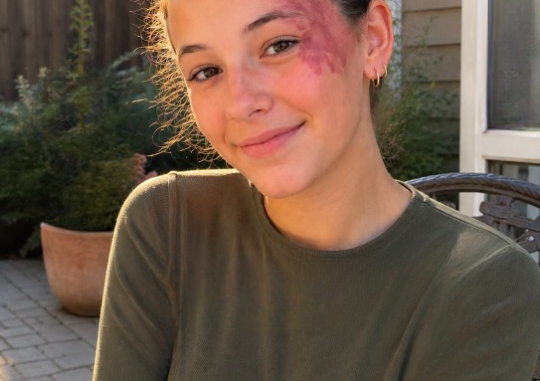
The laughter echoed through the auditorium while my 15-year-old daughter, Eliza, stood frozen beneath the stage lights. Just moments earlier, she had been singing with confidence in a soft blue dress, her dark hair pinned back so the large crimson birthmark on her left cheek was fully visible. Then Maddie, a girl who had quietly targeted her for years, called out, “Wow, somebody’s feeling confident tonight.” A handful of students laughed, Eliza stopped singing, and her hand immediately drifted toward her face. I was already rising from my seat when she looked directly at me. That morning, she had asked me to make a promise that suddenly felt impossible to honor: “Don’t come rescue me.”
For years, I watched Eliza hide behind her hair, avoid cameras, and carefully position herself so people saw only one side of her face. But earlier that day, I discovered she had painted a self-portrait showing her birthmark without hiding it and had secretly signed up for the school talent show. Backstage, when Maddie made another cruel comment, I nearly stepped in, but Eliza stopped me. Holding my wrist, she quietly said, “This night isn’t about Maddie. Sometimes I need you to trust me before you protect me.” Now, as an uncomfortable silence settled over the auditorium and I forced myself back into my chair, someone unexpected stood up and walked toward the stage.
Elliot, one of the student hosts and one of the most popular students in school, picked up a spare microphone and calmly asked Maddie to repeat what she had said. When she tried to brush it off, he simply asked what was supposed to be funny about it. The room fell silent. He didn’t insult her or turn it into a dramatic confrontation. He simply made her confront her own behavior. Then he turned to Eliza, apologized for interrupting her performance, and stepped aside, returning the spotlight to her.
Eliza slowly lowered her hand from her face and tucked a loose strand of hair behind her ear.
“Actually, Maddie,” she said, “you’re right about one thing. I am feeling confident tonight.”
Then she asked for the music to start over.
Her first note shook slightly. The second didn’t.
By the final chorus, parents and students were on their feet applauding. Meanwhile, the principal quietly escorted Maddie and her friends out of the auditorium.
Eliza didn’t win the talent show that night, but by the time we were sharing melting ice-cream sundaes afterward, the trophy no longer mattered. She admitted she had been seconds away from leaving the stage, but Elliot’s choice to stop the mockery without taking over the moment gave her the chance to decide what happened next.
That night taught me something important. For years, I believed loving my daughter meant shielding her from every cruel thing the world could throw at her. But sometimes what she needed most was for me to stand beside her, not in front of her.
The next afternoon, Eliza walked into the kitchen, pushed her hair behind her ear, and asked me to take a picture of her.
There was no carefully chosen angle. No hair covering her cheek.
When I asked if I could keep the photo, she smiled.
“Obviously.”
For the first time in years, my daughter wasn’t trying to hide who she was. She was finally letting the world see her exactly as she was.
Leave a Reply