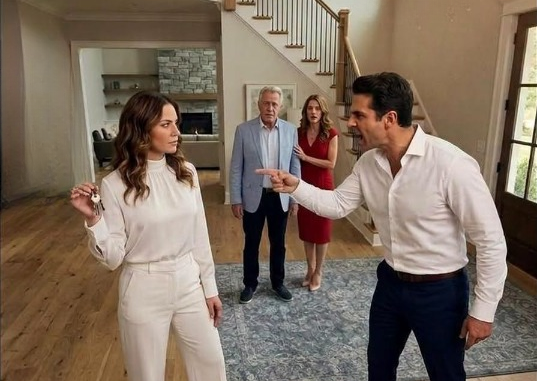
Gerald Mercer had barely crossed the threshold of my new house when he slowly looked around and said, “This will work.”
My parents stood behind me in complete disbelief. For almost twenty years, they had been saving money so their pregnant daughter could have a secure home outside Columbus, Ohio. Dad had taken every overtime opportunity at the auto-parts factory where he worked, while Mom spent her evenings cleaning offices after finishing her pharmacy shifts. Almost everything they had managed to save went toward the down payment.
The four-bedroom Craftsman was legally mine. My name was the only one listed on the deed.
Yet Gerald immediately started assigning rooms as though the house already belonged to him.
He announced that Aunt Dorothy would have the downstairs suite. Aaron’s brother, Scott, along with his wife, Melissa, and their children, would use the bedrooms upstairs. Then my husband, Aaron, casually asked me for the spare keys so his father could have copies made.
I stared at him, finally realizing this wasn’t some spontaneous suggestion.
They had already planned everything.
When I refused to hand over the keys, Gerald treated me like I was too naive to understand the importance of “sharing resources” within a family.
There was just one thing he didn’t know.
Six months earlier, Aaron had signed a postnuptial agreement clearly stating that he had no ownership interest in the property.
Then my phone vibrated.
It was my attorney, Rachel Lane, who had been waiting outside with paperwork from our lender. She came inside, opened a thick folder, and placed a loan application on the dining table.
Someone had tried to use my house as collateral for Gerald’s struggling construction company, Mercer Home Solutions.
At the bottom of the application was a signature that looked remarkably similar to mine.
The problem?
I had never signed it.
Rachel then explained where the application had originated, and Aaron’s expression immediately changed. It became obvious that there was far more to the situation than he had admitted.
According to the lender’s records, Aaron knew his father was trying to use my property as financial leverage. He also knew that our legal agreement specifically prohibited him from placing any mortgage, lien, or other financial obligation against the house.
But the situation went even deeper.
Investigators uncovered two credit accounts that had been opened using my identity. They also found bank statements that had apparently been used to make Gerald’s company look financially healthier than it really was.
Rachel immediately began helping me protect my credit, insurance information, savings, and ownership rights in the property my parents had sacrificed so much to help me purchase.
Once investigators began examining suspicious investment documents, exaggerated business revenue, and forged paperwork, Aaron hired an attorney of his own.
I changed every lock on the house and filed for separation while the lender’s fraud department continued digging into the case.
Gerald had assumed that family loyalty would keep everyone quiet.
Instead, once the evidence reached investigators and eventually the court, the financial trail became impossible to hide.
Months later, my marriage was over, and Gerald’s company collapsed under the weight of debts it had been concealing for years.
Aaron eventually admitted his role and began rebuilding his relationship with our daughter, Lily Grace, but only under strict boundaries.
Patricia, my mother-in-law, eventually turned over company records to investigators and began creating an independent life of her own.
My parents never left my side.
They helped finish Lily’s nursery and planted roses along the front walkway.
The house became peaceful again.
And somehow, it never felt empty.
Gerald had walked through my front door believing that the rooms, the property’s value, and the security it provided were family resources he could simply claim.
My parents had always understood the house differently.
They hadn’t sacrificed for me to own something others could take.
They had sacrificed so I could have a place where I—and someday my daughter—could decide exactly who deserved a key.
Leave a Reply