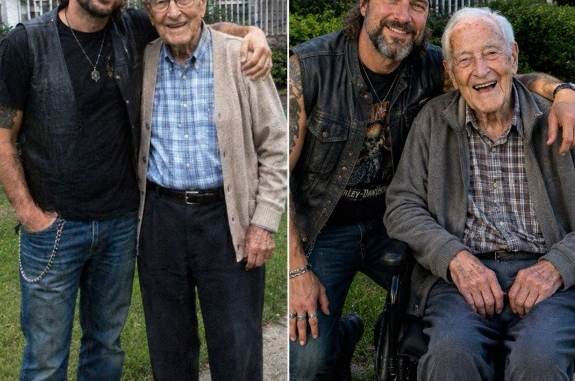
For years, every Sunday looked exactly the same to me. I believed I was simply lending a hand to an elderly neighbor, never realizing those quiet mornings would become some of the most meaningful moments of my life.
I was 28 the first time it happened.
It was one of those peaceful suburban Sunday mornings when the streets were nearly empty and everyone was still enjoying their first cup of coffee. I stood at the curb with my recycling bin, watching leaves drift across the road.
Nothing about that morning felt extraordinary.
Maybe that’s why I remember it so vividly.
Ezra had lived next door for years.
We exchanged friendly waves now and then and occasionally chatted for a minute, but we mostly kept to ourselves. We were neighbors, nothing more.
That morning, I noticed him struggling with several grocery bags in the trunk of his car. One nearly slipped from his grasp.
Before I even thought about it, I walked over.
“Let me help you with those.”
“You really don’t have to.”
“I know. But I’m already here.”
He smiled and let me take them.
His house smelled faintly of old wood and fresh coffee. He moved slowly, carefully, like someone who had gotten used to doing everything alone.
Once the groceries were inside, he looked at me.
“At least let me pour you a cup of coffee.”
Normally I would’ve politely declined. I wasn’t the type to sit in a stranger’s kitchen.
But something in his voice made me pull out a chair.
“One cup,” I said. “Then I’ve got chores waiting.”
He chuckled softly.
That single cup of coffee stretched into almost an hour.
Ezra told stories about the neighborhood back when farms surrounded the area and the elementary school hadn’t even been built.
I shared how I’d bought my house expecting to stay only a couple of years.
He laughed.
“I said the same thing to my wife when we moved here in 1971.”
During our conversation he briefly mentioned a nephew named Marcus.
“He calls every now and then,” Ezra said. “Usually when he needs something.”
He shrugged as though it didn’t bother him, but I noticed his eyes linger on his coffee mug.
I didn’t pry.
As I got ready to leave, I smiled.
“Next time you go grocery shopping, just give me a call. Save yourself the heavy lifting.”
“I don’t want to inconvenience you.”
“It wouldn’t be an inconvenience.”
He smiled—a slow smile that seemed almost surprised.
As I walked home, I figured I’d simply done a small favor for an elderly neighbor.
I had no idea I’d just started a tradition that would last twelve years.
The changes came gradually.
Ezra’s walk slowed.
His hands shook a little more each month.
Eventually driving became too difficult, and every Sunday I began picking up his groceries before bringing them over.
At first he insisted on paying me.
“Anthony, take the money.”
“I’m already making the trip.”
“Then at least use it for gas.”
“Maybe next week.”
Neither of us believed that.
Eventually he stopped offering.
I’d unpack the groceries, put the milk in the refrigerator, leave the bread on the counter, and we’d sit together over coffee.
Sometimes we talked about his late wife, Margaret, and the flowers she used to grow.
Sometimes he asked about my job, my marriage, and whether Claire and I planned to have children.
Other Sundays we barely spoke at all, simply watching birds gather around the feeder outside his kitchen window.
It never felt extraordinary.
It was simply what Sundays had become.
When Claire and I got married, she quickly noticed my weekly routine.
“You’re heading to Ezra’s again?”
“Just for an hour or so.”
She smiled.
“You’ve been doing this for years.”
“He doesn’t really have anyone else.”
She disappeared into the kitchen and returned with a tin of homemade cookies.
“Take these to him.”
Ezra treasured that tin like it contained gold.
He asked me several times to thank Claire.
That same morning he mentioned Marcus again.
“He stopped by recently.”
“How’d it go?”
“He wanted to know what I planned to do with the house.”
“What did you tell him?”
“I told him I planned to keep living in it.”
He smiled, though sadness lingered behind it.
I made a mental note to bring Claire over one Sunday so the three of us could spend time together.
Sadly, that day never came.
The next Sunday something immediately felt wrong.
It was early October.
Ezra’s porch light was still glowing long after sunrise.
That wasn’t like him.
He was meticulous about little routines.
I tried convincing myself he’d simply forgotten.
But I couldn’t shake the uneasy feeling.
Around noon, an ambulance arrived.
Before anyone even spoke, I knew.
Ezra had passed away peacefully in his sleep.
He was eighty-four.
I stood outside his house long after everyone else had gone.
Claire eventually found me standing there in silence.
She simply took my hand.
The funeral was much smaller than I expected.
Only a handful of people attended.
Ezra had deserved far more.
One man immediately caught my attention.
He wore an expensive suit and spent more time looking at his phone than paying attention to the service.
Afterward, he approached me.
“You must be the guy who brought groceries.”
“I’m Anthony.”
“I’m Marcus. Ezra’s nephew.”
He barely acknowledged my condolences.
“So… twelve years of visiting an old man every Sunday?”
“He was my friend.”
Marcus shrugged.
“Well, the house is being sold soon anyway.”
Then he leaned closer.
“People get close to lonely old folks for all kinds of reasons.”
I answered quietly.
“I never accepted a single dollar from him.”
“That’s what everyone says.”
He walked away before I could respond.
A few minutes later another man approached me.
“Are you Anthony?”
“Yes.”
“I’m Mr. Whitman. Ezra’s attorney.”
He held an old leather suitcase.
“My client instructed me years ago to give this directly to you after his passing.”
I accepted it carefully.
It was surprisingly heavy.
“Did he tell you what’s inside?”
“He said you’d understand.”
Before I could ask anything else, Marcus hurried over.
“What’s in that suitcase?”
Mr. Whitman remained perfectly calm.
“It isn’t part of the estate.”
“What?”
“Your uncle made separate legal arrangements years ago.”
Marcus became visibly angry.
“He was manipulated!”
“The paperwork is legally valid.”
Marcus glared at me.
“I’ll find out what’s inside eventually.”
I said nothing.
I carried the suitcase home.
Claire was waiting when I arrived.
“Open it.”
Inside wasn’t money or jewelry.
There were hundreds of unopened letters.
Two photo albums.
And a weathered journal.
The first letter was dated twelve years earlier—the Sunday we’d first shared coffee.
There was another letter for every Sunday after that.
Every single one.
He had written them but never mailed them.
The journal revealed something I’d never fully known.
Years earlier Ezra had lost a son named Daniel.
He admitted that over time he’d quietly begun thinking of me the way he’d once thought of his own child.
There was also a sealed envelope addressed to me along with notarized legal documents.
Years before, Ezra had arranged for the suitcase—and a modest savings account separate from his estate—to be left entirely to me.
He had updated everything only weeks before his passing.
Claire read beside me with tears in her eyes.
We hugged without saying much.
Three days later Marcus knocked on my door.
He’d just learned the savings account wasn’t part of the estate.
“You manipulated my uncle.”
Instead of arguing, I retrieved one of Ezra’s letters.
Marcus read it silently.
In it, Ezra described how his nephew only appeared when he wanted money or favors.
Marcus read the page again.
His anger slowly disappeared.
“He never told me he felt that way.”
Without another word, he walked away.
I used part of Ezra’s gift to create something in his memory.
Every Sunday volunteers now deliver groceries and spend time visiting elderly people who live alone.
I named the program the Harrison Sunday Circle.
Every Sunday morning before leaving home, I read one of Ezra’s letters.
Eventually I realized the suitcase had never been about money.
It was about kindness, consistency, and twelve years of showing up for someone who needed a friend.
Those Sundays changed both of our lives.
I still miss Ezra every week, and I hope he’s finally at peace.
Leave a Reply