PART 2
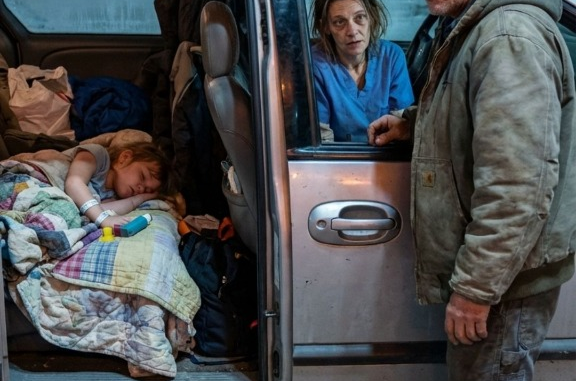
If you thought the hardest part was finding Elena’s little girl asleep in that freezing van, you’d be wrong. The real challenge came afterward.
It came when people who had never smelled that van, never seen that hospital bracelet, never heard a child fight for every breath, decided they knew what was fair.
The drawing was still on my desk—yellow sun, small apartment, warehouse, three figures under light—when regional walked in. My assistant knocked once and let them in.
“Mr. Mercer,” she said carefully. “They’re here.”
A woman in a gray coat and a man with a perfectly clean leather folder entered.
“I’m Valerie Shaw, regional operations,” she said, smiling politely but sharply.
“Ethan Doyle, employee relations,” he added.
Nobody from regional shows up at six-thirty unless someone is bleeding money—or threatening to.
Valerie’s first words cut straight to the point: “Why is Elena back on active status?”
No small talk. No niceties. Just a knife.
“Because I made a mistake,” I said.
She sat without being invited. Ethan remained standing.
“That’s not what I asked,” Valerie said.
I explained carefully: I had reversed her termination after understanding the circumstances.
Ethan leafed through his folder. “The handbook doesn’t allow local managers to reverse terminations once documented.”
“I know,” I said. “And that’s part of the problem.”
They slid a formal complaint across the desk: unfair reinstatement, selective enforcement, unauthorized hardship exceptions, potential discrimination against employees without dependents.
That last line hit hardest.
Valerie said, “A warehouse can’t operate as a private charity based on one manager’s guilt.”
Her words were clean, sharp, designed to make compassion sound unprofessional.
I asked the questions that mattered: Was anyone forced to contribute? Was company money used? Was anyone denied help because they had no children? No, no, and no.
“The point,” she said, “is a manager can’t decide whose hardship counts.”
She was right. I had acted humanely, but that didn’t automatically make me fair.
They left, and I was alone with the drawing. It struck me: being right in one moment doesn’t mean you’re complete. Life isn’t simple correction and applause.
By morning, the warehouse buzzed with whispered fear. Employees noticed every shift in demeanor, every sidelong glance. I checked in with Elena. She was scanning cartons, shoulders tight, aware that her life could be yanked again by titles and folders.
I asked, “You okay?”
A small nod. “My daughter liked the picture I made for you.”
“Tell her I’m keeping it,” I said.
“Am I in trouble?” she whispered.
No. I knew better than to lie.
As the day went on, Valerie and Ethan requested attendance records, histories, and emergency fund documentation. Rumors spread. People stopped talking near me. Staff were divided—some resentful, some cautious.
Rhonda, a long-time worker, confronted me: she had faced crises too, yet no one bent the rules for her. “Was I less worthy because my emergency didn’t come with a little girl in pink blankets?” she asked.
I admitted: “No—but that’s how it feels.”
By lunchtime, I understood the larger truth: rules maintain operations, but rules don’t feed children or save lives. They keep people silent, suffering alone.
I reviewed old terminations: missed starts, custody hearings, bus delays—every one signed by me. Seeing my name on others’ failures was crushing.
Marcy, my assistant, said it bluntly: “They’re going to use Elena as an example. She won’t survive another gap in pay, and you might not survive this week.”
The next morning, I started talking to people individually, asking simply: “What’s going on? What would have helped?”
I learned: a man slept in his truck to see his son; a young picker skipped inhalers for her brother; a woman stayed on time thanks to sacrifices from her teenage daughter. None of it fits in a policy manual.
By mid-morning, Valerie, Ethan, and site director Curtis Bell confronted me: the policy had been violated, and favoritism claims loomed. They wanted Elena terminated properly to restore compliance.
I realized what it meant: if I refused, my job—and possibly others’—was at stake.
On the floor, Wade and Tasha confronted the unfairness openly: who gets grace, who doesn’t? People were fearful, resentful, and suspicious. I told them honestly: “I was wrong before, not that I’m wrong now.”
Elena, alone in the break room, feared reprisal. I reassured her: “They don’t get to fix this by putting you back out in the cold.”
“Why?” she asked.
“Because I still hear myself saying I had to be fair—and I’ve been figuring out what fair really is ever since.”
She blinked back tears and told me: “Rhonda’s mad.”
“Yes,” I said. “And she has a right to be.”
Elena nodded slowly, understanding that fairness is messy, uneven, and painfully human.
Even when cornered, she still found space for someone else’s pain.
Two days before the storm, her daughter’s apartment lost heat for six hours—not long enough for the landlord to care, but enough for a child with fragile lungs to start coughing by bedtime.
Elena called for the first time since I reinstated her—not asking for anything, just letting me know she was at urgent care and didn’t know if her daughter would be admitted or sent home.
I was by the dock printer when the phone rang, Valerie ten feet away. I told Elena, “Stay where you are. Don’t rush.”
Valerie looked at me sharply. “That’s exactly the problem.”
“No,” I said. “This is life.”
She didn’t raise her voice—people in power rarely do. “If you intend to make side judgments, make peace with the consequences.”
“And those are?”
She looked at the gray sky. “Friday’s weather already puts this site at risk. Miss that shipment, and performance numbers won’t save you.”
There are threats, and there are forecasts that sound like threats. This was the second kind. The shipment mattered—respiratory supplies, mobility equipment—heading to clinics across three states. Miss the carrier, and penalties, unsustainable reports, and consequences followed.
That night, I sat in my driveway, engine off. My daughter had once told me the hardest part of modern work was how easily people could sound reasonable while demanding cruelty. I understood that now.
Fire Elena again and “restore consistency.” Audit names of those who asked for help. Prove I could still be a serious manager by becoming the man I was trying not to be.
Inside, the house held its quiet—the kind widowers live in. I made a sandwich I didn’t want, watched the weather report: hard freeze, snow bands, road danger before dawn. I glanced at a photo of my wife laughing in a red scarf. She would have asked not about rules or who deserved help, but about the people at the bottom when the storm hits and the top still expects results.
The next morning, before five, I acted.
-
I told Marcy to open the training room, set up tables, bring blankets, and start coffee early.
-
I called my sister at the pantry about portable soup kettles from the winter coat drive.
-
I texted every supervisor: if you’ll be late for any reason—storm, childcare, medical—call us. No one gets written up today without my say-so.
Three minutes later, Curtis called. “What are you doing?”
“Trying to make sure people get here alive.”
“You don’t have that authority.”
“Watch me.” He hung up.
By six-fifteen, the first conflict arrived. June from returns glared at the training room full of blankets and juice boxes. “This is a job, not a shelter.”
I kept stacking water. “Today it’s both.”
Behind her, Benny arrived carrying his six-year-old. School delayed. Ex-wife on night shift. I took the boy from him; the child wrapped his legs around me and breathed as though it were normal. June saw it, her expression shifting, then looking away.
By seven, the training room held three kids, a grandmother, and a crockpot simmering with pride and canned tomatoes.
By seven-thirty, Curtis, Valerie, and Ethan confronted me. Liability. Unapproved use of space. I answered calmly: “I understand the weather.”
“Life is forcing it. I’m refusing to pretend otherwise,” I said.
Outbound volume was heavy. Workers stranded. Elena had not arrived. Valerie warned of consequences. I agreed, unapologetic.
At eight-ten, Rhonda came. Dialysis for her husband, tight schedule. “I’m not asking for pity,” she said. I scheduled coverage and rides. She stared, stunned, then said, “You should’ve asked years ago.”
Small acts followed. Tasha covered a lane. Wade helped a stranded worker. June returned with clementines. No fanfare, just people stepping into each other’s realities.
Around one-thirty, Elena arrived—damp hair, hospital paperwork, exhaustion etched on her face. I met her near the time clock. “I know I’m late.”
“Your daughter?”
“Breathing treatment. They let us go.”
Her voice broke. The building listened. Policy demanded punishment—late is late, example must be made. I swiped her badge myself.
“You’re here now,” I said. Silence—just the weight of ordinary work. Valerie stepped forward. I turned. “If anyone has a problem, bring it to my office. Nobody is being punished today for keeping their child alive.”
No speeches. No applause. Just work.
Snow worsened, roads slowed, pressure mounted. Valerie came down: “Cut nonessential labor and lock the attendance list.”
I looked at the training room—sleeping kids, a grandmother, homework, blankets. “Everybody here is essential.”
She didn’t argue. “You’re confusing sentiment with operations.”
“No. You’re confusing operations with people who don’t count until the pallet tips.”
I huddled the shift at six—five minutes, cold air, wrecked faces. I stood on a crate.
“Regional thinks I’ve lost my mind,” I said. “Tonight matters. Shipment matters. Your families matter. No package matters more than a human being trying to survive this week.”
Wade asked: “What if we miss the cut?”
“Then we miss it.”
Permission to work like humans, not clock parts, changed everything. Hours blurred: snow, boots, shrink wrap, playlists, exhaustion, care. Elena worked efficiently, no longer proving anything, just part of the solution. June peeled oranges. Rhonda returned from dialysis. Tasha covered. Wade barked pallet numbers.
At 2:40 a.m., power flickered. Elena looked at the training room. A child lifted his head. June said yes—the lights were playing a game.
By 4:15 a.m., the final truck was sealed. Ordinary metal on metal. I nearly cried—not for success, but for completing it without cruelty.
Valerie approached. “You made the shipment.”
“We did.”
She looked at blankets, kids, Marcy, Rhonda, Wade, Elena. “This does not make it acceptable,” she said.
“Maybe what’s unacceptable is that it took a storm for anyone above this floor to see how people live,” I replied.
She said, “Millions live hard lives. A workplace cannot absorb all that.”
“No,” I said. “But it can stop pretending those lives end at the time clock.”
The next morning, first shift gone, kids picked up, the training room restored, I got the notice: 10 a.m., Conference Room B. Leadership review. Regional finance, legal, and operations strategy joined—nobody from the floor invited.
Of course not.
The people most affected are rarely considered relevant until after damage is done.
Valerie gave the summary: unauthorized reinstatement, procedural deviations, misuse of space, potential privacy issues, missed chain of command, refusal to follow orders.
She could have just said: You stopped acting like one of us.
Then came the question that revealed everything:
“Has site productivity improved enough to offset manager judgment concerns?”
Not: Did anyone get home safely? Did turnover slow because people felt human? Did Elena stabilize enough to care for her child?
Just: offset.
Curtis pointed out we retained the shipment. Valerie clarified: under conditions that couldn’t be normalized. I almost respected her consistency.
Finance asked for a recommendation. Valerie said: “Leadership change, plus review of attendance policy and supervisory authority.”
Clean. Tidy. My career boiled down to one calm sentence. Administrative leave notice slid across the table: my name, my building, the same formal language I’d used on others. Only now I felt it in my chest.
Then the knock. Marcy entered, pale, holding papers. Behind her: Rhonda, Wade, June, Tasha, Benny, and finally Elena.
For a moment, silence. Valerie objected. Marcy placed the papers on the table: “What’s not appropriate is judging this week without the people who lived it.”
Ethan tried to argue. Wade interrupted: “Want policy? Fine. Here’s reality.” He listed ride shares, coverage swaps, call-outs prevented, risks reduced. Numbers with context.
Rhonda spoke next. She admitted her anger wasn’t about Elena—it was about no one being asked sooner. Silence.
June admitted she still valued rules, but peeled oranges for kids while critical work continued in a storm, and the building would have failed without that flexibility. “Rules matter. They just aren’t holy.”
Tasha, skeptical at first, said grace shouldn’t be just for parents. It was about anyone finally being seen. “Build a system. Don’t kill the first decent thing because it started messy.”
Elena stayed still. She didn’t want to be a symbol—just to survive and care for her daughter.
Ethan cited policy risk. Marcy countered with performance metrics: turnover down, overtime acceptance up, scan errors down, retained a trained employee. Wade offered operational examples, Rhonda human ones.
Elena spoke softly: “I don’t want anyone fired for me. He helped me because he saw me, not because I’m special. If he’s punished, what does that say to everyone else?”
The room shifted. Truth over policy. Systems that stay neat leave lives unseen—this week had changed that.
Strategy asked what employees were requesting. Wade, Rhonda, Tasha, June, and Marcy outlined a practical hardship system: emergency fund, rotating review committee, temporary attendance flexibility, transportation and childcare support, short-term stabilization—not public or punitive.
Valerie questioned if it was prepared. I hadn’t prepared it—the floor had. They knew the gap between policy and survival because they lived it.
Finance asked about cost: modest, barely covering an executive dinner. Legal questions followed; Marcy and the team answered them. The strongest force in the room wasn’t my defiance—it was the workforce itself.
After twenty tense minutes, leadership paused the transition. A ninety-day pilot could proceed with oversight, restrictions on individual financial discretion, and formal review of the hardship system. Not a victory, not redemption—but not a funeral either.
Some argued rules exist for a reason; others said no one should almost lose everything before being treated humanely. Both truths coexist. Fairness isn’t competing suffering—it’s rules with eyes and ears, rules that recognize emergencies before someone has to live them in full view.
I still run the warehouse. I care about productivity. I still get impatient. I still believe some will game the system—but better systems matter anyway. The lesson: workplaces should not be so cold that honest people stop speaking.
Last winter, Wade posted a simple sign under the attendance board:
Before you write someone up, ask what’s going on.
No logo. No slogan. Just the principle.
I stood there as workers began clocking in: wet boots, tired faces, lives still messy. And for the first time, the building didn’t demand they leave all of that outside before stepping in.
Leave a Reply