My Mother Gave Me Two Days to Leave the House I Owned — Then the Police Examined Her “Proof”
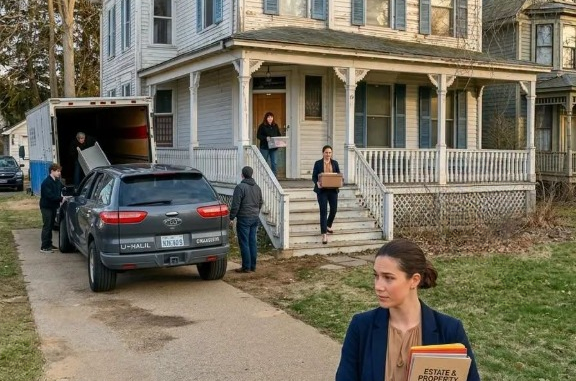
At exactly 9:14 on a Sunday morning, my sister Stephanie stepped out of a moving truck holding a set of keys and wearing the confident expression of someone who already believed the house belonged to her.
My mother, Diane, arrived right behind her in her SUV. Two movers stood by the truck, waiting for instructions so they could begin carrying furniture into the three-bedroom colonial home my grandmother had left to me.
Stephanie walked up the front steps, inserted her key into the lock, and immediately frowned when it didn’t turn.
She tried again.
Harder.
Meanwhile, Mom started pointing toward the upstairs windows, already deciding which rooms would belong to whom.
Then a police cruiser slowly pulled up to the curb.
No sirens.
No flashing lights.
But the moment both women saw it, they stopped.
What they didn’t know was that I had been inside the house since early morning, quietly watching everything through the blinds with a folder of certified legal documents sitting beside me.
When I finally opened the front door and stepped onto the porch, Stephanie’s expression changed.
That was when she realized something important.
I wasn’t moving out.
There were no packed boxes.
No furniture waiting outside.
Because I had no intention of leaving my own home.
The white colonial house with blue shutters had belonged to my grandmother, Elaine Harper.
She wasn’t just my grandmother—she was the person who truly raised me. She taught me lessons I carried throughout my life: how to manage money, how to carefully read contracts, and how to stay calm when people tried to pressure me into giving in.
After she passed away, her attorney revealed her final wishes.
The house was left entirely to me.
There was no shared ownership.
No temporary agreement.
No promise that my younger sister would eventually receive it.
The probate process was completed eight months later, and the official deed listed only my name.
The property was worth around $485,000.
Since inheriting it, I had personally covered the taxes, utilities, repairs, and nearly $6,200 every year in insurance costs.
But Stephanie had always viewed the word “mine” as something that could be challenged.
Throughout our lives, my parents often adjusted decisions to keep her satisfied, even when it came at my expense.
Then, that Wednesday, my mother called me while I was leaving Boston Housing Court.
Her words shocked me.
She told me I had 48 hours to remove my belongings because the house now belonged to Stephanie.
I didn’t argue.
I didn’t scream.
I simply said, “Okay.”
But behind the scenes, I spent the next two days preparing.
I gathered the deed.
The will.
The probate documents.
Tax records.
Insurance payments.
Security footage.
And every message proving they had planned this without my knowledge.
When the officer asked who legally owned the property, I handed him my folder.
I didn’t argue with my mother.
I didn’t confront Stephanie.
I simply let the documents speak.
The officer reviewed the recorded deed and probate records before looking at Stephanie.
He asked why she had arrived with movers when no transfer appeared in county records.
That was when Stephanie pulled out a folded document from her bag.
She claimed my grandmother had signed the house over to her before she died.
Mom stood behind her with her arms crossed, looking completely confident—as if being certain was enough to make something true.
My father stood silently near the SUV, staring at the ground.
The officer opened the paper.
He compared it with my certified documents.
Then he looked carefully at the notary information.
After several quiet moments, he turned toward my mother.
“Why does this document show Elaine signed this three weeks after she passed away?”
The entire driveway went silent.
The officer explained that the date could not simply be called a mistake, especially because the notary commission listed on the document had already expired.
Stephanie immediately looked at my mother.
She said she had been told everything was already “taken care of.”
Mom insisted that Grandma had wanted things to be divided fairly.
But the evidence said otherwise.
My attorney later confirmed that Elaine had completed a competency evaluation before signing her will, and the court had accepted everything without challenge.
The legitimate deed, probate filings, insurance records, and ownership history all confirmed the same thing:
The house legally belonged to me.
The document Stephanie brought had never been recorded and had no legal power.
I also showed the officer messages where they discussed paint choices, room arrangements, and moving plans—all without asking me or receiving permission.
This was not a simple family disagreement.
Someone had attempted to take control of my property.
When the officer asked whether I wanted the questionable document and attempted entry investigated, I said yes.
He explained to my family that any claim they believed they had would need to go through the proper legal process.
A moving truck and confidence were not enough.
The movers left first.
Then my father drove away.
My mother and Stephanie eventually followed, both too shocked to continue arguing.
After everything was documented, my grandmother’s longtime neighbor, Mrs. Delaney, walked across the yard carrying a warm pan of lasagna.
She hugged me and said Elaine would have been proud.
I locked the front door, placed the legal documents safely away, and slowly walked through the rooms my sister had already imagined as hers.
Above the fireplace was a picture of Grandma and me covered in blue paint from the summer we restored the shutters together.
Looking at it, I realized something.
For years, my family had mistaken my quiet personality for weakness.
They thought because I avoided conflict, I would eventually surrender.
But they were wrong.
That house wasn’t just an inheritance.
It was a promise my grandmother had carefully protected.
And defending it wasn’t creating drama.
It was standing up for myself.
It was refusing to let anyone erase me from my own life.
Leave a Reply