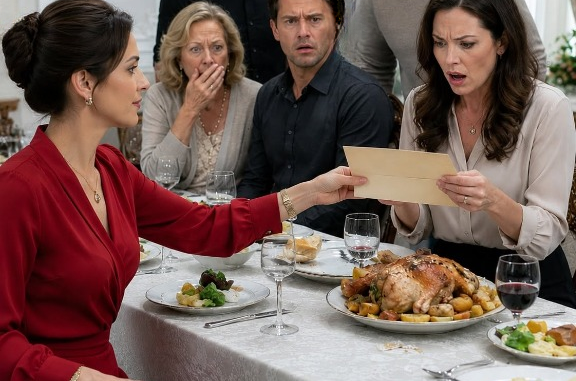
At Sunday dinner, my sister-in-law Vanessa waited until everyone had finished being served before turning her attention to me.
“Claire, you’re forty-two,” she said with a smile. “You need to accept that motherhood may not happen for you.”
The room instantly became uncomfortable. My husband Michael lowered his fork, but Vanessa wasn’t finished.
“Don’t worry, Margaret,” she told my mother-in-law. “I’ll give you the grandchildren this family deserves.”
She laughed as if she had made a harmless joke. My brother-in-law Aaron looked uneasy but said nothing. Margaret gave me the same sympathetic look she had shown me after my miscarriages, failed fertility treatments, and years of painful questions.
I didn’t argue.
Instead, I reached into my purse and placed a cream-colored envelope on the table.
Vanessa grabbed it before Margaret could touch it.
“What is this?” she asked. “Another medical bill?”
“Open it,” I replied.
The confidence disappeared from her face as soon as she read the first page.
Inside was a certified adoption decree from the Cook County courthouse. Three weeks earlier, Michael and I had officially adopted seven-year-old Lily Carter after fostering her for fourteen months.
We had kept the adoption private because Lily had already experienced loss and instability. She didn’t need to become the center of a family announcement or have relatives treating her arrival like a victory statement.
Margaret covered her mouth in shock. Michael reached over and held my hand.
Then Vanessa looked at the second document.
Her expression changed completely.
William Cole, Michael’s late father, had created a family trust designed to support every legal grandchild’s education and medical needs. The trust recognized biological children, adopted children, and legally placed foster children equally.
Once Lily became our daughter, the trust company sent us a full financial review.
That report revealed that $386,000 had been taken from the trust over the past eighteen months under the label of “future grandchild expenses.”
The money had been transferred to a business owned by Vanessa.
She immediately looked at Aaron.
“You said nobody could access those records,” she said.
Margaret slowly pushed her chair back.
“What records?”
I placed my phone beside the envelope.
Our trust attorney, Daniel Price, was on speaker.
“Mrs. Cole,” he said, “the bank stopped another transfer today. We need answers regarding the falsified medical invoices and construction expenses.”
Vanessa stood so quickly that her wineglass fell and shattered across the table.
“They were just advances,” she argued. “The money would have gone to my children eventually.”
“You don’t have children,” Michael said.
“That’s not the point.”
“It is exactly the point,” Daniel replied.
Aaron stared at his wife.
“You told me your father paid for the renovation.”
Vanessa looked between the documents, Margaret, and me.
“You planned this,” she whispered.
“No,” I said calmly. “I became a mother. The truth came with the paperwork.”
Then the doorbell rang.
Daniel spoke again through the phone.
“That will be the bank investigator. Please make sure Mrs. Cole does not leave with those documents.”
The bank investigator didn’t arrest Vanessa that night. He photographed the evidence, collected the paperwork, and instructed everyone to remain available for questioning.
Vanessa refused to speak without an attorney.
Aaron followed her into the hallway, demanding to know why his name appeared on the trust documents and what company she had created.
The company was called Bright Beginning Interiors. Vanessa had started it eighteen months earlier, shortly after William Cole passed away.
She knew exactly what the trust allowed.
She knew adopted children counted.
She also knew Margaret was temporarily managing the trust.
After William’s death, Vanessa began telling Margaret that she and Aaron were preparing for a baby. She claimed they needed fertility treatments, special insurance, and expensive home renovations before welcoming a child.
At first, Margaret approved smaller requests because she trusted her.
But the demands grew larger.
Vanessa submitted fake medical paperwork, false contractor invoices, and documents supposedly signed by doctors.
Every one of them was fabricated.
The next morning, Daniel explained everything to Michael and me. Lily’s adoption had triggered a required beneficiary review, which meant the trust company sent us financial records that Vanessa assumed no one would ever see.
She believed that without a legal grandchild, there would be no reason for anyone to examine the withdrawals.
She was wrong.
Investigators discovered that much of the money had gone toward paying Vanessa’s personal debts, leasing a luxury SUV, and renovating a lakefront condominium she secretly owned with a friend.
Bright Beginning Interiors was nothing more than a fake company.
Aaron admitted he had signed some early documents but claimed Vanessa told him they were related to fertility planning. His signature also appeared on later requests, though he denied approving them.
That detail mattered.
If Vanessa had copied his signature, she could face additional charges.
Margaret called us while we were still meeting with Daniel. She was crying and blaming herself.
She admitted she rarely questioned Vanessa’s requests because Vanessa always accused her of choosing Claire over her.
“If I asked questions, she said I didn’t believe she deserved children,” Margaret said.
“That was the strategy,” I told her. “She made responsibility look like cruelty.”
Lily knew nothing about what happened.
She had stayed with my friend during dinner because Michael and I wanted her first meeting with our relatives to be a happy memory, not a night filled with accusations and investigations.
After the confrontation, we postponed introducing her to the extended family.
Lily had already lost enough.
I would not allow her to believe her place in our family came from exposing someone else’s wrongdoing.
But Vanessa made things worse.
By the next day, she had posted online claiming Michael and I adopted Lily only to gain access to the family trust.
She even revealed Lily’s first name, age, and former school district.
Daniel immediately secured a court order requiring Vanessa to remove the information and preventing her from contacting Lily or speaking publicly about her.
Aaron moved out that same night.
When investigators searched Vanessa’s office, they found fake medical forms, copied signatures, and spreadsheets showing future withdrawals she planned to make.
One planned request was for $240,000 to buy a “special-needs accessible home.”
The address belonged to the same lake condo she already owned.
At the bottom of the spreadsheet was a note Vanessa had written:
“No beneficiary means no audit. Keep Claire discouraged.”
Michael read the sentence over and over.
For years, Vanessa hadn’t just mocked my age or my struggles with fertility.
She needed me to believe motherhood was impossible because a child entering our family would reveal everything she had done.
The investigation lasted eleven months.
The trust company froze the questionable transactions and appointed an independent manager. Accountants traced the stolen $386,000 and uncovered another $240,000 Vanessa had attempted to withdraw.
The fake documents included copied doctor signatures, false tax numbers, and unauthorized electronic approvals.
Aaron was not criminally charged, but investigators determined he had ignored warning signs. He benefited from the renovations, vacations, and expensive purchases without questioning where the money came from.
Vanessa eventually pleaded guilty to forgery, fraud, and theft from the trust.
Because she had no previous criminal record and repaid much of the money by selling the condo and SUV, she avoided a long prison sentence. She received six months in county custody, probation, community service, and full repayment requirements.
She was permanently banned from managing anyone else’s finances.
During sentencing, Vanessa’s attorney argued that she had only been preparing for motherhood.
The judge looked at the evidence and replied:
“Preparing for a child does not require stealing from one who already exists.”
Vanessa never looked at me.
Margaret was not charged, but the court removed her as trustee because she failed to properly oversee the account. She had to cover the legal costs caused by her negligence.
The hardest part for her was realizing she had allowed the dream of biological grandchildren to cloud her judgment.
For months, Margaret asked to meet Lily.
Michael and I waited until our therapist believed the relationship could begin safely. Lily was not a symbol in a family argument. She was our daughter.
When Margaret finally visited our home, Lily was building a cardboard castle in the living room.
Margaret sat beside her and asked permission before helping.
She never mentioned the trust, biology, or grandchildren.
Before leaving, she gave Michael a letter apologizing for every time she treated having children like a competition.
Eventually, we explained a simplified version of what happened to Lily. We told her that someone had taken money meant to help children and that adults worked together to fix it.
We never told her that becoming our daughter exposed the fraud.
A child should never feel responsible for a family falling apart.
Aaron divorced Vanessa after her conviction. He moved into a smaller apartment, repaid the money connected to the documents he knowingly signed, and asked to remain part of Lily’s life as her uncle.
We allowed short visits, but trust had to be rebuilt slowly.
Vanessa wrote to me once during probation.
She said seeing the adoption papers made her feel like everything she believed she deserved had been taken away. She had built her entire identity around being the woman who gave Margaret grandchildren.
When Lily became part of the family first, Vanessa felt replaced.
I wrote back only one sentence:
Children are people, not positions in a family.
The recovered trust money remained protected under independent supervision.
Michael and I only used approved funds for Lily’s medical needs, therapy, and education. We paid our everyday expenses ourselves because we wanted her to know she was loved—not valued because of money.
Two years after that dinner, we celebrated Lily’s tenth birthday in our backyard.
Margaret brought a handmade scrapbook. Aaron brought a telescope.
No one asked when Michael and I planned to have a biological child. No one treated Lily’s adoption as something that needed explaining.
After everyone left, Lily asked why I kept the old cream envelope in my desk.
I told her it contained the document that officially confirmed what we already knew.
“What did you already know?” she asked.
“That you were our daughter.”
She smiled and returned to her birthday cake.
That night, Vanessa thought the envelope would prove I had failed at becoming a mother.
Instead, it revealed the truth.
I was already a mother.
And the child she dismissed without ever meeting was the person who brought the truth into the light.
Leave a Reply