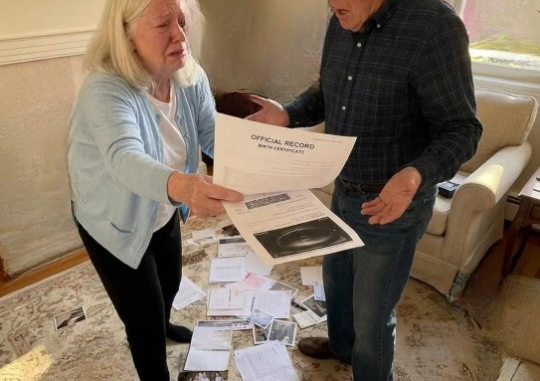
The coffee mugs were still warm in my hands when my daughter told me I had thirty days to leave the home I had built my entire life around. Frost covered the porch outside, and the kitchen still carried the scent of the breakfast I had prepared that morning. Hannah stood by the doorway with her coat zipped up and her phone held tightly in her hand, refusing to meet my gaze. She told me that she and her husband, Marcus, had already arranged a place for me at an assisted living facility. Then she casually announced that they intended to sell my farmhouse and the eighty acres surrounding it once spring arrived.
I looked over at the towel my late wife, Ruth, had placed on the oven handle years ago and felt the weight of everything I had lost.
“It’s already been decided, Dad,” Hannah said, as if the forty-one years I had spent building a life there meant nothing.
My name is Walter Bram. I was sixty-eight years old, a widower, and still fully capable of caring for the farm Ruth and I purchased back in 1983. What had once been a simple piece of rural property for a young couple had become incredibly valuable over the years. With new housing developments expanding nearby, the farm was now worth almost $2.4 million.
Marcus worked in commercial real estate and had spent eleven years looking at my land like it was just another business opportunity waiting to be sold. Before Ruth passed away from cancer, she made me promise something important: never give up the farm just because I felt alone or because someone pressured me.
Four months after her death, I met with attorney Delia Osei and placed the property into an irrevocable trust. The agreement meant that no one could sell, transfer, or borrow against the land without my approval.
I never told Hannah or Marcus about the trust.
I wanted to see how far they were willing to go.
Within days, a developer was walking through my fields with a tablet in hand. Shortly afterward, the assisted living facility contacted me about a move-in date I had never agreed to. Then Hannah showed up with Marcus and a doctor named Prewitt, who began asking me questions about the date, current events, and simple memory tests.
I answered every question correctly.
Still, I noticed the disappointment on my daughter’s face.
Marcus claimed the evaluation was meant to “protect everyone,” but I understood exactly what was happening. They were trying to create evidence suggesting I was no longer capable of making decisions about my own property.
The next morning, I went straight to Delia.
Together, we prepared a meeting they would never forget.
Three weeks later, Hannah, Marcus, Dr. Prewitt, and Delia sat around my kitchen table believing I had finally accepted their plan. They thought I was ready to move out and surrender everything.
Instead, I calmly told them there would be no assisted living arrangement, no property listing, and no sale.
Delia introduced herself as my attorney and explained that the trust protected the farm, the property rights, the financial assets connected to it, and my entire estate from anyone attempting to take control without my permission. She also warned that any effort to falsely question my mental ability or pressure me into giving up my assets could be viewed as financial exploitation.
Marcus immediately turned on Hannah.
Hannah told him to stop.
Dr. Prewitt confirmed that I was completely competent and left the house clearly uncomfortable with the situation.
Their entire plan fell apart the moment they realized the farm had never been theirs to claim.
Marcus walked away that night and never came back.
Hannah cried, but I didn’t immediately forgive everything. A lifetime of love does not erase the pain caused by betrayal. I told her I forgave her, but forgiveness did not mean trust returned overnight, and it did not mean she was automatically entitled to inherit what she had tried to take.
A year later, Hannah divorced Marcus, and slowly, carefully, we began rebuilding our relationship through quiet Sunday visits and honest conversations.
The farm remains protected under a conservation agreement, ensuring that Ruth’s land will never become another crowded subdivision.
They believed my silence meant weakness.
They were wrong.
My silence was patience—the same patience every farmer learns while waiting for the right season.
Leave a Reply