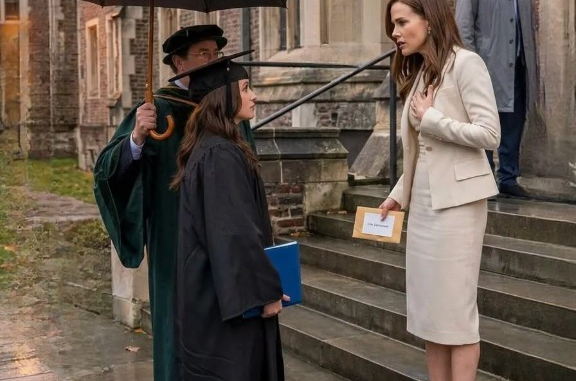
The evening before my medical school graduation, I returned home after a grueling twenty-hour hospital shift carrying the single VIP invitation I had received for the ceremony. My legs ached, my scrubs carried the familiar scent of disinfectant and coffee, and all I wanted was to invite my father to watch me receive my degree. Instead, he removed the elegant invitation from its envelope, barely looked at it, and immediately handed it to my stepsister, Haley. She excitedly talked about recording videos from the front row while my stepmother reminded me that the kitchen still needed cleaning. When I objected, my father dismissed me, insisting I was “just a hospital assistant” and claiming no one would notice whether I attended at all. The next morning, he even blocked me from entering through the main doors, saying my rain-soaked graduation gown would ruin Haley’s photos. As they disappeared into the auditorium carrying my invitation, someone stepped beside me with an umbrella. It was Dean Jonathan Bradley, who smiled and said, “Dr. Hensley, everyone is waiting for you.”
For four years, my family had watched me leave for overnight rotations, carry stacks of medical textbooks, and spend countless hours studying, yet none of them ever showed genuine interest in what I was doing. When I first told my father I had been accepted into medical school, he brushed it aside, assuming it was merely another hospital training program before quickly changing the conversation to Haley’s modeling ambitions. Every month I contributed hundreds of dollars toward household bills, handled chores after exhausting shifts, and quietly completed advanced pediatric heart research while my stepmother treated me more like unpaid help than family. Meanwhile, Haley enjoyed designer clothes, professional photo shoots, and generous financial support because my father believed her social media career would eventually elevate the family’s reputation.
Behind the scenes, I had been working alongside Dr. Lena Morris to develop an early-warning system for infants recovering from heart surgery, research that was already being introduced in several hospitals. The university had selected me as valedictorian, keynote speaker, and recipient of the prestigious Bradford Research Medal—achievements my father never knew about because he had never taken the time to listen. Even the VIP invitation clearly identified it as reserved for the family of Dr. Clara Hensley, but he assumed Haley deserved that seat more than I did. As Dean Bradley escorted me through the faculty entrance, my father, stepmother, and stepsister sat proudly in the front row, completely unaware that the ceremony centered on me.
Before the graduation proceedings officially began, Dean Bradley invited the family of the valedictorian and Bradford Medal recipient to stand. My father remained seated until another guest pointed toward the reserved name card in front of him and quietly mentioned that the printed name matched mine. Haley slowly lowered her phone, my stepmother’s confident smile disappeared, and my father reluctantly stood as hundreds of people turned to look in their direction.
Moments later, the curtains opened, and I walked onto the stage to a standing ovation from professors, physicians, classmates, and university trustees. Rather than reading the speech I had prepared, I spoke from the heart about what it feels like to be overlooked, to return home after demanding hospital shifts without anyone asking how the day had gone, and to spend years seeking acknowledgment from people determined not to see your accomplishments. I never identified my family directly, but every sentence reached the three people sitting with the invitation they had taken from me. When I said that family isn’t always the person holding your ticket, but sometimes the one who quietly offers shelter when everyone else walks away, the audience stood and applauded once again. Haley’s livestream continued broadcasting as my father’s expression turned pale.
Then Dean Bradley returned to the microphone with one final announcement.
He explained that my research had helped create a new monitoring protocol for a rare complication following infant heart surgery and revealed that the university would fund its expansion across five hospitals. He formally presented me with the Bradford Research Medal, confirmed my residency at St. Catherine’s Medical Center, and surprised everyone by naming me the first Bradley Clinical Research Fellow.
After the ceremony, my father asked why I had supposedly never shared any of this with him. Every explanation he offered only reminded him that I had told him many times before—he simply hadn’t paid attention. My stepmother accused me of humiliating the family in public, while Haley attempted to hand back the VIP invitation after online viewers began criticizing her livestream.
I calmly explained that I had already rented an apartment near the hospital, stopped sending the monthly payments that had helped cover their mortgage and insurance, and arranged to move out the following day. There was no legal dispute over money because everything I had earned—from my salary to my research awards—belonged solely to me, and my attorney had already reviewed every financial detail before my move.
My father’s sudden pride meant very little because it only appeared after respected physicians, university leaders, and donors had recognized my achievements. When he grabbed my arm and insisted I return home, Dean Bradley stepped between us, asked whether everything was all right, and deliberately addressed me as “Doctor” until my father quietly let go.
The next afternoon, I packed my medical textbooks, research notes, and one treasured photograph of my late mother, who had once given me a toy stethoscope and told me that hard work could make any dream possible. Residency proved exhausting, my apartment was small, and the old radiator rattled through the night, but every corner of that space represented independence.
Over time, my father continued writing letters. At first, they were filled with excuses. Later, they became sincere questions about my patients, my research, and life as a physician. I responded only when I felt ready.
Two years later, I returned to my university as a guest speaker. Sitting quietly in the back row was my father, holding a ticket he had purchased himself. He didn’t seek special treatment or mention our relationship. He simply stood and applauded when I walked onto the stage.
After the event, I agreed to share a cup of coffee with him—not because the past had disappeared, but because he had finally begun accepting responsibility without expecting immediate forgiveness.
For years, I believed the greatest moment of my life would be the day my father recognized my worth. Instead, that moment came much earlier—when I walked through those auditorium doors and realized that someone else’s inability to see my value had never diminished who I truly was.
Leave a Reply