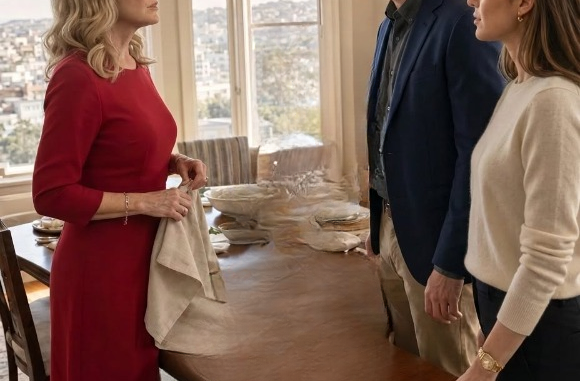
The House He Thought Belonged to Him
My son looked straight at me from across the dining table and said, “Sometimes I wish I could have chosen a different mother.”
For a moment, the only sounds filling my Pacific Heights home were the ticking of the old brass clock above the shelves and the faint movement of fog against the windows. The dinner I had spent hours preparing sat untouched between us. The roast chicken had gone cold, the rosemary potatoes had lost their warmth, and the salad leaves had begun to wilt.
Three places were set with linen napkins, my late husband Richard’s silverware, and the crystal glasses I still washed carefully by hand because he always believed some things deserved to be treated with respect.
Brandon did not look away after saying those words.
That was what hurt the most.
He was not an angry teenager saying something cruel in the heat of the moment. He was a grown man in his early thirties, sitting inside the house where I had raised him, calmly waiting for me to give him what he wanted.
Beside him, Jessica gave a small, knowing smile.
It was not obvious enough for anyone else to notice, but I saw it. She looked down at her phone, tapped the screen with perfectly manicured fingers, then glanced back at me as if she was waiting to see whether I would break.
For a second, I almost did.
But losing Richard had changed me. Grief teaches you how to survive moments that should destroy you. You can feel your heart breaking while your hands still fold a napkin neatly. You can hear words that change everything and still lift a glass without spilling a drop.
I placed my napkin beside my plate.
Near Brandon’s hand sat a thick cream-colored envelope with my attorney’s office information printed in the corner. Inside were the documents he had brought, claiming they were meant to “simplify the estate.”
He had repeated that phrase all evening.
First in the entryway while Jessica removed her coat.
Then again in the kitchen while I prepared dinner and he admired the renovations his father had completed years earlier.
Simplifying the estate.
That was the polite version.
What he really wanted was my signature transferring ownership of my home.
The Pacific Heights house was the greatest achievement Richard and I had ever built together. Not because it was large or impressive, but because we remembered how impossible it once seemed.
When we bought it, the wiring was outdated, the porch needed repairs, and one upstairs window refused to open. Richard used to joke that the window had more stubbornness than half the executives he worked with.
Over the years, we restored everything.
We planted hydrangeas along the walkway. We marked Brandon’s height on the pantry door every birthday until he became embarrassed by it. We hosted holidays, celebrations, charity events, and family dinners beneath that roof.
That house carried our entire history.
And Richard had made sure it stayed mine.
Not Brandon’s.
Not part of a business plan.
Mine.
Brandon knew that.
He also knew I had spent most of his life giving him whatever support he needed.
“Mom,” he said, lowering his voice as if he were the calm, reasonable one, “you’re acting like I’m trying to steal something from you.”
I looked at the envelope.
“Aren’t you?”
Jessica leaned back slightly.
“Linda, nobody is trying to take anything,” she said. “We’re talking about making smart decisions. This house is an asset that isn’t being used properly.”
Unused.
That word bothered me more than I expected.
Because I could still see Richard sitting in his study on Sunday mornings with his coffee and newspaper. I could still picture Brandon as a little boy building forts in the living room. I could still remember standing in the kitchen after Richard’s funeral, unable to remember why I had opened a cabinet.
“This is my home,” I said quietly.
Brandon sighed.
“And it could become something bigger. Do you understand what this opportunity means? The San Jose project could completely change my company. Investors want security. They want proof that I have real assets behind me.”
“You already receive money from your father’s trust.”
“That’s not enough.”
“It was enough to build your company without debt.”
His expression hardened.
Jessica looked down, but I noticed the slight satisfaction in her face.
Brandon pushed the envelope toward me.
“Dad would have understood.”
There it was.
The argument hidden beneath everything else.
For nearly four decades, Richard had been my partner in every decision. He was patient, thoughtful, and honest. He loved Brandon deeply, but he also understood him better than I sometimes wanted to admit.
When Brandon’s first business failed, Richard told us not to immediately rescue him.
I ignored him.
I paid his debts quietly.
When Brandon wanted his first apartment, Richard suggested he save longer.
I helped with the deposit.
Every time Brandon struggled, I stepped in before he had to face the consequences.
I called it love.
Richard called it protecting him from becoming independent.
“He would have wanted you to stand on your own,” I said.
Brandon’s face changed.
“That’s easy for you to say. You’re sitting on everything he created.”
The clock continued ticking.
Jessica’s phone lit up beside her plate. Before she turned it over, I saw the message preview.
Did she sign yet?
I saw it.
Jessica knew I saw it.
For the first time that evening, her confidence disappeared.
I looked back at my son and understood the truth.
This dinner had never been a conversation.
It was a transaction.
They had arrived expecting my signature the same way someone expects a service to be completed.
“You’ve always controlled everything,” Brandon said. “Jessica’s family believes in ambition. They don’t hold onto things just because of memories.”
I almost smiled.
I was sixty-one years old. I served on nonprofit boards, managed family investments, reviewed foundation grants, and knew every detail of the accounts Richard left behind.
But because I valued responsibility over appearances, they mistook patience for weakness.
I stood.
Brandon looked surprised.
I collected the plates quietly and carried them into the kitchen.
The sound of silverware against china filled the silence.
Once I was alone, my hands began to tremble.
Only slightly.
Not enough for them to notice.
I rinsed the dishes slowly while listening to their whispered conversation in the dining room.
Jessica spoke first.
Brandon answered.
A chair moved.
When I returned, the envelope was still waiting.
Brandon stood with his coat in hand.
“We’ll give you a few days,” he said.
“No.”
He looked confused.
“No?”
“I will not sign over this house. Not tonight. Not tomorrow. Not ever.”
Jessica’s smile disappeared.
Brandon laughed bitterly.
“So that’s it?”
“Yes.”
“You’re choosing a house over your own son?”
I looked around the room Richard and I had created together.
The photographs.
The piano.
The memories.
“No,” I said.
“I’m choosing to stop confusing love with giving in.”
For a moment, Brandon looked at me like he did not recognize me.
Then he left.
The front door slammed behind him.
The sound echoed through the house before fading into silence.
And for the first time in years, I allowed him to walk away without chasing him.
Leave a Reply