The man in the neatly pressed shirt placed a fifteen-page contract on my kitchen table and pointed to a marked signature line with his pencil.
His name was Sturgis, a cattle rancher whose property bordered mine on the eastern edge. Over the years, his operation had expanded by taking over three smaller ranches nearby. Sitting beside him was county official Harold Pruett, who claimed the paperwork was nothing more than a routine update to the valley’s water records.
But Sturgis wasn’t watching the documents.
He was watching me.
He wanted to know whether I would sign without asking questions.
When I told them I intended to read every page carefully, Pruett sighed and reminded me that calving season was already underway. Sturgis leaned back in my father’s old chair and casually remarked that a 66-year-old man managing a ranch alone should appreciate someone helping him keep everything legal.
That was when I stood up, opened the door, and told them both to leave.
By the end of the night, I understood exactly why they had been so desperate to get my signature.
My name is Wallace Red Hawk, and my family’s connection to that creek goes back more than a century.
In 1912, my grandfather established our original water claim after digging the first irrigation channel through frozen soil with nothing but a shovel and a mule. That claim gave our ranch one of the oldest water priorities in the entire region.
My father, Joseph, protected the land through endless hardships—droughts, floods, financial struggles, and years when mortgage warnings arrived almost monthly.
When the ranch eventually became mine, it supported a cattle herd worth nearly a quarter of a million dollars and required significant yearly expenses to keep running. But without reliable water, none of it mattered. The cattle, the fields, and the land itself depended on that creek.
Sturgis knew exactly what our water rights were worth.
He didn’t want my home.
He didn’t want my barns or my pasture.
He wanted the date attached to my grandfather’s claim.
A 1912 priority meant my family had the right to access water before newer operations during dry seasons. To Sturgis, generations of hard work were nothing more than a valuable number on a government record—something he believed he could acquire with one signature from an aging rancher.
The first two pages of the agreement appeared ordinary.
Then I reached page three.
Hidden beneath a section titled “administrative consolidation” was the real purpose of the document.
The agreement would transfer my family’s historic water rights to an organization called Valley Water Holdings.
And that company was controlled by Sturgis.
If I signed, I would be voluntarily giving up my grandfather’s 1912 priority and allowing Sturgis’s operation to claim the creek before my cattle ever received water.
I immediately went to the cedar trunk at the foot of my bed and pulled out an oilcloth package my grandfather had insisted our family protect forever.
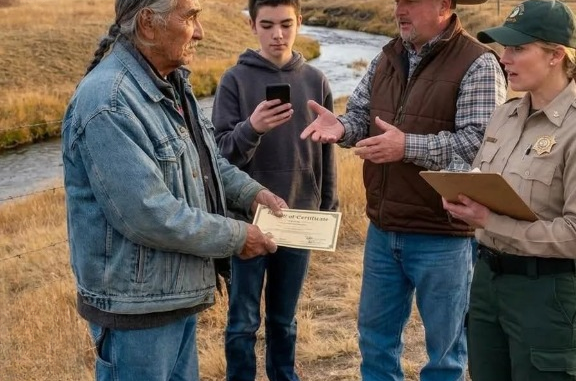
Inside was the original territorial water certificate.
It carried his name, the official seal, and the original 1912 claim date.
The next morning, county clerk Corinne Davis reviewed the document against the official records.
What she discovered made everything clear.
Someone had recently altered the county ledger.
My family’s priority date had been changed from 1912 to 1936.
That single adjustment would have pushed Sturgis ahead of us, even if I refused to sign the contract.
Then Corinne found the authorization approving the change.
The signature belonged to Harold Pruett.
My attorney immediately filed an emergency challenge with the state water court. Corinne prepared certified copies of the original certificate, the altered records, and the suspicious transfer agreement.
State officials verified the authenticity of the original claim and restored our rightful 1912 priority. Investigators also uncovered the connection between Valley Water Holdings and Sturgis, leading them to examine how his company had gained control of other ranch water rights.
Pruett was suspended after evidence showed he had approved record changes without proper notice or legal support.
I also informed my lender and insurance company because losing access to the creek could have severely damaged the ranch’s value and threatened the future of the entire operation.
My attorney documented the water rights as a protected asset and updated my estate plans so my grandson Trevor would inherit the ranch without anyone being able to separate the land from its most valuable resource.
The attempted transfer was declared invalid, and the court blocked any future changes to our water records without official approval.
Sturgis had walked onto my property expecting an older rancher to surrender a family legacy.
Instead, he left facing questions about every property his company had absorbed.
The creek continued flowing through my northern pasture, even during one of the driest summers we had experienced. Our grass stayed green while newer water claims faced restrictions.
Months later, Sturgis returned to my doorstep.
This time there was no county official beside him.
No paperwork.
No confident smile.
He apologized and admitted he had underestimated how fiercely I would defend the ranch.
I told him the truth.
Four generations of my family had already defended this land.
I was simply the one standing there when he tried to take it.
Today, the original certificate hangs beside my grandfather’s photograph instead of sitting hidden away in a cedar trunk.
One day, Trevor will sit at this same table, and I will hand him the oilcloth that protected our family’s future for more than a hundred years.
I kept the water because my grandfather preserved the proof.
And because I took the time to read the third page.
This story is a dramatization. The names, characters, and events are fictional.
Leave a Reply