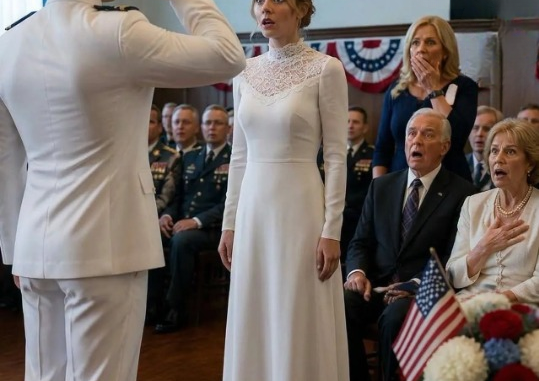
I had just placed the last drink on the tray when the officer in full dress uniform stopped in front of me.
The busy Veterans Hall suddenly went quiet.
Captain Julian Mercer lifted his gloved hand and gave me a formal military salute.
Until that moment, nearly everyone there believed the story my stepmother, Marjorie, had been telling for years—that I had failed in the Navy and returned home embarrassed and disgraced.
My father, Robert, stood frozen on the stage.
Marjorie, who had been confidently holding a stack of ceremony programs near the aisle, suddenly lost her smile.
Without thinking, I returned the salute, my hand shaking slightly as I raised it to my forehead.
“Lieutenant Commander Natalie Hayes,” Captain Mercer announced loudly, “may I speak with you before the presentation?”
The whispers that had followed me around town disappeared immediately.
Everyone finally realized the woman they thought was just serving drinks in the back row was still an active Navy officer.
I had only come back to Georgia to attend my father’s veterans ceremony and watch him receive a community honor for his years of service.
My plan was simple:
Stay in the background.
Avoid attention.
Leave quietly.
But during my time away, I had been assigned to a confidential maritime investigation involving old training documents, contractor finances, and a safety failure connected to my late uncle, Commander Daniel Keene.
Because my name temporarily vanished from public records, Marjorie created her own explanation.
She assumed I had been removed from the Navy.
Then she shared that version everywhere.
At church.
Around town.
With the nearly 300 people attending the ceremony.
Captain Mercer explained that my absence had been necessary because of the investigation and that the truth was finally coming out.
The review had cleared my uncle’s name.
For years, my family believed Daniel was responsible for the equipment failure that ended his career and eventually contributed to his death.
But the recovered records showed something completely different.
Daniel had actually reported the dangerous equipment before the incident happened.
The documents also uncovered nearly $2.8 million in payments made to a civilian contractor named Thomas Vale, whose company had supplied the defective equipment.
My father had spent decades carrying the belief that his brother-in-law was to blame.
When Captain Mercer handed him the corrected report, Dad’s eyes filled with tears.
Then he turned toward me in front of everyone.
He admitted that he had trusted rumors instead of asking his own daughter for the truth.
And that mistake had cost us years.
After the ceremony, Captain Mercer showed us a letter my uncle had written before I was born.
Inside, Daniel mentioned my mother, Claire, and explained that the safest copy of his evidence had been entrusted to “R.H.”
My father’s initials.
But Dad had no memory of ever receiving anything.
So we searched through my mother’s old cedar chest.
Hidden inside was a secret compartment.
Inside were photographs, financial records, notes, and a safe-deposit key labeled:
“For Natalie only.”
The key led us to a bank vault in Atlanta, where a metal box had been stored under the names of my mother, my uncle, and me.
Inside were contractor records, photographs, and an old cassette tape with a warning from my mother.
Captain Mercer placed the tape into a recorder.
Then my mother’s voice filled the room.
“Natalie, before you trust Marjorie, you need to understand why she came into our family.”
The recording revealed a truth none of us expected.
Before marrying my father, Marjorie had worked as an assistant for Thomas Vale—the same contractor connected to the missing safety reports.
After my mother’s death, Marjorie entered my father’s life claiming she wanted to support him.
But my mother had suspected she was searching for the evidence Daniel had hidden.
The box contained proof that supported those concerns.
Inside were altered invoices, insurance records, investment transfers, and property documents showing Vale’s company had hidden financial risks while facing possible liability.
My mother had preserved copies because she feared the originals would disappear before anyone could investigate.
Marjorie denied being involved in the original wrongdoing.
But she eventually admitted several things:
She had hidden the letter meant for me.
She discouraged my father from looking through my mother’s files.
And after learning about my Navy investigation, she spread rumors about my career to protect the image she had created.
The recovered evidence allowed officials to reopen the contractor case, restore my uncle’s reputation, and stop remaining assets from being secretly moved through Vale’s estate.
Marjorie was not accused of causing the original accident, but her actions became part of the investigation.
My father asked her to leave the house while he decided what he wanted for the future of their marriage.
The apologies from people in town came slowly.
Many tried to explain that Marjorie had sounded convincing.
But I no longer needed everyone to admit they were wrong.
What mattered was that the truth was finally known.
Over time, my father and I rebuilt our relationship through quiet conversations, weekly calls, and private moments—not public apologies.
He donated part of the compensation connected to my uncle’s case toward a scholarship supporting veterans entering technical safety careers.
I helped create the program’s standards.
Marjorie never became part of my life again.
Eventually, she returned the remaining letters and admitted that her obsession with controlling the family’s image had hurt everyone around her.
Months later, my father attended a Navy ceremony where I received recognition for my work on the investigation.
This time, he did not sit in the background.
He sat in the front row.
And when my name was called, he stood before anyone else and applauded proudly.
Not because the town was watching.
But because he finally saw the truth.
Leave a Reply