I never imagined I would be the person who found him.
When my stepfather became seriously ill, everyone assumed his biological daughter would be the one to care for him. After all, she lived nearby, had grown up in that home, and always made sure people knew she was his “real family.”
But the days went by.
Then the weeks.
Still, there were no phone calls, no visits, and no sign that she was worried.
One afternoon, an uneasy feeling came over me that I couldn’t ignore. I drove to his house and used the spare key to get inside.
What I saw broke my heart.
He was barely able to take care of himself. He had lost so much weight, looked completely exhausted, and struggled with even the simplest tasks. The house felt painfully empty, as if it had already accepted that he was fading away.
I didn’t think twice.
That same night, I moved in.
I prepared his meals, cleaned the house, organized his medication, and helped him with things he could no longer do on his own. When his hands became too weak, I helped him bathe. Some nights, I slept in a chair beside his bed because I was afraid something would happen while I wasn’t there.
We didn’t spend much time talking about what was behind us or what was ahead.
Most of the time, we simply sat together in silence.
But it was a peaceful kind of silence—the kind shared between people who understand each other without needing many words.
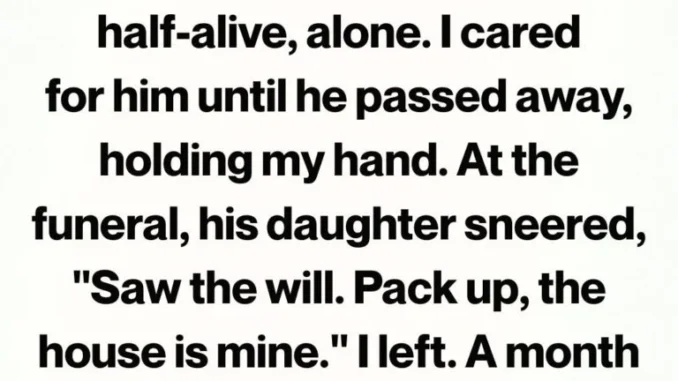
When he finally passed away, he was holding my hand.
At the funeral, his daughter finally showed up.
She arrived dressed perfectly, showing no emotion, wearing a look on her face I’ll never forget.
She leaned closer and whispered,
“I saw the will. Start packing. The house belongs to me.”
I didn’t argue.
I didn’t fight.
I quietly packed my things and left.
I was already carrying enough pain.
A month later, my phone rang.
It was her.
Her voice sounded different—shaken and desperate.
“You need to come here. Right now.”
That was when I discovered the truth.
My stepfather had never been as helpless financially as he appeared.
He had enough money saved to afford private nurses, professional caregivers, and any assistance he needed.
But he chose not to use it.
Before his death, he had arranged a final test.
He wanted to know who would truly be there when he was vulnerable—when he was sick, frightened, and no longer able to offer anything in return.
After I moved in and cared for him until his final moments, he reached out to his attorney.
Exactly one month after his passing, the money was transferred to me.
The house went to his daughter because it held her childhood memories, and he didn’t want to take that away from her despite the way she had treated him.
But his savings.
His financial security.
The future he wanted someone to have.
That went to the person who never left his side.
He left this world with one final act of generosity and fairness.
Even now, I think about the quiet strength and dignity he carried until the very end.
Leave a Reply