CHAPTER 1: The Rain That Felt Colder Than Water
“If you’re so desperate to get home, Mom, take the bus. I’m not ruining my seats for you.”
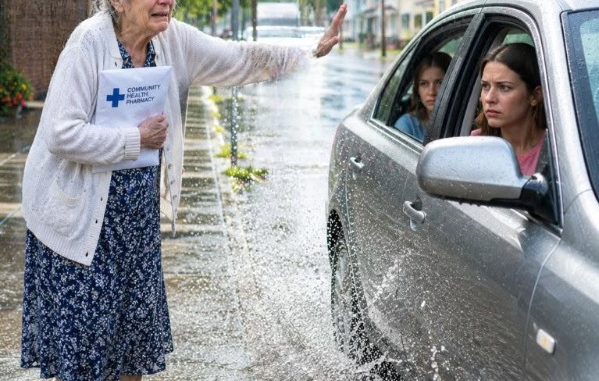
Those were the words my daughter, Jessica, said to me on a cold, rainy afternoon outside Fairview Community Clinic. I stood by the curb with soaked clothes, mud on my shoes, and a sharp ache burning through my lower back.
My name is Martha Higgins. I am sixty-eight years old, and I spent most of my life working as a seamstress. For over four decades, I bent over an old Singer machine—mending trousers, stitching uniforms, sewing dresses, hemming curtains, and taking every job I could get. Some people paid late, some in small change, but I worked anyway. That’s how I survived—and how I raised my daughter.
That Thursday morning in Springfield, the sky was already heavy and dark. I had gone to the clinic for my blood pressure medication. The forecast had promised only clouds, so I left my umbrella at home. The moment I stepped outside, the rain came down like the sky had split open.
There was no shelter at the bus stop—only a rusted pole and a deep puddle. Water ran down my neck. My clothes clung cold and heavy. I held my bag tightly, trying to keep my documents and medicine dry.
Then I saw the car.
A new charcoal-gray sedan pulled up to the curb, shining even in the storm. I knew that car. I had signed for it. I had put my name on everything. Jessica had begged me for it, saying it was necessary for her “professional image” at work.
“Everyone there drives nice cars, Mom,” she had said. “I’ll make the payments, I promise.”
But the loan was mine. The registration was mine. And more often than not, the payments came from my pension and late-night sewing work.
I raised my hand, thinking she would stop.
Jessica was driving. Brittany sat beside her, laughing and relaxed. The car slowed just enough for us to see each other. I saw Jessica recognize me.
Then I saw her expression change.
Brittany laughed.
The car moved on, splashing muddy water across me as it passed. My hand dropped slowly. The rain was cold—but the humiliation burned deeper.
I called her.
“Mom, I’m in traffic,” Jessica said immediately.
“Jessica, you just drove past me. I’m soaked. Please come back.”
A pause. Then Brittany’s laughter in the background.
“Oh, I saw you,” Jessica said. “But there’s no space. Brittany has bags in the back, and you’d get everything wet. Just take the bus. You’ll be fine. Make tea when you get home.”
Then she hung up.
I stood there in the rain, frozen. I had sacrificed so much for that car—my glasses, my comfort, even my health—only to be treated like an inconvenience.
The bus ride took nearly an hour. By the time I reached home, every part of me hurt.
The gray sedan sat safely in the garage, untouched and dry.
Inside, I heard voices.
“You should’ve seen her,” Jessica laughed. “Soaked and standing there. Imagine her getting into my car.”
“Oh my God,” Brittany said.
“She’s used to it,” Jessica replied. “She’ll just make dinner anyway.”
I stood still in the hallway.
Something inside me shifted—not loudly, but permanently.
I went to my room, locked the door, and opened the drawer where I kept important documents.
There it was.
Vehicle Registration.
Owner: Martha Higgins.
For the first time, I understood clearly: I was not just being disrespected.
I was being used.
CHAPTER 2: The Quiet Decision
That night, I still cooked dinner.
Jessica didn’t ask if I was okay. Brittany acted as if nothing had happened. I washed dishes while listening to their laughter echo through the house.
But inside, something else was forming—quiet, deliberate, and sharp.
After they went to bed, I reviewed my records.
Nine out of twelve car payments had come from me. Every excuse Jessica had given replayed in my mind.
Then I found the envelope.
Tickets. Fines. Notices. Over $7,000 in penalties—all under my name.
My hands shook, but my thoughts steadied.
The next morning, Jessica acted as if nothing had happened.
“Did you fix everything with the car?” she asked.
“Yes,” I said calmly.
She smiled. “Perfect.”
She left for the day without another thought.
I went to see Mr. Kelley, a man I had once helped years ago when he could not afford his wedding suit.
When I showed him the documents, he studied them carefully.
“The car is legally yours,” he said. “But the fines must be cleared first.”
So I paid them. All of them. Using money I had saved for emergencies—for myself.
Then I arranged a sale.
By Monday, everything was ready.
CHAPTER 3: The Day the Car Disappeared
Jessica came home in a rush.
“Mom, where are my keys?”
“They’re where you left them,” I said calmly.
She found them and left again.
Moments later, a scream echoed through the house.
“The car is gone!”
She ran back inside, panicked.
“They stole it!”
“No one stole anything,” I said quietly.
I placed the signed contract on the table.
“I sold it.”
Her face drained.
“You WHAT?”
“It was my car,” I said. “My name. My payments. My responsibility.”
“That’s impossible!”
“It isn’t.”
Her voice rose. “I need that car!”
“You needed me to pay for it more than you needed it,” I replied.
Outside, Brittany arrived.
“Where’s your car?” she shouted.
Jessica looked at me, desperate.
“Mom, please don’t—”
I opened the door.
“She doesn’t have a car anymore,” I said. “She’ll take the bus like she told me to.”
Brittany left immediately.
Jessica broke down.
“Please, I’m sorry.”
I looked at her—not with anger, but with clarity.
“I forgive you,” I said. “But I will not be disrespected in my own home anymore.”
From that day forward, everything changed.
She learned responsibility. She paid bills. She cleaned. She worked.
And slowly, something else returned between us—not control, not dependence, but respect.
A year later, rain fell again.
Jessica came home carrying an umbrella.
“Mom, I made coffee. Do you want some?”
I smiled.
“Yes, daughter.”
Outside, the storm continued.
But inside, I was no longer invisible.
Because love without respect is not love at all—it is sacrifice without end.
Leave a Reply