My Mother-in-Law Declared She Didn’t Care About My 9-Year-Old Daughter, and My Husband Backed Her Up. Then He Called Me Stupid and Said I’d Sign Anything They Put in Front of Me. Seven Days Later, Their Lawyer Called Me in a Panic Because the Papers I Signed Were Not the Ones They Thought They Were.
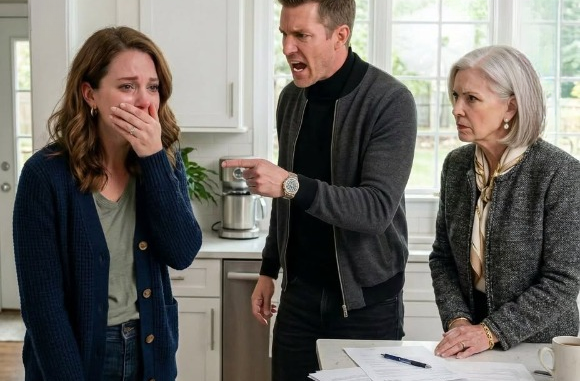
“I don’t care about that child,” my mother-in-law said, referring to my nine-year-old daughter.
She didn’t even bother lowering her voice. She said it in the middle of my kitchen, her pearl earrings catching the light from the chandelier, while my daughter, Lily, lay upstairs battling the flu, hugging a pink plastic bucket and asking when Daddy would bring her ginger ale.
My husband, Preston, stood beside his mother, Elaine Whitmore, and nodded as though she had commented on nothing more important than the weather.
Then he smiled and added, “My wife isn’t exactly bright. She’ll sign whatever we put in front of her.”
I stood barefoot in the hallway, a basket of laundry balanced against my hip. They assumed I had gone into the garage.
For eight years, I had played the part they expected of me—the quiet wife, the grateful daughter-in-law, the woman who smiled politely through charity galas and allowed Preston to interrupt her because he was the one making money.
Except he wasn’t the only one.
My late father had left me a valuable commercial property in Richmond, Virginia—a small medical office building. Preston always dismissed it as “dead weight.” Elaine preferred calling it “an opportunity for the family.”
That evening, I finally understood what those words really meant.
They wanted me to sign what Preston described as a routine refinancing agreement so he could use the building as collateral for his latest investment company.
But the paperwork Elaine’s attorney prepared told a very different story.
It was a transfer agreement designed to move ownership into a trust controlled entirely by Preston and Elaine.
And Lily?
“She isn’t a Whitmore,” Elaine said coldly. “We’re not building wealth for another man’s child.”
Preston chuckled.
“Mara never reads paperwork. She’ll never notice.”
My hands tightened around the laundry basket until they felt numb.
The next morning, I made the first smart decision I’d made in years.
I called my father’s longtime attorney, Samuel Price.
At seventy-two, Samuel was as sharp as ever and still remembered my father well. After I explained everything, he simply told me to send him the documents the moment Preston handed them over.
Two days later, Preston dropped a folder onto the breakfast table.
“Just sign where the tabs are,” he said casually.
I smiled.
I even apologized for being “slow.”
Then I suggested taking the paperwork to the school notary while attending Lily’s parent-teacher conference so I could “take care of everything at once.”
Preston leaned over and kissed my forehead.
“Good girl.”
Seven days later, Elaine’s attorney called me sounding completely panicked.
Because the papers I had signed weren’t the transfer documents.
They were a sworn legal affidavit, attached to a recorded preservation notice, documenting attempted fraud, financial coercion, and conspiracy to interfere with a minor child’s inheritance.
And Samuel Price had already filed every page with the county clerk.
PART 2
The attorney introduced himself as Dennis Calhoun, but his expensive legal reputation wasn’t reflected in his voice.
He sounded terrified.
“Mrs. Whitmore,” he began carefully, “there seems to have been… some confusion regarding the paperwork signed last week.”
I was sitting outside Lily’s elementary school, watching her through the fence as she patiently showed another little girl how to braid a friendship bracelet.
She was still recovering from the flu, but she was smiling again.
“There was no confusion,” I answered calmly.
Silence.
“I would caution you against making allegations.”
“I’m not making allegations,” I replied. “I signed a sworn statement of facts. There’s a difference.”
He sighed.
“Where exactly did that document come from?”
“My attorney.”
Another long pause.
“And who would that be?”
“Samuel Price.”
The silence that followed was almost satisfying.
Everyone in Richmond’s legal community knew Samuel.
For decades, he had dismantled people who believed wealth automatically made them clever.
When I arrived home, Preston’s black Range Rover was parked haphazardly across the driveway.
He was waiting inside.
His tie hung loose, and his perfectly styled hair looked like he’d spent the afternoon running frustrated hands through it.
Elaine sat stiffly in the living room, her makeup flawless but the color drained from her face.
“What did you do?” Preston demanded.
I calmly set my purse on the entry table.
“I read.”
Elaine jumped to her feet.
“You foolish woman! Do you realize what you’ve done to this family?”
“For the first time,” I answered, “yes.”
Preston stepped closer.
“Mara, listen carefully. You’re upset. You overreacted. My mother didn’t mean what she said.”
“She said she didn’t care about Lily.”
“She was frustrated.”
“And you agreed with her.”
His jaw tightened.
Elaine pointed at me.
“That property belongs with the Whitmore family. Preston is your husband.”
“It belonged to my father,” I answered. “After me, it belongs to Lily.”
Preston laughed, but there was little confidence behind it.
“She’s nine years old.”
“She’s still more trustworthy than either of you.”
For the first time, I saw the real man behind Preston’s charm.
Not the husband who bought flowers after cruel comments.
Not the smiling family man posing in Christmas photos.
Just someone who genuinely believed obedience was something a wife owed him.
“You really think Samuel Price can protect you?” he sneered.
“No,” I said quietly.
“I think evidence will.”
His eyes immediately shifted toward Elaine.
That was when I knew.
Samuel had already delivered everything.
The hallway security footage.
The kitchen audio captured through Lily’s old baby monitor app.
The original email chain showing the first draft of the transfer agreement.
Preston’s own text message telling me to “just sign it and stop making things difficult.”
Elaine slowly sat back down.
Preston’s voice became almost desperate.
“What do you want?”
I glanced toward Lily’s backpack hanging from the staircase.
“I want my daughter protected.”
“I want my property left alone.”
“And I want both of you out of my life.”
PART 3
Preston didn’t leave.
Men like Preston rarely accept the first boundary a woman sets.
Instead, they assume it’s temporary.
“This is my home too,” he snapped.
“No,” I answered.
“It isn’t.”
He laughed bitterly.
“Excuse me?”
I removed a folded document from my purse and placed it beside my keys.
“This house belongs to Whitmore Residential Holdings,” I explained. “Your mother’s company owns it. My name has never been on the deed.”
He stared at me.
“So this morning I contacted the leasing office.”
“The lease is only in your name.”
“I’ve already rented a townhouse near Lily’s school.”
“We’re moving Friday.”
For several seconds, neither Preston nor Elaine spoke.
Elaine recovered first.
“You’re not taking any furniture.”
“I don’t want it.”
“You’re not taking the car.”
“My Toyota was purchased before we married. It’s titled in my name.”
“You can’t—”
“I can take my daughter.”
“My clothes.”
“My documents.”
“My father’s watch.”
“Lily’s books.”
“Her stuffed rabbit.”
“My sister’s casserole dish.”
“You can keep everything else.”
Preston stared at me.
“You planned this.”
“For exactly seven days.”
“The same seven days you kept calling me stupid.”
That sentence hit harder than anything else I said.
Not because it hurt Preston.
Because Elaine looked at him.
In her world, failure mattered far more than cruelty.
The following morning, Samuel and I met in his office while Lily quietly colored pictures nearby.
Samuel laid out every piece of evidence.
The recordings.
The emails.
The hidden purpose behind the documents.
Dennis Calhoun had very little left to argue.
Finally, Samuel wrote one word on my legal pad.
Settlement.
Instead of dramatic courtroom scenes, justice unfolded exactly the way real justice often does.
Through paperwork.
Evidence.
Deadlines.
Calm voices.
Dennis eventually offered everything we wanted.
Preston would acknowledge that the commercial property belonged solely to me.
Neither he nor Elaine would ever make another claim against it.
They would pay my legal fees.
Preston would agree to an uncontested divorce.
Elaine would never contact Lily or me again.
When Dennis referred to Lily merely as “the child,” I interrupted him.
“She has a name.”
“Her name is Lily Bennett.”
When visitation was mentioned, I refused immediately.
Preston had never adopted Lily.
Her biological father had died when she was three.
Preston had only wanted the image of being a devoted family man.
Not the responsibility.
By Friday afternoon, my sister Claire arrived with a moving truck and my teenage nephews.
We packed only what truly mattered.
Preston wisely stayed away.
Elaine didn’t.
She pulled into the driveway in her cream-colored Mercedes and watched as Lily’s little bookshelf was carried outside.
“You’re embarrassing yourself,” Elaine said.
“You drove here to watch,” I answered.
“Preston is heartbroken.”
“No.”
“He’s inconvenienced.”
“He loved you.”
“He loved what I could provide.”
For the first time in years, those words came effortlessly.
Elaine removed her sunglasses.
“You think you’ve won.”
“I think I finally left.”
“There’s a difference.”
“Yes.”
“Winning still revolves around you.”
“Leaving doesn’t.”
She looked at me coldly.
“You never belonged in this family.”
Years ago, those words would have shattered me.
Now they barely landed.
“You’re right,” I replied.
“I never did.”
Lily stepped outside holding her stuffed rabbit.
Elaine looked at her.
“You should say goodbye.”
I didn’t answer.
I wanted Lily to choose.
She hugged her rabbit tighter.
“Goodbye, Mrs. Whitmore.”
Not Grandma.
Not Nana.
Just Mrs. Whitmore.
Elaine said nothing.
We drove away before sunset.
The townhouse was small.
The kitchen was outdated.
The bathroom mirror had a crack.
The backyard was overgrown.
But Lily raced from room to room smiling.
“This can be my bedroom and my art studio!”
That evening we ate takeout on the floor because our furniture hadn’t arrived.
After Lily fell asleep beneath her new night-light, I sat on the stairs and cried quietly for the first time in years.
Claire simply handed me a paper towel.
“You know now,” she said.
And she was right.
The weeks that followed were predictable.
Flowers.
Apologies.
Angry texts.
Accusations.
Claims that I had destroyed the family.
Samuel instructed me to respond only through legal counsel.
So I never answered.
The divorce concluded quickly.
Preston had too much to lose.
Elaine hired another attorney.
That attorney wisely advised her to disappear from the matter completely.
At the final hearing, the judge stated,
“No children of the marriage.”
The words hurt.
But they also guaranteed Lily would never become another tool Preston could use against me.
Outside the courthouse, Preston stopped me.
“Mara… do you really think I’m a monster?”
I looked at him.
Then I answered honestly.
“I think you listened while your mother said she didn’t care about a sick little girl.”
“And your first instinct was to agree because it benefited you.”
He whispered,
“I was under pressure.”
“So was I.”
Then I walked away.
One year later, the medical building was still mine.
Samuel helped me update every estate document.
If anything ever happened to me, Claire would raise Lily, and the property would be held in trust for her future.
This time…
I read every page.
Lily changed too.
One day she asked,
“Did Grandpa leave us the building to keep us safe?”
“Yes.”
“Then we should protect it.”
By spring she no longer mentioned Preston.
By summer she painted our little townhouse.
She even painted the weeds like beautiful wildflowers and turned the cracked bathroom mirror into a rainbow.
At the school art show, her painting won a blue ribbon.
Its title read:
Our Real House.
I stood there staring at those words until my eyes filled with tears.
Claire nudged me.
“Don’t cry on the artwork.”
“I’m not crying.”
“You absolutely are.”
Lily ran over laughing.
“Mom! I won!”
I hugged her tighter than ever.
Nobody at the art fair knew the story behind that painting.
Nobody knew about Elaine’s words.
The hidden documents.
The desperate lawyer.
And that was perfectly fine.
Because the happiest endings are often the quiet ones.
A recorded deed.
A locked legal file.
Breakfast in a small kitchen.
A child sleeping peacefully.
A mother who finally learned that being underestimated can become the greatest advantage of all.
Six months after the divorce, a pale blue envelope arrived.
I recognized Elaine’s handwriting immediately.
Inside was only one sentence.
“You have made your point.”
No apology.
No regret.
No mention of Lily.
I fed the letter into the shredder.
Lily looked up from her homework.
“What was that?”
“Nothing important,” I said.
And for the first time…
That was completely true.
Leave a Reply