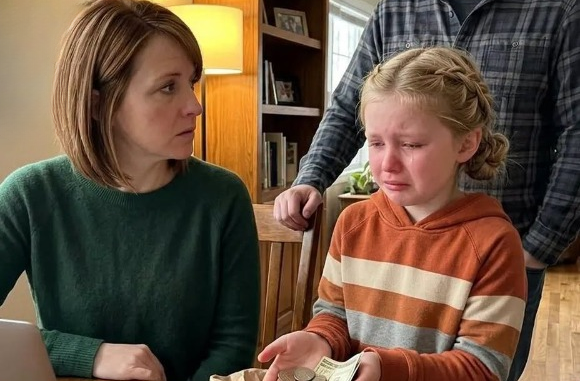
The moment I stepped inside the house that afternoon, I could tell something was wrong. Before my daughter even said a word, the silence gave it away. Twelve-year-old Mia was sitting alone at the kitchen table, still wearing her backpack, with her hands hidden in her lap. When I noticed her fingers were red and irritated, I gently asked what happened.
After a long pause, she admitted she had spent three hours after school cleaning a neighbor’s house to earn twenty dollars. I thought she was saving up for something she wanted, but her answer left me speechless.
“It’s for Sophie,” she whispered.
Sophie, my sister Heather’s daughter, had always been treated like the family’s golden child. Mia explained that everyone was expected to contribute one hundred dollars toward Sophie’s birthday present. When I asked who told her she had to do that, she looked down and quietly answered, “Grandma.”
Then she said the words that shattered me.
“She told me that if I don’t pay, I’m not really part of the family.”
Mia had even taken money from her piggy bank before deciding she needed to find a job because she believed she had to earn her place with money. She was just a child, yet she had already learned to measure love by what she could provide.
I called my mother right away, hoping there was some kind of misunderstanding. Instead, she confirmed it without hesitation. She said Mia needed to learn responsibility and that helping family financially was simply something everyone should do.
As I listened, memories from my own childhood came flooding back.
I had always been the reliable one—the child expected to make sacrifices while my younger siblings received more attention, support, and opportunities. I worked through my teenage years, delayed my own goals, and spent much of adulthood stepping in whenever my parents, sister, or brother needed financial help.
They always called it family responsibility.
But for the first time, I saw it clearly.
It wasn’t always love.
Sometimes it was just an expectation placed on the person who was willing to give the most.
Later, when I spoke with Heather, she casually admitted that the money would help cover Sophie’s horse camp. She even said Mia was “responsible,” just like I had always been.
That word used to feel like a compliment.
Now it sounded like an excuse people used to take advantage of someone’s kindness.
That night, Mia brought me an envelope filled with crumpled bills and loose change. She smiled nervously and told me she was only ten dollars away from reaching her goal.
I sat beside her, placed the envelope back into her hands, and told her something I wished I had understood years earlier.
“You never have to buy your way into being loved,” I said. “Anyone who makes you prove you belong by giving money is not showing you real love.”
Then I sent a message to our family group chat explaining that Mia would not be contributing anything and that we would not be attending Sophie’s birthday party.
The reactions came immediately.
Some were angry.
Some tried to guilt me.
But none of it mattered compared to what happened a few days later.
My parents approached Mia outside her school and blamed her for creating conflict within the family.
That was the moment I knew they had crossed a boundary I could not ignore.
I removed them from all school contact lists and made it clear that they would no longer have unsupervised access to my daughter.
A few weeks later, my parents and Heather came to my house asking if we could “move forward” and return to how things used to be.
I calmly told them that was exactly the problem.
The old version of normal had to end.
There would be no more financial pressure, no more guilt trips, and no more making a child feel responsible for adult expectations.
They left disappointed, but for the first time in years, I felt completely free.
Over time, everyone learned to handle their own responsibilities, and our home became more peaceful than it had been in years. Most importantly, Mia stopped believing she had to earn her place in our family.
Her hands healed.
Her confidence returned.
And she learned a lesson far more important than any birthday present.
I spent years thinking love meant constantly sacrificing myself for others. But seeing my daughter smile without fear reminded me of the truth: a real family is built through compassion, respect, and unconditional love—not through what someone is able or willing to give.
Leave a Reply