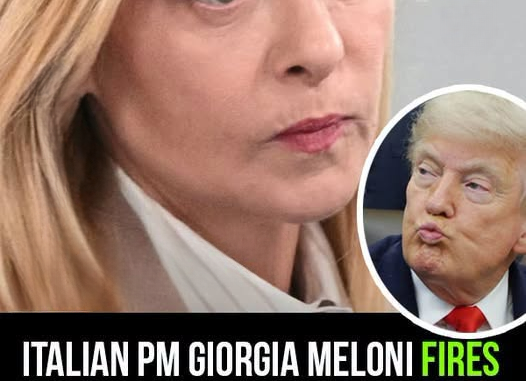
The international political scene has been shaken by a heated public dispute involving U.S. President Donald Trump and Italian Prime Minister Giorgia Meloni. In a controversial interview, Trump claimed that Meloni had strongly pushed for a photo with him during the recent G7 Summit in France, suggesting that he only agreed out of sympathy. The remark triggered widespread criticism and raised questions about the future of the relationship between Washington and Rome.
The dispute began after Trump appeared on Italian television network La7 and discussed his interactions with Meloni at the G7 meeting. Instead of offering a diplomatic response, Trump described the encounter in a way many viewed as dismissive and insulting. He claimed that Meloni wanted a picture with him and portrayed her request as excessive, saying he agreed only because he felt sorry for her. The comments quickly spread and were seen by many as an unusual public attack against another major world leader.
Meloni, who is known for defending Italy’s reputation and speaking firmly on national issues, responded shortly afterward. In a post on social media, she rejected Trump’s description of events and expressed disbelief at his remarks. She emphasized that neither she nor Italy would ever beg for anything and questioned why the U.S. president appeared to treat allies with such hostility. She added that stronger pressure should be directed toward adversaries rather than friendly nations.
The reaction from Italy was immediate. Foreign Minister Antonio Tajani criticized the situation and canceled a planned diplomatic visit to the United States scheduled for June 21–22. He argued that Trump’s comments were not simply a personal insult toward Meloni but a disrespectful message toward Italy as a whole. The decision highlighted how quickly diplomatic cooperation can be damaged, even between governments that share some political similarities.
The conflict also reflects deeper tensions that have developed between the two countries over recent months. Although Trump and Meloni are both associated with right-wing politics, disagreements over foreign policy and international strategy have created growing friction.
Earlier disputes reportedly emerged over issues involving military cooperation, including Italy’s position on U.S. operations connected to Iran. The disagreement contributed to a cooling of relations, with Trump publicly criticizing Meloni’s approach and suggesting that her political stance had changed.
The relationship has also faced disagreements involving religious and cultural topics. A previous controversy developed after Trump criticized the Pope’s approach to foreign policy and crime. Meloni defended the Pope’s calls for peace, arguing that such messages were appropriate. The exchange further exposed differences between the two leaders.
Observers are now considering what this latest confrontation could mean for the broader alliance between the United States and Italy. When leaders of major democratic nations publicly criticize each other, it can weaken trust and create opportunities for rival powers to take advantage.
The cancellation of the Italian foreign minister’s visit suggests Rome may be reassessing how closely it wants to align with Washington. Whether the situation is only a temporary political clash or a sign of a deeper shift in transatlantic relations remains uncertain.
What is clear is that the image of a unified political partnership has been damaged. The disagreement between Trump and Meloni has turned what should be a cooperative relationship into a public dispute over respect, influence, and national pride.
For Meloni, responding strongly reinforces her image as a defender of Italian interests. For Trump, the confrontation reflects his tendency to challenge leaders he believes are not acting strongly enough or following his expectations.
As tensions continue, the world is watching to see whether the U.S.–Italy relationship can recover—or whether this moment marks the beginning of a lasting diplomatic divide.
Leave a Reply