Here’s a condensed and fully paraphrased version that preserves the emotional storyline while improving readability and flow:
That Saturday morning felt completely ordinary. The smell of coffee and cinnamon toast filled the kitchen, and my six-year-old daughter, Nicole, was happily playing in her room. Nothing suggested that within an hour, I would uncover a painful secret that would send me searching for answers.
Nicole’s beautiful dark curls had always been her pride. She loved her long hair, even though brushing it every morning often ended in tears and complaints. She had never once talked about cutting it.
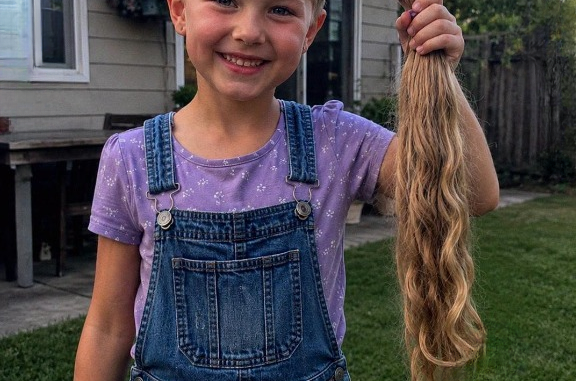
So when she walked into the kitchen holding a thick ponytail in her hand and chunks of uneven hair hanging around her face, I was speechless.
“Nicole, what happened?” I asked.
Instead of looking guilty, she proudly held out the cut hair.
“It’s for Daddy,” she said.
Confused, I knelt beside her and gently asked why.
Her answer broke my heart.
She explained that she thought her father was seriously ill and would lose his hair. Weeks earlier, her school had hosted a cancer awareness event where students learned about hair donation. Nicole believed that if her father became sick, she could give him her hair so he wouldn’t feel sad.
As tears filled her eyes, she revealed where the idea had come from.
She had overheard her grandmother talking on the phone several times, saying that Daddy was very sick and that the family was keeping it a secret from me.
My stomach dropped.
My husband had been acting differently for weeks—taking private phone calls, spending more time alone, and avoiding conversations about what was troubling him. Suddenly, all of it seemed connected.
When I called my mother-in-law, she quickly dismissed Nicole’s story as a misunderstanding. But I knew my daughter wasn’t confused.
Later that day, my husband came home.
The moment he saw Nicole’s cut hair, he was horrified.
When I confronted him, he finally admitted he had undergone medical testing a few weeks earlier. Worse, his mother had known about it all along.
Then I discovered something even more shocking.
Searching through his office, I found the medical report. It clearly stated that his results were normal and that there was no evidence of cancer. The report was dated three weeks earlier.
He had known he was healthy the entire time.
His explanation was simple but painful: he had planned to tell me, then kept postponing the conversation. Meanwhile, his mother convinced him that sharing the news would only create unnecessary stress.
Yet while encouraging him to stay silent, she was telling relatives that he was gravely ill.
That evening, she arrived at our house carrying a casserole dish and her usual expression of concern. For the first time, I saw through it all.
Every crisis, every dramatic phone call, every offer to help had served the same purpose—she needed to feel important. If there wasn’t a problem, she created one. If there wasn’t someone to rescue, she found one.
After calling the clinic and confirming the timeline, I confronted her directly. The truth became impossible to deny.
Most devastating of all, her actions had convinced a six-year-old girl that her father was dying.
For once, she had no defense.
And for the first time in his life, my husband didn’t protect her.
Instead, he quietly asked her to leave and told her not to return until she could take responsibility for what she had done.
In the days that followed, he contacted family members and corrected every rumor. Relatives who had spent weeks worrying learned that his health scare had ended long ago and that the stories had been exaggerated by his mother.
That shift changed everything.
Later, as I carefully trimmed Nicole’s uneven haircut into a neat bob, she looked up at me and asked if she was in trouble.
“Not at all,” I told her.
Then I reminded her that her kindness mattered far more than her hair ever could.
When her father joined us, he hugged her tightly and thanked her.
“Why?” Nicole asked.
He smiled sadly.
“Because you reminded me what matters most—and who I should have been protecting all along.”
That night, Nicole looked at her reflection and grinned.
“I look brave,” she said.
And she was.
What began as a frightening misunderstanding ultimately brought hidden truths into the open, repaired broken trust, and helped our family find its way back to one another.
For the first time in weeks, our home felt peaceful again.
Leave a Reply