PART 1
“Another cheap bakery cake, mother-in-law? How embarrassing… oops.”
The cake crashed onto the patio floor just as everyone was preparing to sing for my sixty-fifth birthday.
For a few seconds, no one reacted.
Cream smeared across the tiles, strawberries scattered under the chairs, and the “65” candle bent sideways as if even it had given up.
Valeria, my daughter-in-law, didn’t bother pretending she felt bad.
She fixed her hair, glanced at the mess, and smiled with that familiar cold satisfaction.
“Oh, sorry, Elenita,” she said, dragging out my name as if I were beneath her. “My elbow slipped.”
Mauricio, my son, stood frozen near the grill. My sister, neighbors, and friends watched in awkward silence, unsure whether to intervene or pretend nothing had happened.
I didn’t cry.
I had already cried too much in private.
My name is Elena Robles. I am sixty-five, a widow, living in the Querétaro home my husband and I built through years of sacrifice. That day, I realized something painful: sometimes a woman loses her peace not because she is unloved, but because she allows herself to be treated like a guest in her own home.
Valeria and Mauricio had moved in “temporarily” to save money. I agreed, thinking it would ease my loneliness after my husband Julián died.
Instead, Valeria slowly took over everything.
A drawer became hers. Then a closet. Then my curtains disappeared, family photos were moved, and my kitchen filled with her expensive replacements.
Meanwhile, I cooked, cleaned, paid bills, bought groceries, and even paid for Mauricio’s car expenses.
Still, she complained.
My cooking was “too greasy.” My house was “too old.” I was “too slow.” And according to her, Mauricio’s lack of maturity was my fault.
That birthday, I only wanted peace. My neighbor Brenda had made my favorite strawberry cake. But when we were about to cut it, Valeria bumped the table and knocked it over.
No one believed it was an accident.
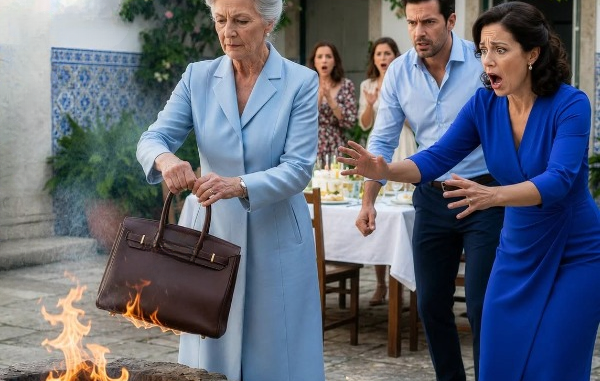
So I calmly walked over to her designer handbag, picked it up, crossed the patio, and dropped it into the glowing brazier.
The leather began to burn.
Valeria screamed.
“My bag! Mauricio, do something!”
Mauricio rushed toward me.
“Mom! Do you know how expensive that is?”
I looked at him calmly.
“Oops.”
Silence followed—but this time it was different. It wasn’t embarrassment. It was realization: the quiet woman had stopped accepting humiliation.
And yet, that wasn’t the worst moment.
The worst came the next day, when I checked my bank account.
PART 2
The next morning, Mauricio stormed into the kitchen.
“We need to talk,” he said.
“Then talk.”
“Valeria didn’t sleep. She’s upset. You owe her an apology—and fifty thousand pesos.”
I set my cup down slowly.
“She destroyed my birthday cake on purpose.”
“It was just a cake, Mom!”
“No. It was my birthday, my home, and my dignity.”
Then he added something worse.
“Valeria thinks you’re not acting normal. Maybe you shouldn’t be living alone anymore.”
That’s when I understood: this had been planned.
Valeria had been planting ideas for months—suggesting I was forgetful, unstable, incapable. Preparing a story.
When Mauricio left, I found her belongings scattered through my private bathroom.
That bathroom was mine. That bedroom was mine. That house was mine.
I packed everything of hers into a box and left it outside her door. Then I called a locksmith.
By evening, new locks were installed.
When she tried to enter later, she screamed that I was treating her like a thief.
I turned up the radio and ignored her.
The next day, I went to the bank.
Years earlier, I had opened a joint account with Mauricio for emergencies. It was never meant for luxuries.
What I saw on the statement made my hands go cold.
Restaurants. Shopping. Spas. Hotels. Clothes. Shoes. Beauty treatments.
Hundreds of thousands of pesos gone.
Mauricio had allowed it.
I closed the account, moved my money into a private one, canceled access, and changed everything.
That afternoon, he called in panic.
“The card was declined! What did you do?”
“I closed the account.”
“You embarrassed me!”
“No, I stopped paying for what I didn’t approve.”
That night, Valeria threw a dinner party in my living room without permission, using my dishes and opening wine my husband had saved.
I walked in, turned off the music, and said calmly:
“The party is over.”
Guests left quickly.
Valeria leaned in, furious.
“You’ll regret this.”
But the next morning, I overheard her speaking on the phone:
“If we get her to sign power of attorney, we can sell the house…”
That was the moment everything became clear.
They weren’t just disrespecting me—they were planning to take everything.
PART 3
That night, I couldn’t sleep.
I thought about my husband Julián and the life we built—slowly, honestly, over years. That house wasn’t just property. It was memory, sacrifice, and survival.
The next morning, I visited a lawyer.
After hearing everything, he acted immediately: securing my accounts, blocking any legal transfer, and preparing eviction notice documents.
When I returned home, Valeria was in my kitchen.
“We brought papers for you to sign,” she said casually. “It’s for your own good.”
I placed my bag down.
“I have papers too.”
For the first time, she hesitated.
Soon after, I took back my car, ended their financial access, and removed anything they had been using without permission.
My daughter Mariana arrived later, taking their side and demanding an “advance inheritance.”
I laughed.
“There is no advance inheritance. There is only a living mother protecting her future.”
That night, I understood something painful: they weren’t trying to support me—they were trying to divide what I needed to survive.
I reclaimed my spaces one by one, including the guest room Valeria had turned into a closet. I cleaned it, opened the windows, and set up my old paints.
I used to paint before life became only responsibility.
That room brought me back to myself.
Soon after, legal notice was delivered: they had to leave.
Valeria eventually left when the money and comfort disappeared. Mauricio followed, shaken and alone.
Before he left, he asked quietly, “Will you ever trust me again?”
“Trust isn’t demanded,” I told him. “It’s rebuilt.”
After they were gone, the house became quiet—not empty, but peaceful.
That night, my sister brought a small cake. We lit a candle—not for my birthday, but for something greater.
I had stopped fearing being alone.
And when a woman loses that fear, she stops accepting disrespect, reclaims her life, and never again lets anyone throw her peace on the floor.
Leave a Reply