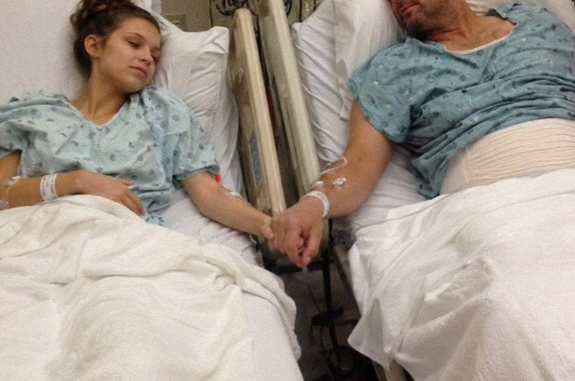
I thought the most difficult part of my life was watching my daughter fight for survival while we waited for a miracle that might never come.
I was wrong.
The real shock arrived months later, standing on my front porch with two worn suitcases and tears in his eyes.
My daughter, Emma, was fifteen years old.
For two years, kidney failure controlled our lives. Three times a week, she sat through dialysis treatments while I watched helplessly from the sidelines. Hospital wristbands piled up on her nightstand, reminders of procedures, tests, and endless appointments. Every month I checked her status on the transplant list, hoping for good news.
Every month brought disappointment.
Eventually, I stopped measuring time the way most people do. My calendar revolved around doctor’s appointments, blood tests, and hospital visits. I knew the sounds of medical equipment better than the sounds of normal family life.
Through it all, Emma amazed me.
One evening, I found her staring at a glass jar filled with hospital bracelets.
“You know you don’t have to keep those,” I told her.
She smiled and picked up the jar.
“Why would I throw them away?”
“Because they’re ugly.”
She shook the jar gently, listening to the bracelets rattle.
“They remind me that I survived.”
I laughed when she said it.
Then I went into the bathroom and cried.
My sister Rachel helped carry us through those difficult years. She drove Emma to treatments when I couldn’t leave work. She brought groceries without being asked and checked on us constantly. Sometimes she sent ridiculous late-night messages because she knew I was awake worrying.
One day she told me, “You can’t keep giving when you’ve got nothing left.”
“I’m not giving anymore,” I replied.
“Then what are you doing?”
“Trying not to fall apart.”
The transplant list continued moving, but never fast enough.
Meanwhile, I rarely thought about Daniel, my ex-husband.
Eleven years earlier, when Emma was only four, he had walked away. He left behind a note, a checkbook, and a silence that eventually became normal. Rachel once suggested contacting him.
“He’s still her father,” she said.
“No,” I answered. “He stopped being that a long time ago.”
The subject never came up again.
Then one Tuesday afternoon, my phone rang.
The hospital.
I stared at the screen for a moment before answering.
“Sarah?” Dr. Smith asked.
“Yes?”
There was a pause.
“We found a donor.”
For a second, I couldn’t breathe.
“What did you say?”
“We found a living donor who is a match for Emma.”
I slid to the floor, barely able to process the words.
Dr. Smith explained that a donor had volunteered through a transplant program and completed all the required testing. He was a perfect match. However, he had requested complete anonymity. There would be no contact before the operation and none afterward.
I wanted to ask why.
Instead, I simply said yes.
When your child is being given a second chance at life, you don’t waste time asking questions.
The surgery was scheduled for the following week.
For the first time in years, hope felt real.
The transplant was a success.
Almost immediately, Emma began improving. Color returned to her face. Her energy came back. She laughed more, ate more, and started acting like a normal teenager again.
The first time she complained about chores, I nearly cried from happiness.
Rachel watched Emma one afternoon and whispered, “She finally looks like herself again.”
I shook my head.
“No. She looks like a kid again.”
The anonymous donor became someone I thought about often.
Eventually, I wrote him a letter through the hospital. I thanked him for saving my daughter. I told him about the sleepless nights, the fear, and the countless prayers.
A nurse later called to tell me he had received it.
“Did he read it?” I asked.
“Yes.”
“Did he respond?”
“He wishes to remain anonymous.”
That was all she could tell me.
So I let it go.
Some people perform incredible acts of kindness without wanting recognition.
Months passed.
Emma returned to school and began talking about her future again. For the first time in years, life wasn’t centered around hospitals.
Then one Friday night, the doorbell rang.
It was nearly nine o’clock.
Emma was upstairs talking to a friend, and Rachel had already gone home.
I opened the door and found a stranger standing there.
He looked exhausted. His coat hung loosely from his thin frame. A scruffy beard covered part of his face, and two battered suitcases sat at his feet.
He stared past me into the house.
His eyes landed on a framed photograph of Emma hanging in the hallway.
Suddenly, tears filled his eyes.
A chill ran down my spine.
“Can I help you?” I asked.
He swallowed hard.
For several moments, he couldn’t seem to speak.
Finally, he said, “You didn’t think I did it for nothing, did you?”
I froze.
“What?”
His voice trembled.
“I wasn’t going to come.”
He slowly opened one of the suitcases and pulled out an old photograph.
The moment I saw it, I stopped breathing.
A little girl sat on a man’s shoulders, both of them laughing.
The child was Emma.
The man was Daniel.
My ex-husband.
The father who had disappeared more than a decade ago.
He was standing on my porch.
“Daniel?”
His face crumpled.
“Sarah.”
I let him inside.
Even now, I’m not entirely sure why.
Maybe I needed answers before Emma ever found out he was there.
We sat at the kitchen table.
The old photograph rested between us.
Finally, I asked the question that had been burning inside me.
“Why are you here?”
Daniel looked exhausted.
“I heard she was doing better.”
“From who?”
“Megan.”
My cousin.
The revelation hit me immediately.
Megan had always seemed unusually interested in Emma’s treatments and progress. Now I understood why.
Daniel admitted he had asked her to keep him updated for years.
For years.
Then he told me how he had learned which hospital was treating Emma.
And suddenly everything clicked.
The anonymous donor.
The secrecy.
The refusal to accept contact.
“You were the donor,” I whispered.
He nodded.
“You donated your kidney.”
Another nod.
For a moment, words failed me.
Then anger took over.
“You got tested behind my back?”
“I knew you would never agree.”
“You’re right,” I snapped. “I wouldn’t have agreed. You disappeared! You abandoned her!”
“I know.”
His calm acceptance only made me angrier.
“You don’t get to walk away for eleven years and suddenly show up as a hero.”
“I’m not trying to be a hero.”
“You think donating a kidney makes up for everything?”
“No.”
The answer came instantly.
Not defensive.
Not angry.
Just honest.
Then Daniel looked down at his hands.
“During the donor evaluation, doctors found an autoimmune disease.”
I stared at him.
“What?”
“They believe it may eventually damage my remaining kidney.”
The room fell silent.
Then he continued.
“I lost my job before the surgery.”
I said nothing.
“I lost my apartment afterward.”
Still, I said nothing.
He explained that a cousin in Oregon had offered him a place to stay. He had a bus ticket for Monday.
He wasn’t asking for money.
He wasn’t asking for forgiveness.
So why had he come?
Finally, I asked him.
His eyes filled with tears.
“I couldn’t stand the thought of dying someday without seeing her face one last time.”
The words landed heavily between us.
I hated him.
I pitied him.
I wanted to thank him.
I wanted to throw him out.
Every emotion collided at once.
Then I remembered what he had said at the door.
“You didn’t think I did it for nothing.”
Daniel sighed.
“I didn’t mean money.”
“Then what did you mean?”
He looked toward Emma’s photograph.
“I did it because she’s my daughter.”
For a moment, I couldn’t speak.
Then I stood.
“Leave.”
Pain flashed across his face.
But he nodded.
A few minutes later, the front door closed behind him.
I sat alone at the kitchen table staring at the old photograph.
Eventually, Emma came downstairs.
She immediately noticed I had been crying.
I tried not to tell her the truth.
I really did.
But once I started talking, everything came out.
The donor.
The photograph.
Daniel.
By the time I finished, Emma sat quietly, absorbing it all.
Finally, she spoke.
“You did the right thing.”
I nodded.
“I don’t want to meet him,” she continued.
“You don’t have to.”
Several moments passed.
Then she surprised me.
“I don’t want a relationship with him right now. Maybe I never will. But he still shouldn’t be alone.”
The words hit harder than anything Daniel had said.
After everything she had suffered, she still found room for compassion.
I immediately called Rachel.
When I explained everything, she was silent for a long time.
Then she sighed.
“We’ll deal with Megan later.”
“What?”
“The spare room.”
I blinked.
“He can stay in my spare room.”
“Rachel…”
“Temporarily,” she said firmly.
Despite everything, I smiled.
“Temporarily.”
“And if he becomes annoying, I reserve the right to throw him out.”
“Deal.”
The following day, I found Daniel sitting alone at the bus station beside his suitcases.
When he saw me, he stood immediately.
“Rachel has a spare room,” I told him.
His eyes filled with tears.
I held up a hand before he could speak.
“Emma decides what happens next. Whether she talks to you, meets you, or ever forgives you.”
He nodded.
“Thank you.”
I shook my head.
“Don’t thank me.”
I thought about my daughter and the second chance she had been given.
“Thank her.”
Three weeks later, Emma handed me a sealed envelope.
Daniel’s name was written across the front.
“It’s only a thank-you letter,” she clarified. “Nothing more.”
I understood.
It wasn’t forgiveness.
It wasn’t reconciliation.
It was simply gratitude.
I drove the letter to Rachel’s house.
When Daniel opened the door and saw the envelope, his hands began to shake.
He accepted it carefully.
Neither of us said anything.
Some moments don’t need words.
Months passed.
Life slowly settled into a new routine.
Emma focused on school, friends, and all the normal teenage problems I once dreamed she would have.
Daniel stayed with Rachel while rebuilding his life.
Emma still hadn’t met him.
But every now and then, she’d ask how he was doing.
For the time being, that was enough.
One evening, I came home and found Emma sitting at the kitchen table.
The glass jar of hospital bracelets sat in front of her.
For years, those bracelets had represented survival.
Proof of everything she had overcome.
She looked up and smiled.
“I think I’m ready to get rid of these.”
Emotion tightened my throat.
“I think you are too.”
Together, we carried the jar to the trash.
As the bracelets disappeared, I realized something.
The years of illness.
The surgeries.
The heartbreak.
Even the people who had left and returned.
None of those things would define Emma’s future.
She had already survived the hardest part.
Now she could finally live.
And as I watched her walk away without looking back, I realized that maybe the rest of us could too.
Leave a Reply