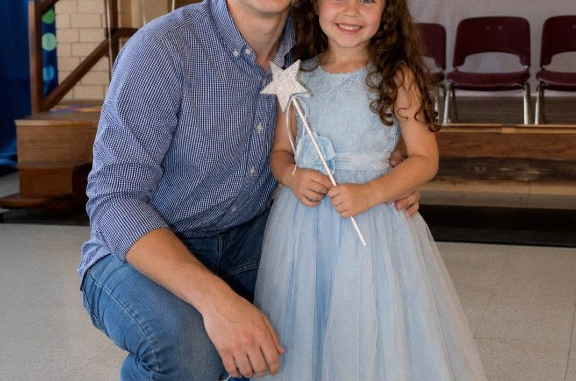
A young man, barely getting by, spends a sleepless night sewing a dream dress for his little sister’s graduation. But after the ceremony, a stranger appears with a letter from his late mother, and everything he thought he understood about his life starts to come undone.
The refrigerator hummed as weak morning light slipped through the kitchen window. A half-finished pink dress rested over a chair, pins still stuck along the hem where I had stopped at around two in the morning. I rubbed my eyes and counted the bills again, hoping something would magically change. It didn’t.
Out of habit, I glanced outside. The street was empty, but I had been doing that all week—watching for a black car that kept appearing near the house and the café. I told myself it was exhaustion playing tricks. Bills turn shadows into something else. That was all.
I ran the brush through her tangled hair the way Mom used to do with mine.
Small footsteps padded across the floor. Mia appeared in oversized pajamas, clutching her rabbit by one ear.
“Noah, is my dress ready yet?”
“Almost, peanut. Come here.”
She climbed up without hesitation while I fixed her hair, slow and careful.
“Will I look like a real princess?” she asked.
“You already do. The dress is just so everyone else can see it too.”
She giggled, swinging her feet.
I poured the last cereal into her bowl, mentally running through numbers again—rent, electricity, her bus pass, the school supplies I still hadn’t bought. Twenty-three dollars left for two weeks.
“Rosa said the sleeve looks nice,” Mia said. “She says you’re learning fast for a boy.”
I let out a small laugh. Rosa, our elderly neighbor, had been the one helping me—showing me how to hold fabric steady, correcting my stitches, scolding me when I pulled too tight.
A cream envelope from a law office sat half-hidden under the mail pile.
“Eat, gossip girl,” I said.
Later, I held the dress up. The seams weren’t perfect, but it shimmered in the light.
“Try it again. I need to check the length.”
Mia ran off to change. While she was gone, I noticed that same envelope again. I had ignored it for weeks, assuming it was another bill.
Then she came back.
She spun into the kitchen, arms wide, the dress flowing around her knees. Her smile lit the whole room.
“That’s my sister,” I whispered to no one.
And then I saw it again—outside the window—a black sedan parked across the street.
The graduation hall smelled like crayons and floor polish. I sat in a cheap shirt while other parents raised cameras and adjusted suits. Mia stood on stage in the dress I made, her ribbon still perfect.
She spotted me and waved hard.
Afterward, she ran straight into me.
“Did you see me bow?”
“I saw everything, princess.”
That’s when I noticed him.
Not the sedan man. Someone else.
A man in a charcoal suit stood near the exit, watching me like he had been waiting for this moment.
“Noah?” he asked.
“Yes?”
“I was assigned to your parents’ legal matters.”
He handed me a thick envelope.
“My parents never mentioned an attorney.”
“They kept it private. I tried contacting you earlier.”
I froze.
“That envelope you ignored,” he added quietly, “was from me.”
My stomach dropped.
“This is from your mother,” he said. “She wanted you to receive it today—after Mia’s graduation.”
“Why today?”
“Because today activates the trust.”
My hands shook as I opened it.
Inside was my mother’s handwriting.
Noah, there is something you were never told. You need to protect Mia from what comes next.
The room tilted slightly.
Mia tugged my sleeve. “Is it from Mom?”
I forced a smile. “It’s an old letter.”
“Are you crying?”
“No. Just… bright lights.”
Back home, I read everything.
Years ago, legal custody arrangements had been made without me knowing. Mia’s biological mother had left legal protections behind, including a trust meant only for her benefit. But control of it depended entirely on guardianship.
And someone else had started moving in the shadows.
The black car. The envelope. The visits.
Someone was watching Mia.
Three days later, a woman walked into my workplace.
She smiled like she belonged there.
“I’m her aunt,” she said softly. “I’ve been looking for her for a long time.”
Something in me tightened immediately.
She spoke gently, carefully, like she had practiced every word.
“I don’t want to take her. I just want to see her.”
For a moment, I almost believed her.
Almost.
But after that, everything accelerated.
Court filings. Investigations. Competing claims. Photographs meant to paint me as unstable.
Rosa saw the investigator in the black sedan taking pictures of the building.
“Be careful,” she warned. “They’re building a story.”
So I built mine too—receipts, school records, rent slips, everything showing a life built around keeping Mia safe.
The courtroom was colder than I expected.
Her lawyer spoke first, polished and confident.
Then it was my turn.
“I’m not perfect,” I said. “But I’m the one who stayed. I’m the one who fed her, dressed her, and sewed her graduation dress because I couldn’t afford to buy one.”
Silence followed.
The judge looked at everything carefully.
Then came the decision.
“Mia remains under your guardianship.”
The words hit harder than I expected.
Outside, Mia grabbed my hand like nothing had ever been wrong.
“Can I wear my dress again for my birthday?”
“Every birthday you want.”
Months later, life didn’t become easy—but it became steady.
The black sedan disappeared.
Bills still came. Work still dragged on. Nights were still long.
But Mia stayed.
And on her birthday, she spun in the same pink dress, a little shorter now, laughing like the world had never been heavy.
I lit the candles.
She closed her eyes.
Then smiled.
“I already have you.”
And for the first time in a long while, I believed that was enough.
Leave a Reply