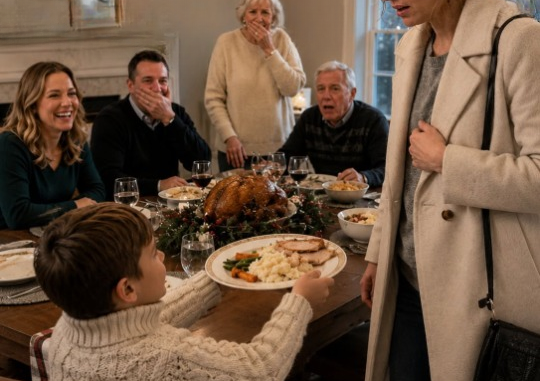
The instant my nephew shoved his plate in my direction during Christmas dinner, I realized our family dynamic would never be the same. I arrived at my mother Diane’s home carrying homemade desserts, several side dishes, and an envelope containing yet another mortgage payment I had quietly taken care of. For years, whenever financial trouble surfaced, I stepped in without hesitation. What began as temporary assistance after my father’s death gradually turned into something everyone simply expected. Running my bakery demanded long hours, and I often put aside my own dreams, vacations, and free time to help keep my mother’s household afloat. Still, as I walked into the festive dining room that Christmas evening, I hoped for nothing more than a warm family gathering and perhaps a little appreciation.
Initially, the celebration felt cheerful. Family members filled the house with conversation and laughter, while holiday lights and decorations created a cozy atmosphere. But it didn’t take long for familiar patterns to emerge. The only place set for me was at the far end of the table, positioned perfectly for someone expected to jump up whenever help was needed. As I reached for my chair, my ten-year-old nephew pushed his plate toward me and looked me straight in the eye. Then he made a remark that instantly silenced the room. He suggested that my job was to serve everyone else, not sit down and enjoy dinner with them. The words stung, but what hurt even more was everyone’s response. A few chuckled. Others looked away. No one corrected him.
As an uncomfortable silence settled over the table, I understood that those words hadn’t originated with a child. They reflected years of assumptions that had quietly taken root. My constant support had become so normal that many relatives no longer viewed it as an act of generosity. They saw it as an obligation. Looking around the room, I realized that many of the people enjoying that meal were doing so in a home I had helped sustain for years. Suddenly, the envelope in my purse felt heavier than ever. Rather than argue, I calmly placed it on the table, wished everyone a Merry Christmas, and walked out. Later, when messages and calls began arriving demanding that I come back and continue helping, I made a decision that surprised everyone—including myself.
By the following day, the full story began to emerge. Once family members learned how much financial responsibility I had quietly carried over the years, their attitudes shifted. Some were stunned by the sacrifices I had made. Others finally recognized how easily kindness can be taken for granted when it becomes expected. Difficult conversations followed, but they were honest ones. Gradually, relationships began to heal, healthier boundaries were established, and a new understanding developed within the family. In the end, the lesson had little to do with money. It was about knowing your worth. Sometimes stepping away isn’t an act of rejection—it’s an act of self-respect. That Christmas taught me that supporting the people you love should never require surrendering your own place at the table.
Leave a Reply