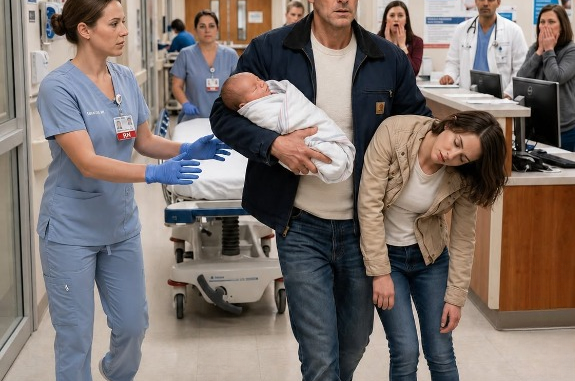
My son was only seven days old when I found him burning with fever beside his unconscious mother.
The doctor only needed one glance at both of them before saying, “Call the police.”
My name is Ethan Miller, and before that morning, I believed fear was the worst thing a man could experience.
I was wrong.
There is something far worse than fear.
It is realizing that the people you loved most were left in the care of someone you trusted—and that trust became the very thing that hurt them.
I grew up in a working-class suburb in Ohio, where every house looked nearly identical: narrow driveways, worn lawns, and porch lights that stayed on longer than they should have after dark.
I worked as a warehouse supervisor for a construction supply company.
Nothing glamorous—just steady work.
Inventory lists, delayed shipments, forklift schedules, broken pallets, frustrated contractors, and the sound a man makes when he’s trying not to admit he’s afraid of losing his job.
My wife, Emily, was nothing like that hardened world.
Not because she was fragile.
But because she refused to let life make her bitter.
She thanked people who barely noticed her.
She remembered birthdays others forgot.
She left cookies for the mail carrier every December.
She apologized when strangers bumped into her in grocery aisles.
When we moved into our small rental home, I kept promising I’d fix the loose porch step, replace the scratched table, and finish the nursery “before anything else.”
Emily just smiled and said, “Home isn’t made by paint, Ethan.”
Then she washed secondhand curtains twice and turned that room into something that felt like hope.
Seven days before everything collapsed, she gave birth to our first child.
A boy.
We named him Noah.
He came into the world red-faced and furious, fists no bigger than bottle caps, crying with a strength that didn’t match how small he was.
Emily cried when they placed him on her chest.
I did too—but I turned away, pretending I was tougher because my mother was in the room.
My mother, Linda, stood at the end of the bed with folded hands.
My sister, Ashley, kept taking pictures.
Everyone smiled.
Everyone said the right things.
“You’ll be fine.”
“He’s perfect.”
“She just needs rest.”
My mother touched Emily’s forehead and said, “We’ll take care of you.”
Ashley leaned over Noah and whispered, “You’re so loved already.”
I believed them.
That is the part I can’t stop returning to.
Not the sirens.
Not the hospital hallway.
But that room—quiet, warm, and full of trust I didn’t realize was already breaking.
Emily came home two days later with discharge papers and careful instructions.
Rest. Fluids. Feeding support. Watch for fever. Call immediately if anything seemed wrong.
I read every line twice.
Emily laughed softly and said, “You’re memorizing it, aren’t you?”
“Yes,” I said.
“Good,” she whispered.
For two days, I barely slept.
I warmed soup, changed diapers poorly, checked Noah’s breathing constantly, and helped Emily sit up when pain crossed her face.
My mother and Ashley came over and took over the kitchen like they belonged there.
At first, I was grateful.
Towels were folded.
Bottles were washed.
Food appeared.
They told me I looked exhausted.
They told Emily she was lucky to have help.
But Emily’s smile changed when my mother wasn’t looking.
Later, she squeezed my hand and whispered, “Your mom scares me a little.”
“She means well,” I said.
A man can build an entire disaster on those words.
She means well.
Four days later, my job called early in the morning.
I still remember the vibration of my phone against the counter, the smell of coffee I never finished, and Noah’s small hiccups from the bassinet.
There was a problem—missing paperwork, a supplier dispute, signatures tied to a shipment I’d overseen.
I said no immediately.
“My son is a week old,” I told them.
They insisted it would only take a few days.
They said my name was already attached to it.
They said I needed to come.
I looked toward the bedroom.
Emily was asleep.
Noah was beside her.
And I made a choice I would never stop paying for.
I went.
I called my mother.
She arrived with Ashley by noon.
I stood in the kitchen with my bag by my feet, feeling like the house itself was judging me.
“Please take care of them,” I said. “She’s still weak. The baby needs constant attention.”
My mother touched my cheek. “They’re family. Go.”
Ashley added, “We’ve got this.”
Emily kissed me before I left.
“I hate this,” I said.
“Come back soon,” she whispered.
That was the last calm moment I would remember clearly.
During the trip, I called constantly.
My mother answered every time.
Sometimes Emily appeared for seconds—pale, tired, fading in and out of frame.
Once she whispered my name.
The phone was pulled away immediately.
“She’s emotional,” my mother said. “Don’t overreact.”
On the second day, I heard Noah crying through the call.
Not strong anymore.
Thin. Dry. Wrong.
When I asked to see him, they said he was asleep.
He wasn’t.
On the third day, Emily finally appeared alone for a moment.
Her lips were cracked.
Her eyes unfocused.
“Ethan…” she said.
Before she could continue, the phone shifted.
My mother’s voice cut in.
“She’s fine,” she said. “She’s just overwhelmed.”
I should have known then.
But denial is easier when it comes from family.
On the fifth night, I finished early.
I didn’t tell anyone.
I drove straight home through the dark.
The moment I entered the house, I knew something was wrong.
No baby sounds.
No movement.
No life.
Just silence.
The living room lights were on.
My mother and Ashley were asleep on the couch.
Fast food boxes scattered across the table.
The TV was off, but the room still felt alive in the wrong way.
Then I heard it.
A faint sound from the bedroom.
Not a cry.
Something weaker.
I ran.
The smell hit me first.
Then the sight.
Emily lay half off the bed, soaked in sweat, unconscious.
Noah was beside her, burning with fever.
His skin was too hot.
His lips were dry.
He barely reacted when I picked him up.
For a moment, everything went silent inside my head.
Then I screamed.
My mother and Ashley rushed in—but didn’t move toward them.
Not immediately.
That hesitation told me everything.
“What happened?” I shouted.
“She was fine,” my mother said.
“She’s unconscious!” I yelled.
Ashley muttered something about attention.
That was the moment something in me broke cleanly.
I wrapped Noah in my hoodie.
I lifted Emily into my arms.
And I ran.
A neighbor drove us to the hospital.
I carried everything I loved through automatic doors while shouting for help.
A nurse saw us and immediately called for a stretcher.
Another took Noah.
The doctor looked at him and then at me.
Her expression changed instantly.
“Call the police,” she said.
Everything stopped after that.
My mother arrived moments later.
Emily was taken behind a curtain.
Noah was rushed to pediatrics.
And my mother—standing in a hospital hallway—said words I will never forget.
“She was difficult,” she said. “She wouldn’t listen.”
Ashley added, “We did our best.”
The doctor looked at them like she already understood everything.
Then she asked for the discharge papers.
I found them in the diaper bag.
The warning section was still visible.
Call immediately for fever.
Failure to feed.
Signs of infection.
We had read it.
We had ignored it.
The police arrived.
Questions started.
Call logs were checked.
Messages were read.
And slowly, the truth came out in fragments—texts between my mother and sister, dismissing every warning, every plea, every sign that something was wrong.
“She’s acting.”
“Let her learn.”
“He’ll come back and blame us.”
The words didn’t feel real.
But my son’s fever did.
My wife’s condition did.
The doctor returned later and told me Emily was severely dehydrated and fighting infection.
She told me Noah’s condition was critical for a newborn.
She told me they were treating them urgently.
I heard her, but I couldn’t accept gratitude yet.
Because I knew I had left them there.
Mr. Harris returned from my house with a grocery bag of items the hospital needed.
Inside were unopened formula, medication, water bottles, and the discharge sheet—with my own circle around the warning section.
Proof that we had known.
And done nothing.
My mother saw it and went silent.
Not guilty.
Just exposed.
There is a difference.
I stood in that hospital hallway, unable to sit, unable to breathe properly, waiting for news about my wife and child.
My mother tried one last time.
“You know I love you,” she said.
But I didn’t hear love anymore.
I only saw what it failed to protect.
And then the doctor returned.
She said my name.
And I knew the next words would change everything.
Interesting story. Did the baby and the wife live? What did the mother and the
sister do?