Michael first heard the crying while standing at the edge of a rented field. At first, he thought it might be a wounded bird hidden in the tall grass, but the sound soon revealed itself as a baby’s cry. Following it through the weeds, he found a newborn lying beside a muddy ditch, wrapped in a faded blue blanket. He stood there in shock, struggling to process what he was seeing. As a poor farmer barely managing his expenses, the thought of raising a child seemed impossible. Still, when the baby reached out weakly and cried again, Michael made a choice that would change his life forever. He carefully lifted the infant, held him close, and whispered, “You’re not alone anymore.”
In the days that followed, uncertainty lingered. Authorities searched for the child’s family but found no leads. While the situation was handled legally, Michael grew increasingly attached to the baby he named Noah. People in town doubted him. Some said he was taking on too much, while others believed the child would be better off elsewhere. Even his sister Sarah urged him to reconsider, warning that he was sacrificing his future for a child who wasn’t his. But Michael stayed firm. He worked exhausting hours, stretched every bit of income, and built his life around raising Noah. Through harsh winters, school days, and endless struggles, he remained a steady presence. To him, fatherhood was defined not by blood, but by commitment.
As Noah grew, he learned how he had been found, but Michael never let that story define him. Instead, he taught him that what mattered most was not where life began, but who chose to stay. Years passed, and Noah excelled in school before leaving the small farming town to chase new opportunities. On the day he left, Michael gave him his last forty dollars and told him to build a better future. Though distance separated them, their bond remained strong through calls, letters, and the occasional visit. Meanwhile, Michael aged along with his worn farmhouse, carrying the toll of decades of hard labor, never once regretting his decision.
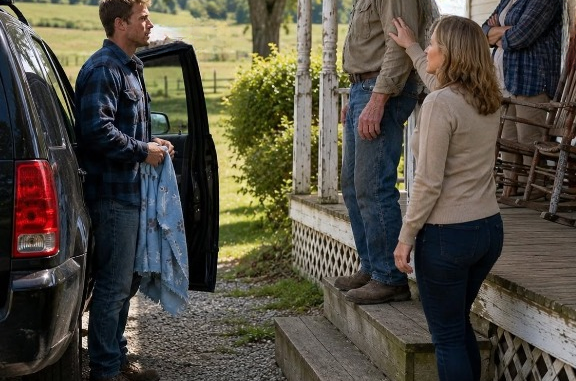
Twenty-five years later, Michael sat on his porch as Sarah again insisted he had wasted his life raising a child who wasn’t his. Before he could answer, a car pulled into the yard. Noah stepped out holding the same faded blue blanket from his infancy. He then revealed what he had come to do: after years of work and planning, he had fully paid off the debt on Michael’s home and secured ownership of the property in his name. The man who once worried about affording basic necessities would no longer fear losing his home. In that moment, Michael understood that the true reward was not the house itself, but the man Noah had become. The boy he once rescued had returned out of love, showing that family is defined by actions, not biology.
Leave a Reply