When my sister asked me to be her surrogate, I agreed without a second thought. Nine months later, I stood by as she held her newborn son for the very first time—only for my mother to walk in, take one look at the baby, drop the flowers she was holding, and whisper, “Oh God… not again.”
My life had been calm, predictable, and exactly the way I thought I wanted it. Then one day, the doorbell rang, and Claire stepped inside with tear-stained eyes.
“Sarah, can we talk?” she asked.
Without hesitation, I made her a cup of coffee.
The moment she sat down, she told me the doctors had confirmed she could never safely carry a pregnancy. Ever.
“Oh, Claire…”
She and Evan had already discussed it. She knew it was a huge favor to ask, something life-changing.
But even before she finished explaining, I understood what she was about to request.
“Would you carry our baby? Please?”
“Yes.”
She broke down right there at my kitchen table, and I held her the same way I had when we were children.
That night, my husband Mark voiced his concern, sitting quietly at the edge of the bed.
“Are you sure about this? It’s a lot for your body to go through again.”
“I’m sure. Claire has always wanted to be a mother.”
“I just want you to be okay too,” he said gently.
“I will be.”
My father worried as well when I told him. Even my mother questioned me privately, suggesting I didn’t have to take on everything for my sister. But I insisted I wasn’t fixing anything—I was helping her build the family she longed for.
The months that followed passed gently. Claire attended every appointment, watching every scan with emotional excitement, while Evan stood by her, equally invested. Mark supported me through it all, though I could see his concern never fully faded.
I kept reassuring everyone the same way: the baby wasn’t mine to keep.
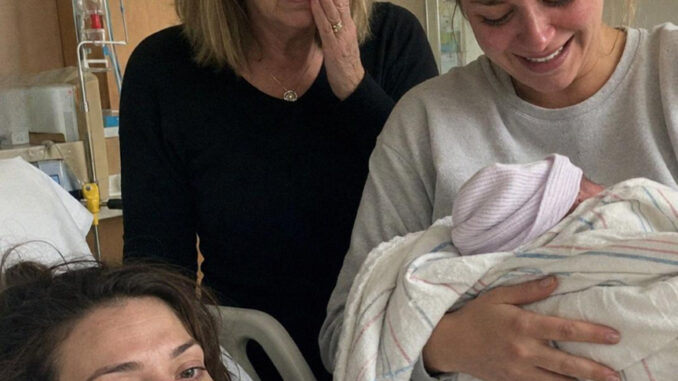
When labor began unexpectedly, the delivery room filled with anticipation and emotion. Claire held my hand tightly as the baby arrived, crying into the world.
And then everything changed.
The nurse placed the baby in Claire’s arms. Joy filled the room—until the door opened.
My mother stepped inside.
At first, she smiled. Then she saw the baby.
Her flowers slipped from her hands.
The color drained from her face.
“Oh God,” she whispered. “Not again.”
Before anyone could react, she turned and rushed out of the room.
Confusion spread instantly. Claire asked what had just happened, but no one had answers.
I couldn’t ignore it. Something about her reaction felt deeply wrong.
Leaving the room, I found her alone in a hallway, shaken and pale, holding a cold cup of coffee.
“What did you mean?” I asked. “Not again—what did you mean?”
She tried to dismiss it, claiming she was overwhelmed, but I knew better. I pressed her until her composure finally cracked.
Tears came, and then the truth.
Thirty years earlier, she had had an affair—brief, hidden, and long buried. When she became pregnant shortly after, she convinced herself Claire was her husband’s child and never looked back.
But seeing Claire’s newborn had shattered that illusion.
The baby resembled the man from her past—down to small, unmistakable features she had spent decades trying to forget.
What she feared wasn’t just recognition.
It was exposure.
She begged me not to tell anyone—not my father, not Claire, no one. She was terrified of losing everything she had built.
But before I could respond, my father appeared in the hallway.
One look at my mother’s face told him something was wrong.
When I told him she needed to explain, the truth finally came out.
He listened in silence, the weight of thirty years shifting in an instant. When she finished, he looked at her differently—as if everything he thought he knew had been rewritten.
Without raising his voice, he said he couldn’t simply move past it. Not after a lifetime built on something false.
Then he walked away to be with Claire and the baby.
My mother was left standing there, no longer pleading, no longer denying—just facing what she had tried to bury for decades.
And I realized, watching it all unfold, that some truths don’t destroy a moment.
They simply arrive too late for anyone to avoid them.
Leave a Reply