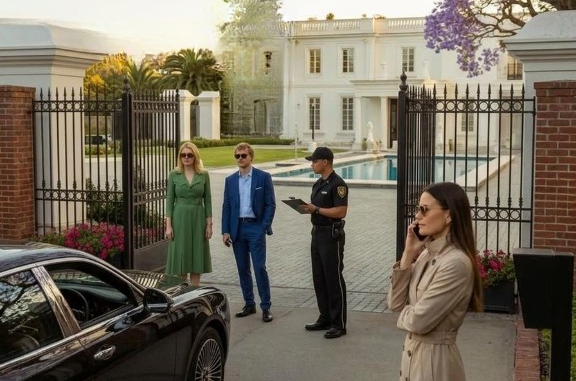
I never thought I would find myself standing behind a line of trees just to observe my own son. Yet that was exactly where I was—quietly watching from near the entrance of my gated neighborhood as Maxwell proudly gave his wife a tour of the community where I lived. Over the years, I had built a successful business and worked tirelessly to create a secure and comfortable life. My house was more than a property; it represented decades of perseverance, hard work, and personal sacrifice. A few days before, my younger son, Julian, had called from abroad with unsettling news. He told me that Maxwell had been telling family members and friends that my home would soon be his because I was supposedly “too old” to maintain such a large place. I initially dismissed it as a misunderstanding. But when I saw him arrive at the gate with complete certainty, behaving as though everything had already been settled, I knew there was more to the story.
Standing beside his wife, Maxwell spoke confidently about the house, introducing it as though ownership had already passed to him. He discussed plans for the future and pointed out where they intended to live, unaware that I was watching nearby. When the security guard requested authorization, Maxwell casually explained that his mother owned the property and that they would be moving in soon. That was the exact moment the guard carried out the instructions I had given him beforehand. He contacted me and politely asked whether I approved their entry. My answer was simple and direct: no one had permission to move into my home. Within seconds, Maxwell’s confidence faded. For the first time, he was forced to confront the reality that assumptions and expectations do not create ownership. The house belonged to me, and the decision about its future was mine alone.
Later that day, Maxwell called, insisting the situation had been misunderstood. As our conversation unfolded, deeper issues came to light. He admitted that he had always assumed the house would eventually become his and argued that moving in early was only practical. Hearing that was difficult because it exposed how differently we saw things. To him, the property felt like an inheritance already promised. To me, it was the result of a lifetime of dedication and sacrifice. I reminded him of the support, opportunities, and help I had provided throughout the years, explaining that kindness should never be mistaken for obligation. For the first time, I set firm boundaries and refused to let guilt influence my choices.
What happened next was something neither of us expected. Rather than continuing to rely on assumptions, Maxwell began to reevaluate his attitude and take responsibility for building his own future. Our conversations gradually became more open and sincere, and over time he started creating a life based on his own achievements instead of expectations about mine. In the end, the most significant moment wasn’t the confrontation at the gate—it was the personal growth that followed. Protecting my boundaries didn’t damage our relationship; it strengthened it. Sometimes love isn’t about saying yes to every request. Sometimes it means having the courage to say no, giving someone the chance to discover their own independence and strength.
Leave a Reply