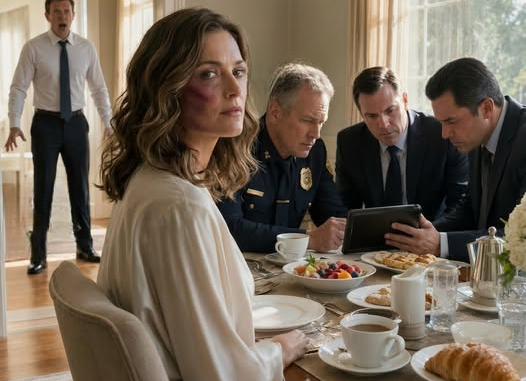
My husband slapped me because his shirt wasn’t perfectly ironed. I didn’t react. By 7 a.m., I had already prepared an elaborate French breakfast and set the dining table.
When he walked in, he smirked and said, “Good to see you’ve finally come to your senses.”
A moment later, his briefcase fell from his hand.
Seated at my dining table were the city’s Chief of Police and two Internal Affairs detectives—calmly eating croissants and watching video footage of him striking me.
The slap had come earlier that morning over something absurd: a single crease on his shirt cuff. Not damage, not dirt—just imperfection.
The sound echoed through the bedroom.
I didn’t cry. I didn’t argue. I simply went still as he loomed in front of the mirror, furious, already rewriting the story in his head.
“You made me do that,” he said.
He always needed silence to feel powerful. I gave him none of the reactions he wanted.
Instead, I looked past him—toward the hidden camera I had installed long before he ever realized I might stop protecting him.
He didn’t notice my calm. He mistook it for obedience.
By the time he left for work, he believed the matter was over.
It wasn’t.
I documented everything. I saved the footage. And I made a few calls.
That night, he returned late—drunk, confident, and accompanied by his colleague Lydia, who treated my home like her own.
They laughed about politics, deals, and influence, unaware that every word was being recorded.
“Once the complaint disappears, it’s handled,” he said casually.
“Your wife won’t be a problem,” Lydia added.
I stood in the kitchen, quietly preparing strawberries.
They thought they were safe because they were inside a private house.
That was their mistake.
By dawn, the table was set again—this time not just for breakfast, but for consequences.
Porcelain cups. Fresh pastries. Coffee poured.
And hidden beneath the linen napkin sat the evidence.
At 7:03 a.m., he entered smiling.
At 7:04, the room changed.
The Chief of Police turned the screen toward him.
There it was—clear footage of him hitting me, followed by recordings of him discussing bribery, witness tampering, and interference with investigations.
His confidence collapsed in real time.
“This is a misunderstanding,” he said quickly. “My wife is unstable.”
I didn’t speak.
I didn’t need to.
More files followed. More proof. More silence from him.
Then the Chief stood.
“Victor Vale, you are under arrest.”
He tried to talk his way out. Then he tried to blame me. Then he tried fear.
None of it worked.
When they led him out past neighbors watching from their windows, he finally looked back at me—not with anger, but disbelief.
I met his eyes calmly.
“You broke me over a crease,” I said softly, “and I documented everything after that.”
Months later, his career was gone, his allies scattered, and his influence erased.
I moved into a quiet apartment above a bakery where mornings smelled like butter instead of fear.
And when people asked how I stayed so calm, I told them the truth:
Calm isn’t surrender.
Sometimes it’s just what justice looks like before it arrives.
Leave a Reply