Here’s a paraphrased version with smoother flow and refreshed wording:
Laura Bennett had always seen her grandmother’s lakeside cabin as far more than property. It was a place filled with warmth and peace, where life felt uncomplicated and where her grandmother, Ruth, spent countless quiet Sundays with her after the rest of the family drifted away. When Ruth passed away, she left the cedar cabin overlooking Lake Michigan to Laura—not because it was her most expensive possession, but because Laura had cherished it as home long before she legally owned it.
That’s why Laura was stunned when her father called to say he had already accepted an offer on the cabin while she was away on a work trip. According to him, she “didn’t really need” the property, and the money would go toward something “important.”
Laura soon discovered that the so-called important expense was actually a luxury getaway for her younger sister, Kelsey. It quickly became clear that her father had misused a limited repair authorization Laura had signed months earlier, treating it as if it granted him authority to sell the cabin. It did not.
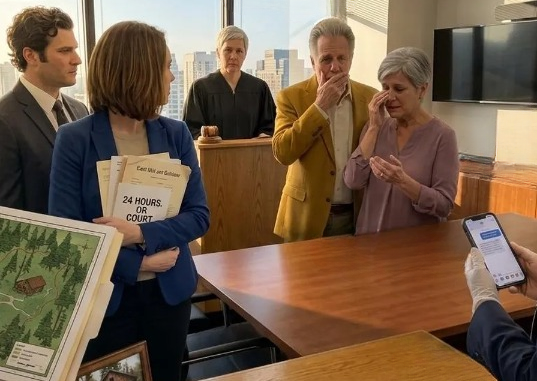
Instead of getting into a heated argument with her family, Laura turned to her attorney, Marcus. She provided him with the will, the deed, the authorization documents, and text messages proving exactly what had happened. Within two weeks, her parents and sister received an official legal notice demanding the sale be canceled and the money returned within twenty-four hours.
The confident tone her family once had disappeared almost instantly. The title company froze the transaction, the buyer began asking difficult questions, and the bank flagged the transferred funds.
The matter became even more difficult because the buyer—a retired schoolteacher—had genuinely believed she was purchasing the cabin legally. Laura sympathized with her situation, but she also knew she could not take responsibility for deception she never approved.
During the court hearing, Marcus carefully presented the evidence: the deed listing Laura as the rightful owner, Ruth’s will, the limited authorization papers, and records showing how the buyer’s deposit had been spent. When the judge directly asked whether Laura had ever given written permission to sell the property, her father was forced to admit that she had not.
The court ultimately voided the sale, ordered the repayment of the funds, and emphasized that family ties do not grant anyone the authority to control another person’s inheritance.
Several months later, Laura returned to the cabin carrying a mix of relief and sadness. Accompanied by a locksmith and contractor, she stepped back into the home where the porch still overlooked the water, her grandmother’s quilt still rested inside, and every quiet room carried memories of unconditional love.
Little by little, Laura repaired the dock, repainted the shutters, and restored the cabin in her own way. In the small back room, she eventually framed the corrected deed—not simply as proof of ownership, but as a reminder that healthy boundaries can protect what even love sometimes cannot.
Kelsey’s vacation ended quickly, but Laura regained something far more meaningful: her grandmother’s final gift, her peace of mind, and the courage to stop allowing family members to rewrite her story.
Leave a Reply