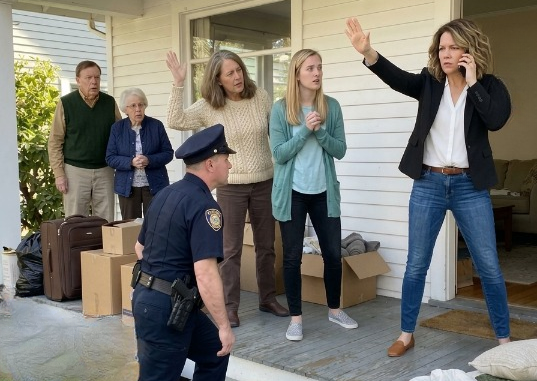
I came home from a three-day business trip to Dallas expecting nothing unusual, but instead found a strange minivan in my driveway, folding chairs on my porch, and muddy work boots by my front door.
For a moment, I genuinely wondered if I had pulled up to the wrong house. That thought didn’t make sense—I had spent seven years working overtime, cutting expenses, and sacrificing vacations to afford this white craftsman home in Portland.
My name is Amanda Blake. Every inch of that house had come from years of discipline and sacrifice.
The moment I unlocked the door, I heard laughter coming from my living room.
Inside, an older couple I didn’t recognize sat comfortably on my couch watching TV, while boxes were stacked across my hardwood floors and my framed photos had been pushed against a wall.
My sister, Melissa, walked out of the kitchen wearing my cardigan and holding my coffee mug like she belonged there. She barely reacted when she saw me.
“Oh,” she said casually. “You’re back early.”
Behind her, my mother stepped into view and added, “Amanda, don’t make this difficult. Your sister needed stability, and her in-laws needed a place to stay.”
I stared into my dining room where strangers were eating at the table I had refinished myself.
“Why are these people in my house?” I asked slowly.
Melissa immediately snapped, “Mom said it’s basically ours anyway. Family shares.”
My mother lowered her voice as if I were the problem. “Your sister is going through a hard time. Just let her have space for now.”
I looked around the room—at the strangers, the boxes, the life that had been rearranged without my permission.
“Let her have space?” I repeated. “In a house with my name on the deed?”
Melissa rolled her eyes. “You’re never even here.”
That was the moment something in me went completely still.
I walked to the guest room and found my belongings stuffed into garbage bags, my office items shoved into a closet, and suitcases spread across my bed.
Without saying another word, I dragged the first suitcase outside and dropped it on the porch.
Melissa screamed at me, but I didn’t stop. By the third bag, my mother was yelling, her mother-in-law was crying, and Melissa was threatening to call the police.
I already had.
When officers arrived, Melissa tried to paint me as unstable, claiming I had “overreacted” to a family arrangement. But I handed them the deed, mortgage documents, and security footage showing she had used a key without permission.
Then I learned the truth in the worst way possible: my mother had given her approval.
The officer made it clear—none of them had legal rights to be there.
Within minutes, everyone without authorization was ordered to leave.
As they were escorted out, Melissa cried loudly that I was destroying her marriage. Her in-laws insisted they had nowhere else to go. My mother begged me to stop “embarrassing the family.”
But I stood on my porch and watched every box returned to the driveway.
That night, I changed every lock and secured every entry point in my home. I barely slept, replaying everything that had happened.
The next morning, I contacted a real estate attorney. After reviewing the evidence, she confirmed what I already knew—my sister hadn’t just crossed a line; she had falsely represented ownership of my property.
A formal trespass notice was issued to everyone involved.
My mother left voicemails accusing me of choosing “walls over family,” but I knew better.
I had chosen my home.
Over the following days, the truth spread through the family. Some defended Melissa. Others admitted this wasn’t the first time she had twisted reality to suit her needs.
Eventually, Melissa and her family were forced to leave the property entirely, dealing with the consequences of her decisions.
I repainted the guest room, restored my space, and never again handed out a key to anyone who believed access was the same as entitlement.
One quiet Sunday morning, I sat on my porch with coffee in hand. The driveway was empty. The house was mine again—not just legally, but peacefully.
And for the first time in a long time, I understood something clearly:
A home you built can be taken over in a moment of deception—but it can also be taken back the same way: completely, decisively, and without permission from anyone who never owned it in the first place.
Leave a Reply