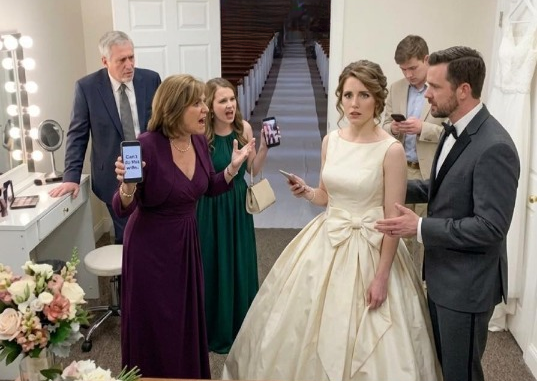
“Relax. Nobody’s coming,” my sister texted just minutes before my wedding. “We’re going to my engagement dinner instead.”
I was standing in the bridal suite of a small white chapel in Asheville, North Carolina, holding my bouquet in one hand and my phone in the other, trying to make sense of what I was reading.
For a moment, I genuinely thought it had to be a mistake.
My name is Grace Miller. I was thirty-two, and in less than twenty minutes I was supposed to marry Daniel Harris.
Outside the suite, the chapel was full—Daniel’s family, his friends, my best friend Elise, and relatives who had actually shown up.
But on my side, the first few rows were completely empty.
My mother had promised everyone would be there. My father, my grandparents, my brother Aaron, my sister Chloe, aunts, uncles—she said rooms were booked and plans were set.
Then Chloe sent that text.
Before I could even react, another message arrived—this time from my mother.
“You’ll be fine. Chloe’s engagement dinner is important, and she needs us tonight.”
Alone. On my wedding day.
Elise grabbed my arm as my vision swayed, worried I might collapse.
Daniel stepped into the room a moment later. One look at my face, and his expression shifted.
“What happened?” he asked.
I handed him my phone.
His jaw tightened immediately.
Chloe had gotten engaged only two weeks earlier, and somehow her dinner had suddenly become more important than a wedding my family had known about for over a year.
But even as it stung, a deeper truth settled in.
I had always been the reliable one. The one who paid bills, covered debts, sent help when asked, and never made a scene because “family comes first.”
This was the first time I asked them to show up for me.
And they chose something else.
My hands steadied.
I opened the family group chat and typed:
“You’ll manage without me too. Don’t expect any more financial help.”
Chloe replied with laughing emojis. Aaron told me I was being dramatic. My mother said we’d “talk after my little ceremony.”
I turned my phone off.
Then I looked at Daniel and said, “I still want to marry you.”
His voice softened. “Good. Because everyone who matters is already here.”
So I walked down the aisle with Elise beside me—no family, no explanations, just silence behind me and certainty ahead.
At the altar, the empty seats didn’t feel like rejection anymore.
They felt like clarity.
The wedding was beautiful in a way I didn’t expect.
Not perfect. Not painless.
But real.
Daniel’s parents welcomed me like I had always belonged. Elise stepped in for every role my family abandoned. And when it came time for photos, I stood with the people who actually stayed.
That night, I finally turned my phone back on.
Dozens of messages flooded in.
Not apologies—photos.
Chloe’s engagement dinner. My family smiling at a rooftop table. My mother beaming beside her. My father raising a glass. Everyone dressed in the outfits meant for my wedding.
The caption read: “When family shows up for what matters most.”
Daniel gently took the phone from my hand.
“Don’t let them back in,” he said quietly.
And I didn’t.
The next morning, I changed everything.
Passwords. Accounts. Shared bills. Credit cards. Rent payments. Insurance. Subscriptions. Emergency funds.
Everything I had been quietly covering for years.
Then I sent a single message:
“I will no longer be providing financial support or access to my accounts.”
Three minutes later, my mother called.
I didn’t answer.
We left for our honeymoon, and for the first time in my life, I didn’t feel responsible for holding everything together.
When we returned, the messages changed.
First came anger. Then disbelief. Then panic.
Bills went unpaid. Cards declined. Rent was overdue. Insurance lapsed. And suddenly, the structure they had built around my money started to collapse.
I didn’t respond.
Not to the calls. Not to the guilt. Not to the demands.
Until one day, my father called from a number I didn’t recognize.
I answered only because Daniel was beside me.
“Your mother got emotional,” he said.
“I’m not discussing this,” I replied.
He tried again. “We need help—Aaron’s struggling, your mother—”
“I’m not sending money,” I said calmly.
A pause.
Then anger. “So this is punishment?”
“No,” I said. “This is the consequence of choices I didn’t make.”
He hung up.
Months passed.
My brother downsized. My father sold his truck. My mother took a job she once dismissed. Chloe postponed her wedding when financial support stopped appearing.
The crisis didn’t destroy them.
It just stopped being funded by me.
Six months later, my mother sent a letter.
Not a text. A letter.
She admitted she assumed I would always forgive them. She admitted she prioritized Chloe because Chloe demanded attention, while I never did. And she wrote, “I didn’t realize missing your wedding would mean losing my daughter.”
I read it twice.
Then I put it away.
Not forgiveness.
Not rejection.
Just distance.
On our first anniversary, Daniel and I hosted a dinner.
His family came. Elise came. Relatives who had shown up when it mattered came.
No empty seats. No waiting for people who didn’t choose us.
At the end of the night, Daniel raised his glass.
“To the people who show up.”
Everyone smiled.
And for the first time, I didn’t feel the absence of the ones who didn’t.
I finally understood the difference between relatives and family.
Relatives are shared by blood.
Family is shown by presence.
Leave a Reply