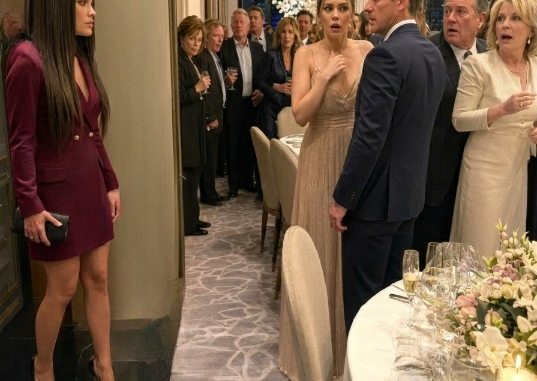
My family spent years telling everyone I was a failure, then still invited me to my brother Colin’s engagement dinner as if my role there was to sit quietly and represent disappointment. But the moment his fiancée, Amelia, finally looked at me, the color drained from her face as if she had just seen something she desperately hoped would never resurface.
The dinner was held at Laurel House, an upscale Nashville restaurant known for its velvet chairs, golden lighting, and staff who anticipated every need before you even asked. Colin was celebrating his engagement to Amelia Voss, the daughter of a prominent hospital executive. For weeks, my parents had spoken about her nonstop—her background, her education, her elegance, and the “prestigious world” Colin was stepping into. Then they invited me, not out of affection, but as a comparison they thought would highlight his success.
My name is Sophie Merritt. I was thirty-one, and in my family’s eyes, I had ruined my own future. Years earlier, I left a corporate consulting role after uncovering serious internal fraud. The company collapsed soon after, my name became tangled in the fallout, and I became the story instead of the whistleblower. My family never asked for the truth—they only repeated whatever version made them look least embarrassed.
So when I walked into the private dining room in a simple black dress, I felt the shift immediately. The whispers started before I even reached the table. Colin greeted me with a quick, performative hug and a reminder not to “make things awkward.” My mother seated me at the far end of the table near the service entrance, framed as a place where I would be “more comfortable.”
Then Amelia arrived. Elegant, composed, and instantly the center of attention. Until she saw me.
Her expression collapsed in an instant—pale, frozen, and unmistakably afraid. It wasn’t just recognition. It was understanding. And something about it told me she already knew who I was. Or more importantly, what I knew about her father.
From that point on, the atmosphere shifted even if everyone else hadn’t noticed yet. Amelia confirmed she had seen my name before. Colin dismissed it. My mother brushed it off with a cruel remark about my “lack of professional circles.” But Amelia could barely hide her reaction, and it became clear she wasn’t reacting to gossip—she was reacting to exposure.
As the evening continued, Colin eventually stood to give a toast about success, discipline, and “building life the right way,” his words carefully arranged to contrast me without naming me. The room applauded politely, but the weight of it settled heavily.
Then Amelia suddenly interrupted him.
Her voice shook as she asked me directly if I was Sophie Merritt from the Meridian investigation team. When I confirmed it, the room changed completely. My parents demanded explanations. Colin insisted it meant nothing. But Amelia revealed the truth: I had worked on a federal compliance investigation tied to her father’s hospital network, one that had quietly begun unraveling financial misconduct behind closed doors.
The realization spread slowly, like a crack widening in glass. Amelia admitted her father had specifically warned her about me. Not because I was dangerous—but because I was connected to the investigation he feared most.
What followed was no longer a dinner. It was exposure. Secrets surfaced, accusations collapsed, and the carefully maintained image my family had clung to began to fall apart in real time. For the first time all night, I was no longer the person they had gathered to shame—I was the one holding the context they couldn’t control.
By the end of the evening, everything had shifted. The engagement unraveled in the weeks that followed. Investigations expanded. Careers changed direction. And the version of me my family had repeated for years stopped matching reality in any way that mattered.
When Colin later apologized, it didn’t erase the past, but it marked the first moment he had ever tried to understand it. My parents eventually fell silent on the subject entirely.
A year later, I received a letter from Amelia explaining she had left that world behind and was now working with organizations supporting whistleblowers like me.
She wrote that I looked calm that night.
I wasn’t. I had just learned how to stand still long enough for the truth to surface on its own.
My family invited me to that engagement dinner expecting me to be the symbol of their disappointment. Instead, I became the moment everything they believed about me stopped holding together.
And in the end, the room didn’t remember my failure. It remembered what it had tried to ignore all along: truth doesn’t disappear just because it’s inconvenient.
Leave a Reply