This deceptively simple math riddle is currently taking the internet by storm, leaving thousands of people frustrated and deeply divided. At first glance, it appears to be an easy arithmetic question that anyone could solve within seconds, yet it has managed to confuse even confident problem-solvers. Most people believe they’ve arrived at the correct answer almost immediately—but surprisingly, the majority end up being wrong on their first try. The question is whether you can spot the trick or fall into the same trap as everyone else.
Initially, the problem seems almost too simple to take seriously. But as you go through the details, the logic begins to feel strangely misleading. The more you think about it, the easier it becomes to overcomplicate. Online discussions are filled with disagreement, with some insisting the answer is $200, others arguing for $170, and a smaller group claiming it must be $130. These heated debates highlight how easily the human mind can misinterpret a scenario when it appears more complex than it really is.
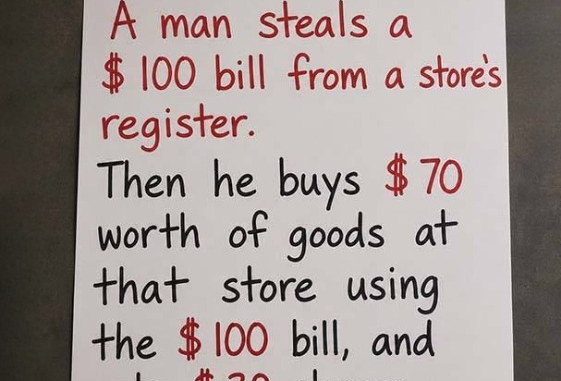
The riddle goes like this: a thief steals a $100 bill from a store. Later, he returns and buys $70 worth of goods using that same stolen bill. The cashier accepts it and gives him $30 in change. The question is: how much money did the store actually lose?
The confusion comes from how the story is framed. People tend to track the stolen money, the purchased goods, and the change separately, which leads to overthinking. The mind treats it like a multi-step equation, when in reality it is a simple breakdown of loss.
To simplify it, imagine the thief never stole anything at all. Instead, imagine he simply walked into the store, took $70 worth of products and $30 in cash, and left without paying. In that case, it becomes obvious that the store’s total loss is $100.
The key realization is that the stolen $100 bill ends up back in the register, meaning it cancels itself out. It is not part of the final loss. What the store actually loses is $70 in goods and $30 in cash.
Riddles like this are so effective because they don’t test advanced math—they test clear thinking. No calculator or complex formula is needed, just careful attention to what is truly lost in the end.
And in the end, despite all the arguments and overthinking, the answer never changes: the store loses exactly $100. It’s simple, but the framing makes it feel complicated. Once you see it clearly, the confusion disappears—and you’re left realizing how easily the mind can be misled by wording alone.
Leave a Reply