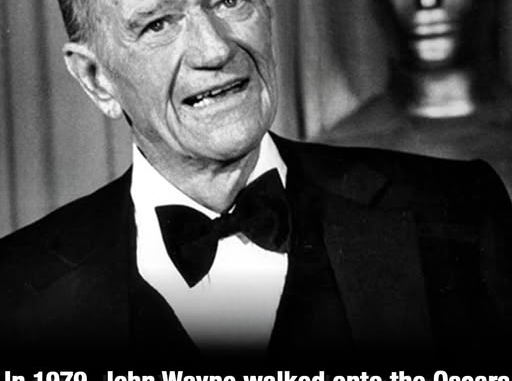
The Academy Awards are often seen as a dazzling spectacle filled with polished appearances and carefully staged emotion. But on April 9, 1979, something truly authentic unfolded inside the Dorothy Chandler Pavilion. It was a moment that rose above Hollywood vanity and focused instead on courage, mortality, and legacy. John Wayne—the iconic “Duke” himself—was gravely ill. Yet despite his failing health, he stepped onto that stage one final time, delivering a powerful appearance that moved an entire room of celebrities to tears.
To grasp the emotional weight of that evening, it’s important to understand what Wayne had endured leading up to it. At seventy-two years old, he had already spent decades conquering both Hollywood and serious illness. With nearly two hundred films behind him, he had survived the evolution of cinema itself, becoming one of the most recognizable faces in American history. But by 1979, his health had deteriorated severely. Just months before the Oscars, what doctors believed would be a standard gallbladder operation became a grueling nine-and-a-half-hour surgery after they discovered stomach cancer. Surgeons were forced to remove his entire stomach in an attempt to save his life.
This battle was far from his first. In 1964, Wayne had fought lung cancer, losing part of a lung and several ribs. Later, he survived open-heart surgery to replace a damaged valve. Though audiences still saw the fearless cowboy on screen, behind the scenes he often relied on oxygen tanks just to breathe. By the time the Oscars approached, many in Hollywood quietly believed the legendary actor no longer had the strength to appear in public again. But when his longtime friend Bob Hope invited him to present at the ceremony, Wayne accepted. It wasn’t merely another public appearance—it was an opportunity for one final farewell.
When his name was announced that night, the atmosphere in the auditorium transformed instantly. The audience, packed with Hollywood’s biggest stars, watched as Wayne slowly appeared at the top of the staircase. He looked noticeably thinner, weakened by illness, yet he still carried himself with unmistakable dignity. His trademark stride remained, and despite everything his body had endured, he moved forward with calm determination.
The reaction from the crowd was overwhelming. It wasn’t routine applause—it was an emotional standing ovation that thundered throughout the theater. Actors, directors, and producers rose to their feet, many visibly crying as they honored a man who had defined American cinema for generations. They weren’t just applauding an actor; they were witnessing extraordinary resilience in real time.
When the applause finally quieted, Wayne stepped up to the microphone with a faint smile. His deep, gravelly voice still carried the strength audiences knew so well. Then he spoke a simple sentence that instantly became unforgettable:
“That’s just about the only medicine a fellow would ever really need.”
Those words struck the audience deeply because they carried so much truth. In that brief statement, Wayne acknowledged both his suffering and the healing power of human support. He later joked about how both he and the Oscar statuette had entered Hollywood in 1928, calling them both “weather-beaten” but determined to stick around longer. It was classic John Wayne—humorous, tough, and defiant in the face of hardship.
He then presented the nominees for Best Picture and awarded the honor to The Deer Hunter. Standing beside the winners, he appeared peaceful, as though he had completed one final mission with grace.
Behind the scenes, however, his condition was worsening rapidly. The emotional boost from the audience’s love could not stop the progression of his illness. Just eleven days later, Wayne was hospitalized again at UCLA Medical Center as his health declined quickly. Yet even in his final weeks, he refused to surrender quietly. Determined to help future cancer patients, he volunteered for experimental vaccine treatments, hoping his participation might someday save others. It was a final act of bravery performed away from cameras and applause.
On June 11, 1979, John Wayne passed away. The world lost not only a movie legend but also a man admired for his toughness and perseverance. In honor of his fight against cancer, his family later helped establish the John Wayne Cancer Institute to continue supporting cancer research and treatment.
For years after his death, even his burial place remained private. Wayne was laid to rest at Pacific View Memorial Park overlooking the Pacific Ocean he loved so dearly. Fearing vandalism and unwanted attention, his family kept the grave unmarked for nearly two decades. There were no elaborate statues or memorials—just a peaceful hillside where one of Hollywood’s greatest icons rested quietly.
Even today, Wayne’s legacy continues to echo throughout the film industry. His final Oscar appearance remains one of the most emotional moments in Academy Awards history because it showed what true dignity looks like in the face of death. He didn’t ask for sympathy, nor did he try to hide his pain. Instead, he stood before the world one last time and reminded everyone that courage is not about avoiding fear or suffering—it’s about facing them with unwavering strength.
The five words he spoke that evening became more than a passing remark. They served as a lasting reminder that sometimes the greatest comfort comes not from medicine, but from love, respect, and the courage to keep moving forward even in life’s darkest moments.
Leave a Reply