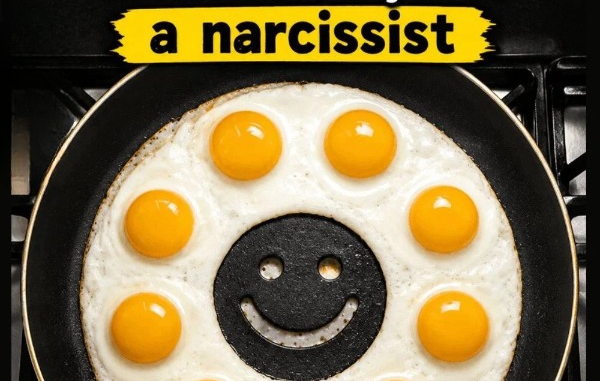
At first glance, the image appears simple: a frying pan, a ring of eggs, bright yellow yolks, and a playful prompt asking how many circles you can find. But like many viral visual puzzles, the answer changes depending on how closely you observe it. Some people count only the most obvious shapes, while others pick up on hidden outlines, subtle patterns, and repeated forms that are easy to overlook.
The image also claims that “the number of circles you see determines if you’re a narcissist.” While this sounds intriguing, it’s important to understand that a puzzle like this cannot actually diagnose personality traits. Narcissism is a complex psychological condition that requires proper evaluation by a professional. Still, puzzles like this are entertaining because they highlight how differently people interpret the same visual information.
1. The Obvious Circles
Most people begin by noticing the egg yolks. Each bright yellow yolk is a clear circle and stands out immediately against the surrounding whites.
Then there’s the larger circular shape formed by the cooked egg itself. The frying pan adds another obvious circle with its rounded shape. These are usually the first elements people count.
2. The Hidden Circles
Looking more carefully reveals additional circular elements. The smiley face in the center includes round eyes. The central area itself may be interpreted as a circle, and the pan’s rim reinforces another circular boundary. Even small highlights or reflections on the yolks can appear circular depending on how closely you examine the image.
This is where opinions differ. Some viewers only count complete, clearly defined circles, while others include partial shapes, outlines, and visual details. As a result, two people can look at the same image and arrive at completely different totals.
3. What Your Answer Might Indicate
A lower count may suggest a more straightforward approach, where you focus on the most obvious elements first and avoid overanalyzing details. This doesn’t imply a lack of attention—it may simply reflect a preference for simplicity and efficiency.
A higher count may indicate a more detail-oriented mindset, where you naturally look for hidden patterns and subtle features that others might miss.
However, these interpretations are not psychological diagnoses. They simply reflect different ways of observing and processing visual information.
4. Why These Puzzles Go Viral
Visual puzzles spread quickly because they encourage comparison and discussion. People enjoy sharing their answers, especially when results vary widely and spark debate.
The added personality claim also increases engagement, even though it is not scientifically valid. People are naturally curious about what their choices “say” about them.
5. The Real Lesson Behind the Image
Ultimately, the value of this puzzle isn’t in labeling personality traits. It’s in showing how perception differs from person to person. Some people notice the overall structure first, while others immediately focus on details.
So, how many circles do you see? Count the yolks, the pan, the face, the eyes, and any other circular shapes you can find—then compare with someone else. The differences in answers may be more interesting than the puzzle itself.
In the end, this image is less about personality and more about perception, attention, and how the mind interprets what it sees.
Leave a Reply