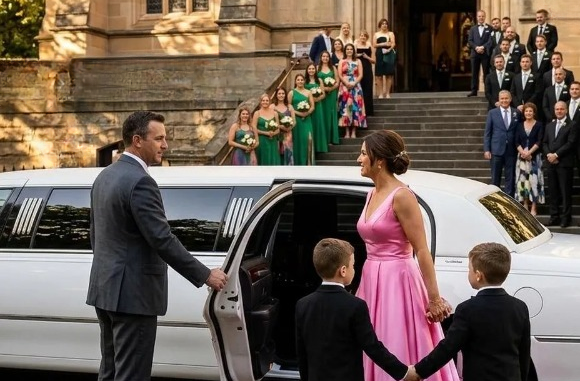
At first, I thought the hardest part would be deciding whether to accept the invitation. I was wrong. That invitation was only the beginning of something far more intentional. The real impact came later, when a man named Eduardo stood in my living room, speaking softly while my sons sat nearby, quietly listening. What he shared wasn’t speculation or hearsay—it was Marcelo’s own words, repeated with a precision that made them impossible to dismiss. It wasn’t a misunderstanding or an offhand remark. It was a constructed narrative, carefully shaped so that I would be cast in a role I never agreed to play.
According to Eduardo, Marcelo had already mapped out how everything was meant to look. He expected me to appear worn down, so others would more easily accept the version of events he had been promoting for months. He wanted contrast—his polished image set against what he intended people to perceive as my decline. Over time, he had rewritten our history, placing blame on me and suggesting I had held him back or failed to support him, while presenting himself as someone who had moved on successfully. What disturbed me most wasn’t just the story itself, but how deliberately it had been shaped.
Then came something that unsettled me even further. Eduardo mentioned Marcelo’s comment about the wedding serving as a distraction from “questions about the house.” That phrase lingered. I was pulled back to the explanations I had once accepted—that the house had been sold under financial pressure, that it was for our stability. I had believed it at the time. But hearing it now, from a different perspective, those answers no longer felt complete. It was as if pieces of the past I had set aside were beginning to shift into place, demanding to be reexamined. The situation was no longer just about an event—it raised deeper doubts about trust and the decisions that shaped our lives.
In that moment, my understanding shifted. This wasn’t simply an invitation to respond to. It was a point of clarity. I didn’t need to step into a story someone else had written for me, nor measure myself against it. What mattered was the example I set for my children—choosing honesty over illusion, and composure over reaction. With Eduardo’s quiet support, I saw that whatever came next would be guided by awareness, not pressure. Sometimes, the strongest choice isn’t to play a part at all, but to step back and define the ending on your own terms.
Leave a Reply