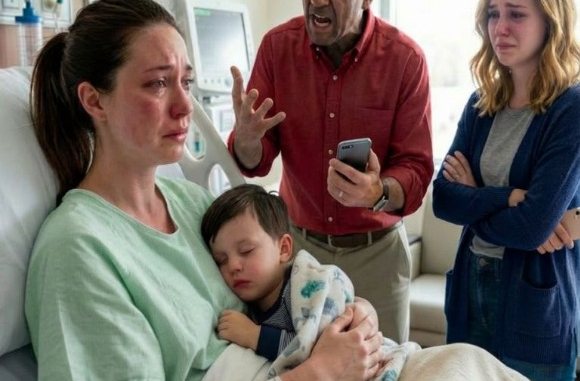
I sent one message after the crash: My son and I are alive. We’re in the hospital. Please keep us in your prayers.
No one responded. Not a single person. But my sister still managed to post a photo online with the caption Family is everything—as if we didn’t exist at all.
Three days later, I woke up to 48 missed calls from my father and one message: Answer now. When I finally did, what he said made me decide to cut them out of my life.
The message Lauren Pierce sent after the accident came from shock and pain. She was in a trauma room at St. Vincent’s in Indianapolis, her sleeve stained with dried blood, while her six-year-old son Oliver slept beside her under a heated blanket. His face was bruised from the seat belt, and every small movement sent panic through her again.
A pickup truck had skidded on black ice and slammed into their car on I-70, forcing it into a guardrail and triggering every airbag. What stayed with Lauren wasn’t the impact, but Oliver’s voice crying from the back seat, calling for her while smoke rose from the hood and traffic slowed around them as if nothing unusual was happening.
Doctors said she had a broken wrist, bruised ribs, and a concussion. Oliver had a mild head injury and stitches above his eyebrow, and needed observation. Everyone kept saying they were lucky. And in a way, she knew they were.
But as the night turned into morning, another reality settled in: not one member of her family had responded.
Not her father Thomas, who always spoke about family values.
Not her sister Megan, who filled her social media with posts about love and loyalty.
Not her brother Cole, who could reply instantly to anything else but stayed silent here.
Lauren checked the group chat repeatedly. Nothing. Hours passed. Still nothing. Even by midday, her message sat ignored between casual updates and holiday plans.
When her friend Tessa arrived with clothes and a charger, she asked the question Lauren already knew the answer to. Then she showed her Megan’s post from that morning: a cheerful family lunch photo with the caption Family is everything.
No mention of the crash. No concern. Not even a question about Oliver.
Lauren said nothing. She simply put the phone down and tried not to fall apart beside her sleeping child.
Three days later, after they were discharged and home, her phone rang violently across the table. Forty-eight missed calls from her father. One message: Answer now.
When she called back, he didn’t ask how they were. He didn’t ask if they were safe. He sounded annoyed.
“What were you thinking?” he demanded.
Not are you okay. Not what happened. Just irritation—because her message had disrupted a family lunch and made people ask questions. Megan, he said, didn’t want things “ruined.” Cole had muted the chat. They had all agreed to deal with it later, after company, after appearances.
Later, Lauren realized, meant not at all—until someone outside the family found out and embarrassed them into reacting.
That was the moment everything became clear.
Her family hadn’t failed to show up by accident. They had chosen not to. They protected comfort and image over her and her injured child.
When her father told her to stop “making it public,” Lauren finally said what she had been holding back: the only thing that mattered was that her son had been in a hospital bed and no one had cared enough to send a single message back.
After the call ended, she didn’t feel anger first. She felt clarity.
That night, she blocked Megan. Then Cole. Then her father. And sent a final message stating that contact would only continue through an attorney if necessary.
The backlash came quickly—accusations of drama, posts about betrayal, lectures about forgiveness. None of it changed what had already been revealed.
When Lauren and Oliver needed them most, they chose silence.
Cutting them off at first felt like loss, not strength. But over time, the silence stopped hurting in the same way. It became space.
Oliver healed. His stitches faded, his headaches disappeared, and he went back to school and soccer and ordinary childhood arguments about dinner. Lauren’s body healed more slowly, but something deeper changed—she stopped waiting for apologies that would never come.
She built a different kind of family instead. Tessa stayed close. A neighbor brought food weekly without being asked. People from a small church helped without making it transactional. Slowly, support replaced absence.
Months later, her father sent a letter. Lauren almost didn’t read it. When she did, it was filled at first with justification—but by the end, something honest broke through. He admitted he had failed Oliver. Not perfectly. Not completely. But enough to matter.
Lauren didn’t respond right away. She waited. She thought. And eventually, she rebuilt contact on her terms—not as before, but with boundaries and accountability.
They met in counseling, then in a park, slowly and carefully. Her father apologized directly to Oliver. The conversation was simple, honest, and child-level clear. No excuses. Just acknowledgment.
Cole stayed distant. Megan didn’t change. But Lauren stopped trying to fix what wouldn’t change.
What she learned wasn’t that family always comes back—it’s that sometimes, stepping away is the only way to see the truth clearly enough to rebuild what’s worth keeping.
And years later, when Oliver asked about it, Lauren told him something simple:
Love isn’t what people say when everything is fine.
It’s what they do when it isn’t.
And in that truth, she finally gave him something she never had growing up—a family that was real, not just spoken about.
Leave a Reply