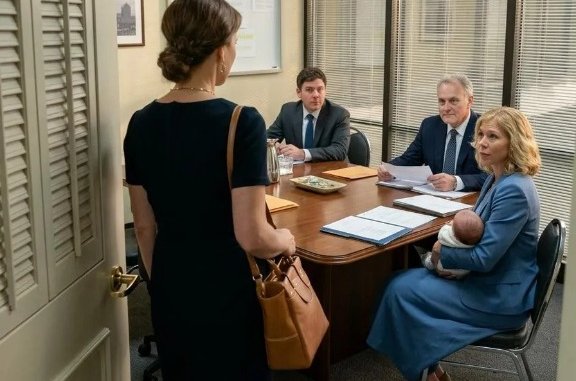
Two weeks after Margaret Caldwell’s funeral, I walked into a downtown St. Louis conference room wearing the same black dress that had started to feel like a uniform for grief. Exhaustion lingered in a heavy, constant way that softened the edges of everything around me. The room offered no relief—faded carpet, the low buzz of fluorescent lights, and a tray of untouched coffee that had long gone cold. On the wall, a framed image of the Gateway Arch hung slightly off-center, as if even the space itself had given up trying. I had come expecting paperwork, signatures, and the quiet reduction of a life into legal terms. I was not prepared for anything that would alter mine so suddenly.
At the far end of the table sat my husband, Ethan, with a posture that suggested possession rather than presence. His arm draped over the adjacent chair, as though reserving it for something—or someone—unspoken but certain. Beside him was Lauren Whitaker, a woman I had spent months keeping at a distance in my mind, reduced to fragments of suspicion I tried not to name. Seeing her in full clarity stripped that distance away. She wore pale blue, her hair softly styled, pearl earrings catching the harsh light. She looked composed, rested—untouched by the weight I had been carrying. In her arms was a newborn wrapped in gray, shifting faintly, as if newly aware of the world.
For a moment, my mind resisted what my eyes already understood. The baby’s small movement, Lauren’s steady expression, Ethan’s silence—it all existed in a suspended space where meaning hadn’t fully settled. When I finally asked why she had brought a child, the question felt strangely far away, almost unreal even as I spoke it. Lauren answered with a calm certainty that felt more damaging than any outburst. The baby, she said, was Ethan’s son. No hesitation. No softness. Just a fact placed on the table as if it belonged there.
Ethan didn’t apologize. He didn’t explain. He only looked at me with that familiar impatience he had worn for months whenever truth became inconvenient. He said they hadn’t wanted me to hear it from anyone else, as though that somehow softened the impact. Something in me gave way then—not explosively, but quietly and completely. I let out a short laugh, sharp and involuntary, because anything more would have given them control I no longer felt they deserved.
In that sterile room, beneath the crooked arch and indifferent lights, I understood something clearly: some endings don’t unfold gradually. They arrive in full, undeniable form, and leave you standing in the aftermath, already forced—without warning—to begin again.
Leave a Reply