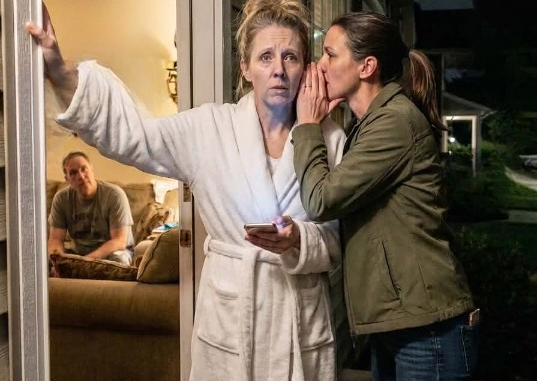
The knocking started at 3:07 a.m.
Not a polite tap, not the kind of knock that suggests confusion or a misplaced delivery—this was urgent, sharp, and insistent enough to drag me out of sleep before I was fully aware of what was happening.
Aaron shifted beside me, half-asleep, turning toward the wall. Lucy was still in her room down the hall, the house otherwise quiet except for the faint glow of the baby monitor we still kept on out of habit. I stared at the clock, trying to make sense of the sound.
“Did you hear that?” I whispered.
Before Aaron could answer, it came again—three hard knocks.
Then a voice from outside the door, low but firm.
“Maya. Open up. Now.”
It was our neighbor, Denise.
She lived two streets over in our Tulsa suburb—mid-fifties, observant, the kind of person who noticed everything but rarely spoke unless she meant it. That alone made me move faster than I otherwise would have. I crossed the hallway barefoot and opened the door.
Denise stepped inside immediately, no hesitation. She looked drained, still in jeans and a jacket, her face tense under the porch light.
“Pack a bag,” she said. “Right now. Your family isn’t who they say they are.”
I just stared at her for a second, trying to process it.
“My what?”
“Wake Aaron. Wake your daughter. Bring documents if you can. You’ve got ten minutes.”
Aaron appeared in the hallway, confused and irritated. “Denise, what is this?”
She didn’t soften her tone. “Your brother is on his way here—and he’s not coming alone.”
That changed the air instantly.
Caleb had been a growing problem for months—pressure, guilt, escalating calls after Aaron refused to co-sign another failed business idea. His mother reinforced it, framing boundaries as betrayal. We thought it was just tension. Denise clearly thought otherwise.
“How do you know this?” I asked.
She pulled out her phone and handed me a screenshot—already deleted from a private group. A message from Caleb: Heading over tonight. Time to fix this. Below it, another message from someone named Wade: Bring the truck.
My stomach dropped.
Denise spoke quietly. “A friend sent it to me before it disappeared. You need to leave.”
That was the moment I believed her.
Not because I understood everything—but because something in me recognized that this wasn’t noise anymore. It was direction.
By 3:11, I was already in Lucy’s room, moving quickly, my hands unsteady. By 3:26, we were in the car.
Denise didn’t let us hesitate. She insisted we take separate vehicles and avoid the house entirely. As we pulled out, headlights appeared at the edge of the cul-de-sac.
No one spoke after that.
Lucy woke halfway through the drive, confused but calm enough to accept a simple explanation. We didn’t tell her more than she could carry.
We ended up at a roadside hotel off the interstate—somewhere Denise knew would be open and quiet. Only once we were inside did the full picture start to come out.
This wasn’t a sudden misunderstanding.
It was buildup.
Caleb had been telling people we were isolating Aaron. His mother had been reinforcing the narrative. A small circle had already started to form around the idea that I was the problem.
And now there were messages about showing up “to handle it.”
Not to talk.
To force.
That was the shift.
What had looked like family tension was actually coordination.
By morning, the police had already confirmed people had arrived at our house looking for us. Caleb. His mother. Others. They left only after realizing we weren’t there.
And then came the detail that changed everything:
Someone had accessed Aaron’s accounts from inside his family’s network and downloaded our personal information—including records tied to our daughter.
That was no longer emotion.
That was preparation.
We didn’t go home that weekend. We changed locks, secured records, and began legal protection immediately. For the first time, Aaron stopped defending his family in fragments and started describing the pattern clearly—pressure, escalation, control.
Three weeks later, in court, that pattern was laid out in full. Messages. Visits. Attempts at access. The narrative they had built collapsed under its own repetition.
The judge granted protection.
But the real change had already happened long before the ruling.
It happened the moment we stopped assuming it was all just family conflict and started accepting it for what it was becoming: control disguised as concern, escalating the moment it was resisted.
Denise was right about one thing that night.
It wasn’t just a warning.
It was a line being crossed.
And by the time we packed that first bag, we had already crossed our own line too—into clarity, into action, and out of the story they had been trying to write for us.
Leave a Reply