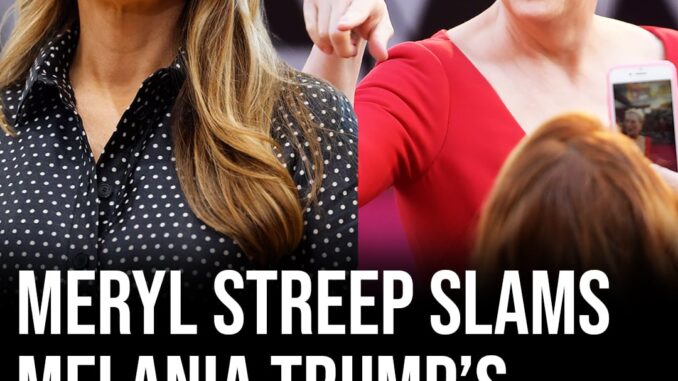
The space where Hollywood influence and political authority collide has long been charged, but few discussions have carried the analytical weight of Meryl Streep’s recent commentary on political symbolism in fashion. In an extensive interview with Vogue, the acclaimed actress turned her attention to one of the most debated wardrobe choices in recent political memory: Melania Trump’s green Zara jacket, marked with the phrase “I Really Don’t Care, Do U?”, worn during a visit to migrant children at the U.S. border.
Rather than treating it as a simple fashion misstep, Streep interpreted the moment as a powerful statement within the language of political imagery. In her view, clothing worn by individuals in positions of global influence cannot be separated from meaning—every color, design, and slogan becomes part of the message they project. She argued that wearing such a phrase during a humanitarian context transformed the jacket into a striking declaration, one that appeared to signal emotional distance at a sensitive moment. For Streep, fashion at that level is never neutral; it either softens authority or reinforces detachment from those affected by policy.
She also connected the incident to a broader pattern of public behavior during Donald Trump’s presidency, suggesting that moments like this and other widely criticized episodes reflected a culture where empathy was often overshadowed by ridicule or indifference. In her analysis, these weren’t isolated controversies but part of a larger atmosphere that normalized dismissiveness, shaping public attitudes toward compassion and authority.
Drawing on her experience as an actress, Streep emphasized how costume functions in storytelling—revealing character before words are spoken. From that perspective, she viewed the jacket as a visual message on a global stage, one that communicated distance rather than care. Her focus was less on the brand or garment itself and more on the symbolic weight of wearing such a statement during a visit involving vulnerable children.
The discussion also extended into broader questions about public responsibility and representation. Streep suggested that figures in highly visible roles cannot fully separate personal expression from public interpretation. In her reading, the jacket became a moment that intensified debate over how leaders and their families use image to communicate values, intentionally or otherwise.
Ultimately, her remarks reignited conversation about the power of symbolism in politics and the expectations placed on those in public life. The jacket, once a viral talking point, is reframed through her perspective as a lasting cultural reference—one that highlights how clothing can become part of political history. Streep’s reflection underscores a central idea: in the public arena, even silence or simplicity in appearance can speak volumes, and the messages conveyed through image can echo far beyond the moment they are made.
Leave a Reply