I didn’t think much about the trip—until I received a call I couldn’t ignore. When I walked into the school the next day, I had no idea what my son had set in motion.
I’m Sarah, 45, raising my 12-year-old son Leo on my own. Since his father passed away three years ago, Leo has become quiet and deeply sensitive, showing his strength in subtle ways rather than words.
Last week, he came home from school different—calm, but glowing with a quiet excitement. He mentioned that his best friend Sam wanted to join the school hiking trip, but had been told he couldn’t because he uses a wheelchair. Leo thought it was unfair but didn’t say much more, and I assumed that was the end of it.
I was wrong.
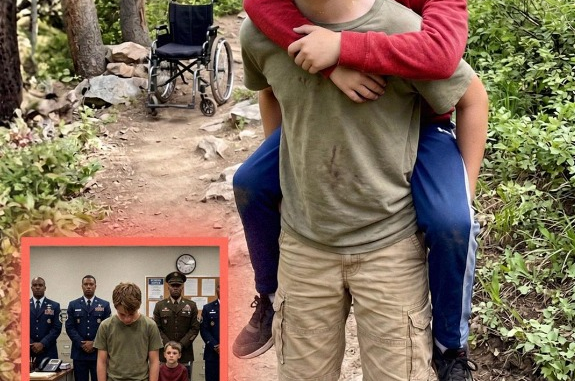
When the buses returned from the trip, I immediately noticed Leo. He looked exhausted—covered in dirt, drenched in sweat, and barely steady on his feet. When I asked what happened, he simply said, “We didn’t leave him.”
Another parent explained the rest: the trail was long and difficult, but Leo had carried Sam on his back the entire way. Even when he struggled, he kept going, reassuring his friend the whole time.
Although no one was hurt, his teacher later scolded him for breaking safety rules by taking a different route. I apologized, though beneath that, I felt an undeniable sense of pride. I thought the situation would end there.
It didn’t.
The next morning, the principal called and urgently asked me to come to the school. When I arrived, I was startled to see several men in military uniforms waiting outside the office. Inside, Leo stood frightened, convinced he was in serious trouble.
But the truth was very different.
The men explained they weren’t there to punish him—they were there to honor him.
Soon after, Sam’s mother arrived and shared what her son had told her: how Leo refused to leave him behind, even when it became physically overwhelming. He had promised to stay with him no matter what—and he kept that promise.
The soldiers then revealed that they had served with Sam’s late father, who had shown the same kind of devotion by always ensuring his son never felt excluded. Leo’s actions reminded them of him.
Moved by what Leo had done, they decided to recognize his courage. They presented him with a scholarship fund for his future education and gave him a military patch as a symbol of respect, saying Sam’s father would have been proud.
Overwhelmed, I held my son close and told him his own father would have been proud too.
Outside, Leo reunited with Sam, and the two laughed and talked as if nothing had changed—but everything had. Sam was no longer left out, and Leo had proven not just that he cared, but that he was willing to act on it.
That night, as I saw Leo asleep with the patch resting on his desk, I realized something powerful: you can’t control everything your child faces in life—but sometimes, you get to witness exactly who they are becoming. And in those moments, you feel deeply grateful they chose to do what was right when it mattered most.
Leave a Reply